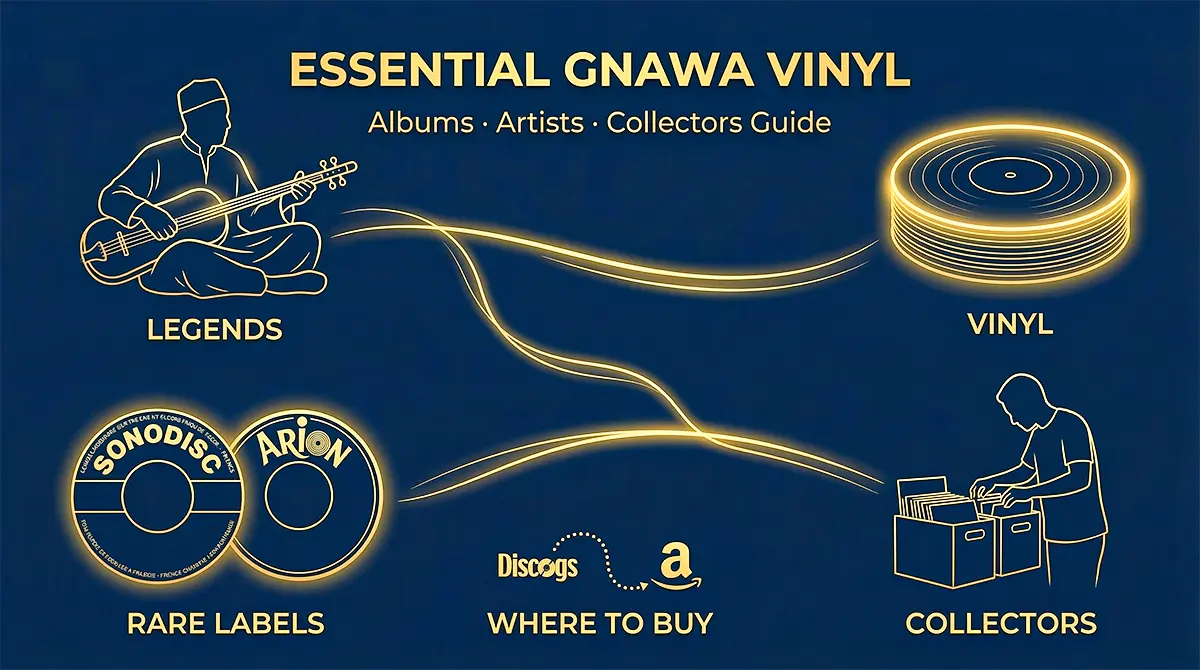
Your complete guide to Gnawa music — discover the essential albums, legendary Maâlems, iconic guembri recordings, and the best vinyl LPs for collectors and first-time listeners alike.
Gnawa music has journeyed from the sacred zawiyas of Morocco to the world’s greatest concert halls — and now, to the vinyl shelves of serious collectors across the globe. Whether you’re hearing the hypnotic pulse of the guembri for the first time or hunting for a rare first pressing on Discogs, this guide maps everything you need to know.
From the Songlines-acclaimed essential albums to the legends behind them, here is the definitive reference for Gnawa music in all its depth.
What Is Gnawa Music? A Brief Foundation
Gnawa music is a centuries-old Moroccan spiritual tradition rooted in the cultures of sub-Saharan Africa — the Bambara, Fulani, and Hausa peoples brought to Morocco from the 16th century onward. At its core is the lila (also called derdeba), a healing ceremony that uses music, color, and trance to communicate with the Mlouk — seven spiritual entities, each associated with a color and a sacred musical mode.
The music is built on two instruments:
- The Guembri — a three-stringed bass lute, the sacred heartbeat of every ceremony, played by the Maâlem (master)
- The Qraqeb — iron castanets that lock in the trance-inducing rhythm
In 2019, UNESCO inscribed Gnawa culture on its Representative List of Intangible Cultural Heritage. On vinyl, these sounds carry an added weight — the analog warmth of the guembri’s deep bass resonates with a physicality that digital formats struggle to reproduce.
The Songlines Essential Albums: The Collector’s Reference List
Songlines magazine — the world’s leading authority on world music — has published several essential Gnawa lists over the years. These are the albums that appear repeatedly across their rankings and are considered mandatory entries in any serious Gnawa collection.
Songlines Essential 10: Gimbri Albums
Compiled by Abdel Benaddi, Essaouira-born Gnawa researcher
| # | Maâlem | Album | Label / Notes |
|---|---|---|---|
| 1 | Mahmoud Gania | Sidi Mimoun | Sonya Disque -- foundational Marsaoui style |
| 2 | Abdelkebir Merchane | Gnawa All Stars | MLP (2011) |
| 3 | Abdeslam Alikane | Gnawa of Marrakesh | Classic Marrakchi school documentation |
| 4 | Hamid El Kasri | Gnawa Soul | Northern + Southern style fusion |
| 5 | Abdelmajid Domnati | Les Maîtres du Guembri | Guembri showcase |
| 6 | Mustapha Bakbou | Ben Hssine | Marrakech zawiya tradition |
| 7 | Mokhtar Gania + Bill Laswell | Tagnawwit: Holy Black Gnawa Trance | Cross-cultural production |
| 8 | Saïd Boulhimas | Gnawa Live in Essaouira | Live festival energy |
| 9 | Hmida Boussou | Les Gnaoua de Casablanca | Casablanca (Marsaoui) school |
| 10 | Allal Soudani | Essaouira Gnaoua Spirit | Essaouira tradition |
This list spans three distinct regional schools of Gnawa — Essaouira, Marrakech, and the North — making it an ideal roadmap for understanding the music’s full geographic range.
Songlines Fusion Essential List (Issue 106, 2015)
| Artist | Album | Label | Year |
|---|---|---|---|
| Gnawa Diffusion | Souk System | Warner Jazz France | 2003 |
| Hassan Hakmoun | Trance | Real World | 1993 |
| Simo Laghnawi | Gnawa London | Waulk Records | 2013 |
| Aziz Sahmaoui & University of Gnawa | Mazal | World Village | 2014 |
The 5 Essential Albums in Depth
1. The Trance of Seven Colors — Mahmoud Gania & Pharoah Sanders
Axiom / Island Records (1994 CD) · Zehra, Germany (2019 Vinyl · 2024 Repress)
The most important Gnawa record ever made. Recorded June 1–3, 1994 in the House of the Caid Khoubane in Essaouira’s medina — not a studio, but a living space charged with centuries of ceremony. Producer Bill Laswell captured Pharoah Sanders’ soprano saxophone spiraling through Maâlem Mahmoud Gania’s deep guembri lines in real time.
The original never appeared on vinyl. Label Zehra (Germany) released the first vinyl edition ever in October 2019 as a 180g double LP (Cat. ZEHRA001, mastered by Rashad Becker). A repress followed in 2024.
Discogs market data: ~$33–$43 (Near Mint). 983 users on the Wantlist. Last sold: February 2026.
Buy on Amazon (Vinyl)→ View Mahmoud Gania’s full profile
2. Night Spirit Masters — Gnawa Music of Marrakesh
Axiom / Island Records (1990) · Zehra, Germany (2022 Remaster)
Bill Laswell traveled to Marrakech and recorded Gnawa musicians outdoors at night — open air, raw, with the full frequency range of the guembri captured on tape. The 2022 remaster by Kassian Troyer at Dubplates & Mastering Berlin (Cat. zehra006) on 180g vinyl is considered the definitive listening experience for audiophiles.
Why collectors want it: The guembri’s sub-bass frequencies and the metallic shimmer of the qraqeb are reproduced on vinyl with a warmth impossible to replicate digitally.
Buy on Amazon (Vinyl)3. Colours of the Night — Mahmoud Gania
Hive Mind Records, UK (2017 Vinyl)
The first-ever solo vinyl release for the King of Gnawa. Recorded in deep sessions featuring his sons Houssam and Hamza Gania. This is the Marsaoui style at its most intimate — no fusion, no crossover, just the pure Guembri voice of Essaouira.
4. The Splendid Master Gnawa Musicians of Morocco — Abdellah El Gourd & Randy Weston
Verve Records (1994)
Grammy-nominated (1996, Best World Music Album). In September 1992, nine Maâlems gathered at the Hotel La Mamounia in Marrakech — the largest assembly of guembri masters ever recorded. Organized by Maâlem Abdellah El Gourd and jazz pianist Randy Weston after nearly three decades of friendship and musical dialogue.
CD copies on Discogs: $5–$44.
5. Lila — Innov Gnawa
Daptone Records (Limited Edition Vinyl)
Brooklyn-based Moroccan expats distilled an 8-hour lila ceremony into six tracks of unbroken trance. Released by the legendary Daptone Records (home of Sharon Jones and Charles Bradley) in a limited pressing of 500 copies worldwide on Sahara Dune-colored vinyl, plus a 10-inch EP with bonus tracks. Grammy-nominated. Near impossible to find — check Discogs immediately if you want one.
Check Amazon (1 copy left)Abdellah El Gourd: The Tangier Legend
View Full Artist ProfileBorn 1947 in Tangier’s Kasbah quarter. By day, Abdellah El Gourd — known by the nickname Boulkhir — worked as a broadcast engineer at Voice of America radio. By night, he led derdeba ceremonies as a Maâlem of the Shamali (Northern) school, having memorized all 243 songs of the Tangier Gnawa tradition together with their associated rituals.
His engineering ear made him exceptionally attuned to sound quality — a gift that shaped his recordings’ clarity.
Dar Gnawa: El Gourd converted his family home in Tangier’s medina into a cultural foundation, museum, and teaching institute — the Dar Gnawa — that became a pilgrimage site for world musicians seeking authentic Gnawa experience.
Key albums for collectors:
| Album | Year | Notes |
|---|---|---|
| The Splendid Master Gnawa Musicians of Morocco | 1994 | Grammy-nominated. With Randy Weston. |
| Spirit! The Power of Music | 2000 | Live at Lafayette Presbyterian Church, Brooklyn |
| Out of This World (Dissidenten) | — | Vinyl on Sire/Reprise — includes his voice |
| Gnawa Home Songs | 2006 | Accords Croisés label; featured in Songlines Sufi Top 10 |
His 30-year collaboration with Randy Weston — which began when the jazz pianist arrived in Tangier in 1967 — produced some of the most significant cross-cultural recordings in world music history.
Rare Label Deep Dive: Sonodisc & Arion
For serious collectors — the ones who dig through boxes at Marrakech flea markets and trawl obscure Discogs seller pages — two French labels define the hunt.
Arion Records (est. 1962)
An ethnographic documentation label that sent field recorders into Morocco in the 1970s and 80s to capture traditional Gnawa before modernization arrived. Their catalog (prefix: ARN) represents Gnawa in its most unfiltered state — raw guembri, hand clapping, call-and-response chants in private ceremony settings.
The collector’s challenge: Liner notes were often vague or inaccurate. Maâlem names were frequently omitted, replaced with generic titles like “Music from Morocco.” This confusion creates the treasure hunt — and inflates prices for well-documented copies.
Sonodisc
The major distributor of African and Moroccan music in France throughout the 70s—90s. Sonodisc handled European distribution for Moroccan labels like Tichkaphone, Fikriphone, and Boussiphone — meaning most Mahmoud Gania and Hmida Boussou cassettes that reached European audiences came through their catalog.
Why their vinyl is rare: The company’s archiving was notoriously chaotic. Tracks were reissued without restoration, credits were mixed up, and catalog numbers were inconsistent. Finding an original 45 RPM or LP in good condition from Sonodisc is a genuine discovery.
Pro tip: When searching, use every spelling variant for Mahmoud Gania: Gania, Guinia, Guinea, Ghania, Guenya, Kania. His Discogs profile (Maleem Mahmoud Ghania) lists over 10 name aliases — all from different label pressings.
Modern Essentials: Contemporary Vinyl Worth Owning
Bab L'Bluz — Nayda! (2020) & Swaken (2024)
Yosra Mansour leads the most exciting contemporary Gnawa band — electric guembri, psychedelic rock, Darija lyrics. Swaken's limited blue vinyl pressing is the most sought-after current release. Songlines Award winners.
Mokhtar Gania & Bill Laswell -- Tagnawwit: Holy Black Gnawa Trance
Mahmoud's younger brother in a modern production context. A bridge between the raw Marsaoui tradition and contemporary audiophile sound design.
Hassan Hakmoun -- Gift of the Gnawa (1991) & Trance (1993)
Raised in Marrakech, relocated to New York. His early albums with Don Cherry (trumpet) are cornerstones of the Gnawa-jazz crossover in America. Increasingly hard to find in good condition.
Where to Buy Gnawa Vinyl
For Rare & Vintage Pressings
Discogs — the only reliable marketplace for graded vinyl with condition transparency. Search using all name variants (see Sonodisc tip above). Filter by Format: Vinyl and Sort by: Lowest price to find deals.
For New & Reissue Pressings
Bandcamp — search Zehra, Hive Mind Records, Daptone Records. Buying direct supports the labels funding future Gnawa reissues.
Our Curated Collection
We select and stock vinyl that meets audiophile standards — remastered pressings, proper credits, and context.
FAQ
What are the best Gnawa vinyl records for collectors? Start with The Trance of Seven Colors (Mahmoud Gania & Pharoah Sanders, Zehra 2019) and Night Spirit Masters (Gnawa Music of Marrakesh, Zehra 2022). Both are 180g audiophile pressings with professional remastering. For rare originals, hunt Sonodisc and Arion pressings on Discogs.
How much does a Mahmoud Gania vinyl cost? The Zehra pressing of Trance of Seven Colors sells for $32–$43 on Discogs (Near Mint). His Colours of the Night LP (Hive Mind Records, 2017) ranges from $25–$45 depending on condition. Original Sonodisc cassettes converted to vinyl are rarer and command higher prices.
Where can I find the Songlines Essential Gnawa albums? Most albums from the Songlines Gimbri Essential 10 were originally released on cassette in Morocco (via Tichkaphone, Fikriphone). Some have been reissued on CD or vinyl. Check Discogs, Bandcamp, and specialist world music shops. The festival performance recordings are often available via streaming only.
What makes Gnawa music special compared to other world music? Gnawa is one of the few living traditions that has maintained its ceremonial function (the lila) while simultaneously engaging with jazz, blues, electronic, and rock musicians at the highest level. The guembri’s bass frequencies and the qraqeb’s metallic rhythm create a sound that is instantly recognizable and deeply physical — which is precisely why it translates so powerfully to vinyl.
Continue Your Journey
Regional Styles
Essaouira, Marrakech & The North: Understanding the Schools
Live Music
Gnawa Festival Essaouira: The Complete Visitor's Guide
The Ceremony
The Lila: Gnawa's Sacred Healing Night Explained
Who's Who
The Maâlem & The Moqaddema: Gnawa's Sacred Partnership
The Instruments
- The Guembri — The sacred bass lute at the heart of every recording on this list
- The Qraqeb — Iron castanets that drive the ceremonial rhythm
- The Bakhour — The sacred incense of the lila ceremony
- The Mlouk — The seven spirit families invoked through each album
Artist Profiles
- Maâlem Mahmoud Gania — The King of Gnawa: full discography and biography
- Maâlem Abdellah El Gourd — The Preservationist of the Northern school
- Maâlem Hamid El Kasri — The 21st-century Gnawa superstar
- Maâlem Mokhtar Gania — Keeper of the Marsaoui tradition
- Maâlem Hmida Boussou — Master of the Casablanca school
- Maâlem Houssam Gania — Carrying the dynasty legacy forward
- Maâlem Hassan Hakmoun — The Gnawa-jazz pioneer of New York
- Maâlem Abdellah Gania — The Essaouira school’s senior keeper
- Maâlem Boubker Gania — The rhythmic foundation of the Gania dynasty
- Asmaâ Hamzaoui — The first female Maâlem to headline Essaouira
Regional Schools
- Essaouira School — The Marsaoui tradition behind the most celebrated recordings
- Casablanca School — The heavyweight sound of Hmida Boussou and Ahmed Ould Dij
- Marrakech School — The fast, virtuosic style of Night Spirit Masters
- Tangier School — Abdellah El Gourd’s Northern tradition
Deepen Your Knowledge
- The Lila Ceremony Explained — Understanding the ritual behind the recordings
- The Seven Mlouk: Colors and Spirits — The spiritual cosmology encoded in every album
- From Chains to Chants: Gnawa and Slavery — The history behind the music
- Gnawa Regional Schools Compared — How Essaouira, Marrakech, and the North differ
- Essaouira Festival Guide — Where to hear these albums performed live