Step inside the sacred all-night ritual of Gnawa — from sunset to sunrise, through seven colors, seven spirits, and the transformative power of trance.
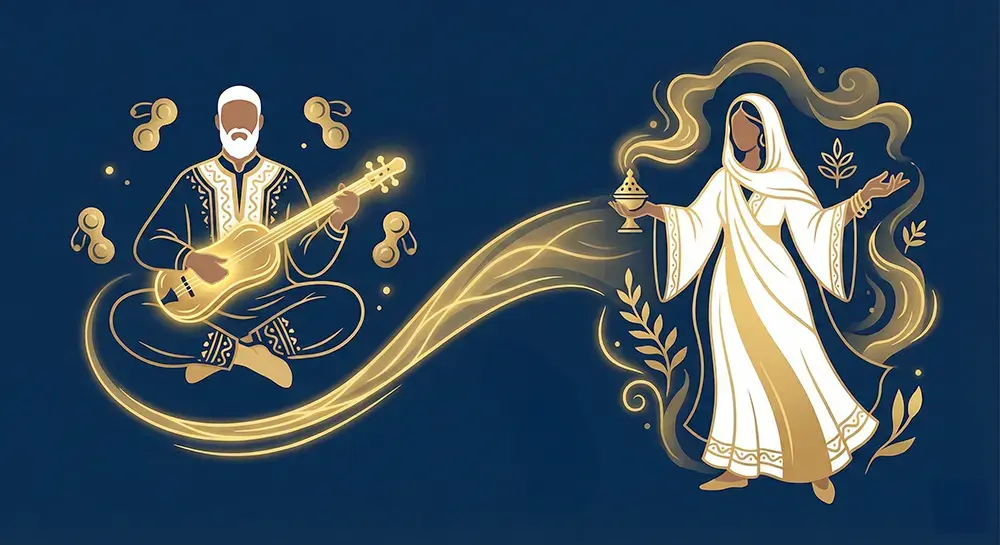
As the sun sets over Morocco, something ancient awakens. In homes and zawiyas across the country, the deep bass of the guembri begins to pulse, qraqeb start their metallic chatter, and the Lila — Gnawa’s sacred all-night ceremony — unfolds.
This is not a concert. This is not entertainment. This is holy therapy — a ritual that has healed troubled souls for centuries, transforming rhythm, scent, and color into a journey through the spirit world.
What Is a Lila?
The word Lila (ليلة) simply means “night” in Arabic — and that is exactly what this ceremony takes: an entire night, from sunset to sunrise, dedicated to spiritual healing and communion with ancestral spirits.
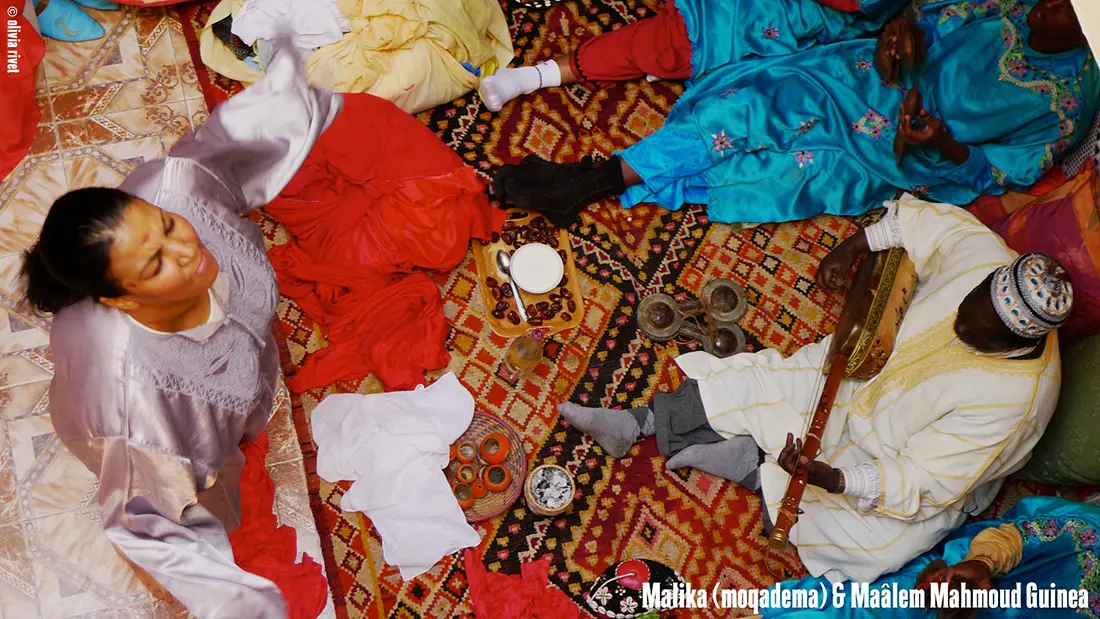
A Lila is a trance ceremony designed to cure spiritual and physical sickness. It is traditionally performed in a private home, a zawiya (Gnawa lodge), or the shrine of a saint. The ceremony brings together:
- The Maâlem — The master musician who leads the ritual with his guembri
- The Kouyou — Musicians who play the qraqeb (iron castanets)
- The Moqaddema — A female spiritual guide who manages the ritual space
- The Participants — Those seeking healing or spiritual connection
The purpose is not exorcism in the Western sense. The Gnawa do not seek to drive spirits out but to negotiate with them, to restore harmony between the person, their community, and the unseen world.
When Does a Lila Start and How Long Does It Last?
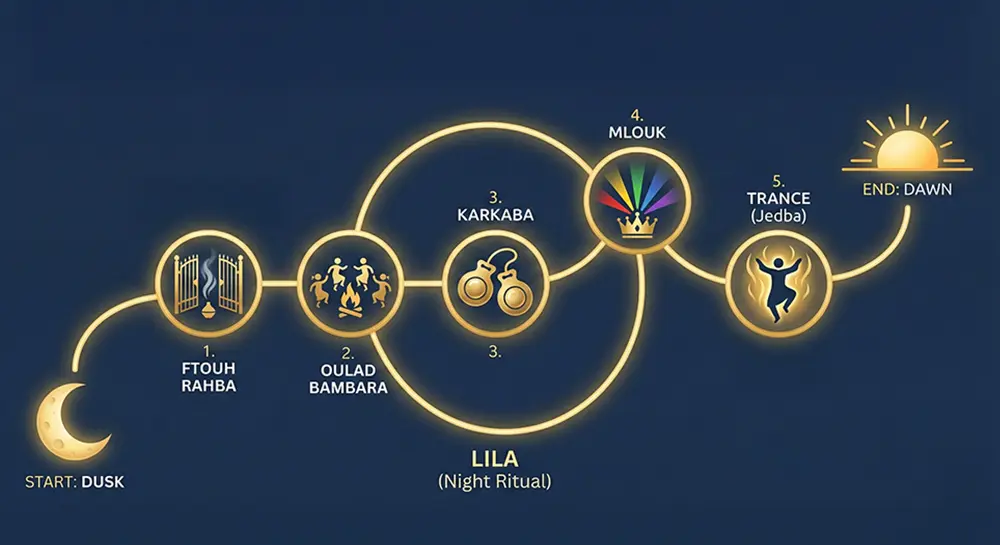
A Lila begins after sunset, typically around 10 PM, and continues until sunrise — often 6 or 7 AM. The complete ceremony can last 8 to 12 hours, moving through distinct phases that build in spiritual intensity.
Before the indoor ceremony begins, there is often a public procession called the Aada (“habit” or custom). The Gnawa musicians parade through streets and alleys, dressed in their embroidered robes and tasseled caps, playing tbel drums and qraqeb to announce the ceremony and gather participants.
This outdoor phase is festive and accessible — the version tourists see in Jemaa el-Fna. But the real work happens indoors, after the doors close.
The Main Phases of a Lila
The Lila follows a precise structure, moving through distinct phases that correspond to different spiritual realms. Each phase has its own music, colors, incenses, and purposes.
Phase 1: The Aada (Preparation)
The ceremony begins with consecration of the space. The Moqaddema prepares the ritual area with candles, incense (bukhour), and blessings. A special plate called the Tbaq is placed before the Maâlem, containing:
- Various incenses (oud, harmal, cheba)
- Colored fabrics representing the spirits
- Candles and ritual objects
The Maâlem opens with a powerful recitation of Al-Fatiha (the opening chapter of the Quran), his resonant voice setting the sacred tone for the night ahead. This marks the transition from ordinary time to ritual time.
Phase 2: Oulad Bambara (Children of Bambara)
Once the guembri emerges, the ceremony enters the Oulad Bambara phase — also called Kuyu or Kouyou. This is the invocation of ancestral spirits and the Prophet Muhammad.
The songs in this phase are sung partly in Bambara and other West African languages — words that even the performers may not fully understand, preserved across centuries as a connection to lost homelands. The lyrics speak of:
- The suffering of capture and enslavement
- Longing for distant homes
- The journey across the Sahara
- Finding strength through faith
This phase is celebratory and social. Tea is served, hands clap, and the community dances together. The qraqeb are sometimes set aside; only voices and guembri fill the space. It honors the ancestors before the deeper spiritual work begins.
Phase 3: Ftouh Rahba (Opening the Space)
Ftouh Rahba means “opening of the marketplace” — a reference to the medieval Moroccan markets where everything was traded, including the Gnawa’s enslaved ancestors. In the ceremony, it marks the opening of the spiritual space to receive all seven Mlouk (spirits).
This phase often includes a sacrifice (traditionally a sheep or goat) whose blood calls the spirits to attend. The sacrifice is not about violence but about offering something precious to establish reciprocity with the spiritual world.
The music during Ftouh Rahba transforms the physical space into a sacred arena where the boundaries between worlds become permeable. Special songs are played to attract the Mlouk, preparing for the main ritual phase.
Phase 4: The Mlouk (The Seven Spirits)
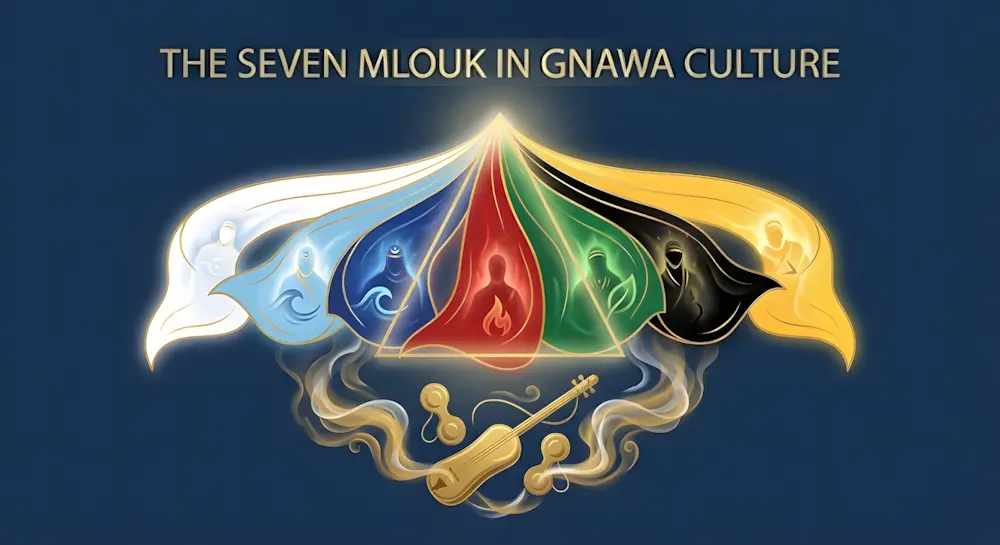
This is the heart of the Lila — the phase that can last for hours as each of the seven spirit families is invoked in sequence.
Each Melk (singular of Mlouk) has its own:
- Color — Participants are draped in the spirit’s color
- Music — Specific songs and rhythms
- Incense — Particular scents that attract the spirit
- Personality — Distinct characteristics and requirements
The colors and their spirits:
White — Purity
Saints and light. Opens with Al-Fatiha. Calm, meditative music showcasing Sufi heritage.
Black — Ancestors
Sidi Mimoun and Lalla Mimouna. Deep, majestic music. Represents Adam, Eve, and Gnawa ancestors.
Blue — Water
Sidi Moussa (Moses). Fluid, purifying music. Dancers may balance water bowls on their heads.
Red — Fire & Blood
Sidi Hamou. Most intense phase. Fast, powerful music. Some trancers may handle knives.
Green — Nature
Forest spirits. Soothing, earthy music. Prayers for fertility and new beginnings.
Yellow — Joy & Danger
Lalla Mira. Playful but unpredictable. Music fluctuates between high and low. Hysterical laughter common.
As each spirit is invoked, those present who have a connection to that particular Melk may begin to feel its pull. They are draped in the spirit’s color and guided into the dance space.
What Happens During the Trance (Jedba)?
The Jedba (also spelled Jadba or Jidba) is the trance state at the heart of Gnawa healing. It is not possession in the horror-movie sense but a controlled spiritual encounter facilitated by music, movement, and community support.
How Jedba Unfolds
When a person feels called by a spirit, they move into the dance space. The music — already hypnotic — intensifies. The polyrhythmic patterns of guembri and qraqeb create a 3:2 hemiola (a rhythmic ratio common in trance music worldwide) that gradually disconnects the conscious mind.
The dancer’s movements become more intense:
- Swaying that deepens into full-body waves
- Head movements that swing the tasseled cap (taqiya)
- Jumping and spinning
- Sometimes crying, laughing, or collapsing
The Moqaddema stays close, reading breath and movement, ready to catch falling bodies or adjust the ritual as needed. She works with the Maâlem, who controls the musical intensity — knowing when to push deeper and when to bring someone back.
The Purpose of Trance
Jedba is not about losing control. It is about releasing what cannot be released in ordinary life — grief, trauma, illness, bad fortune. The Gnawa believe that many afflictions are caused by unbalanced relationships with spirits. The trance allows:
- Direct communication with the Melk
- Negotiation of terms (what the spirit needs to be appeased)
- Release of accumulated spiritual tension
- Restoration of harmony
When the trance ends — sometimes after minutes, sometimes after an hour — the person returns to ordinary consciousness exhausted but lighter. The community has witnessed their struggle. The spirits have been honored. Balance is restored.
Dawn: The Return
As the sky lightens, the Lila winds down. The final spirit invoked is often associated with Sidi Bilal, the Ethiopian slave who became Islam’s first muezzin — a figure who embodies the Gnawa journey from bondage to spiritual elevation.
The participants, weary from a night of ritual, share a sense of collective catharsis. Tea is served. Stories are exchanged. The community has traveled together through the spirit world and returned.
The Lila concludes not with applause but with quiet gratitude. The space is cleansed. The instruments are put away. The sun rises on people who feel, in ways difficult to explain, renewed.
Lila Today: Between Sacred and Stage
Modern Gnawa navigate a tension between traditional Lilas and public performances. Festival shows — what Gnawa call Fraja (spectacle) — condense the all-night ritual into a few hours, omit the sacrifice, and perform for audiences who may not share the spiritual framework.
Some traditionalists worry this strips the music of its healing power. Others argue that the public face of Gnawa introduces people to the tradition who might eventually seek a true Lila.
What matters is understanding the difference: a concert is a concert; a Lila is medicine. Both have value, but they are not the same thing.
"A Lila is a night where music listens as much as it sounds, where pain is held rather than hidden, and where a person returns to the circle with lighter shoulders."
Continue Your Journey
Dive deeper into Gnawa’s spiritual world:
- The Seven Mlouk: Colors, Spirits & Their Sacred Meanings — Explore each of the seven spirit families invoked during the Lila.
- The Maâlem & The Moqaddema: Gnawa’s Sacred Partnership — Understand the two figures who lead every ceremony.
- Gnawa Instruments Guide: The Full Sacred Ensemble — Discover every instrument used during the Lila ceremony.
The Sacred Instruments
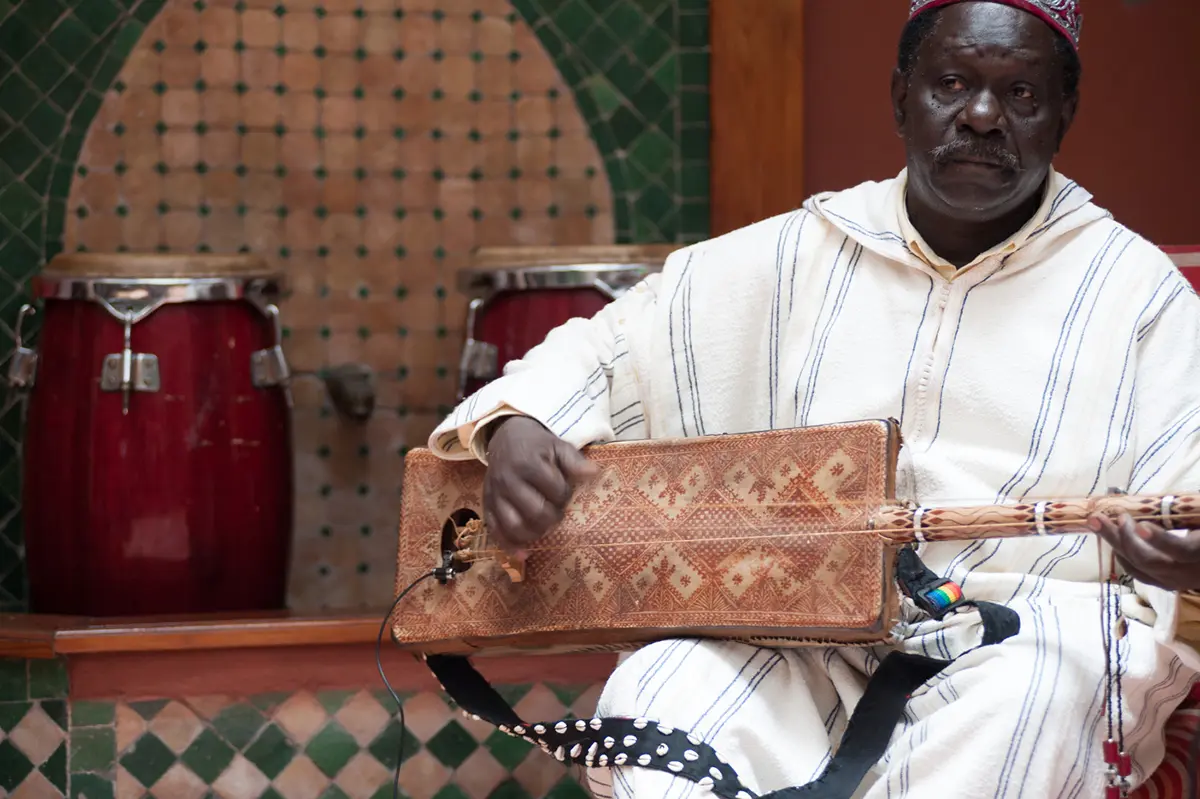
- The Guembri — The three-stringed bass lute that calls the spirits during the Lila.
- The Qraqeb — The iron castanets that create the trance-inducing rhythms.
The Ceremony Leaders
- Hamid El Kasri — A modern master known for powerful Lila performances.
- Mustapha Bakbou — The Zawiya master whose Lilas were known for deep spiritual authenticity.