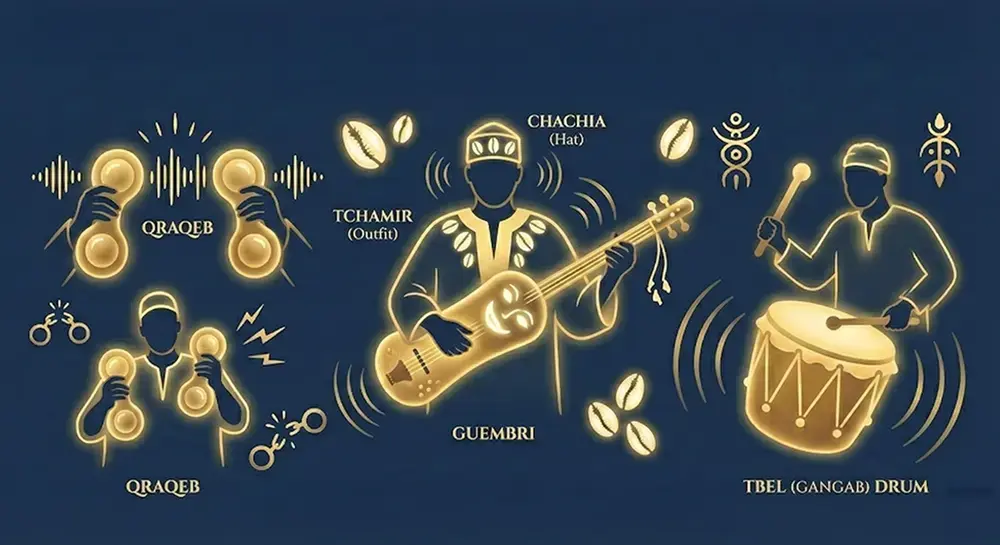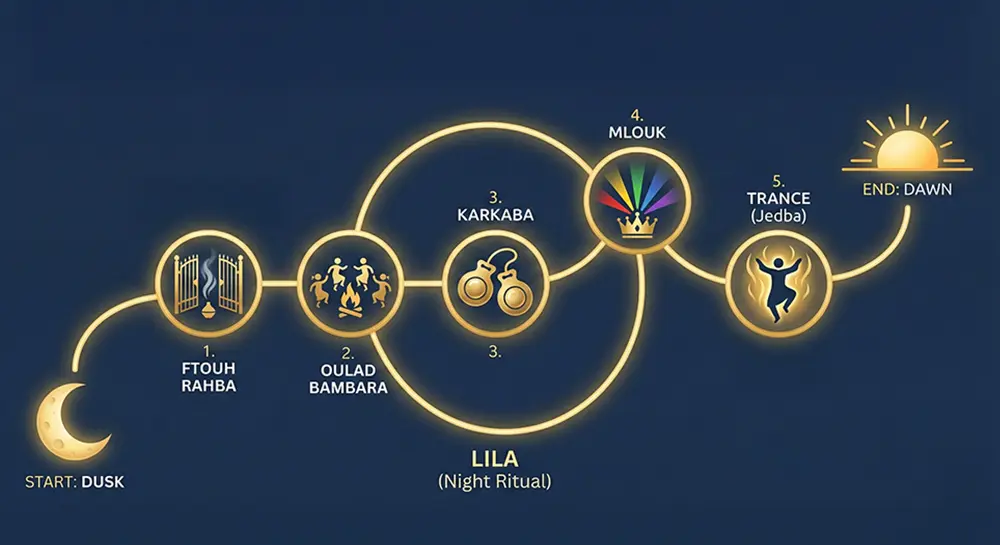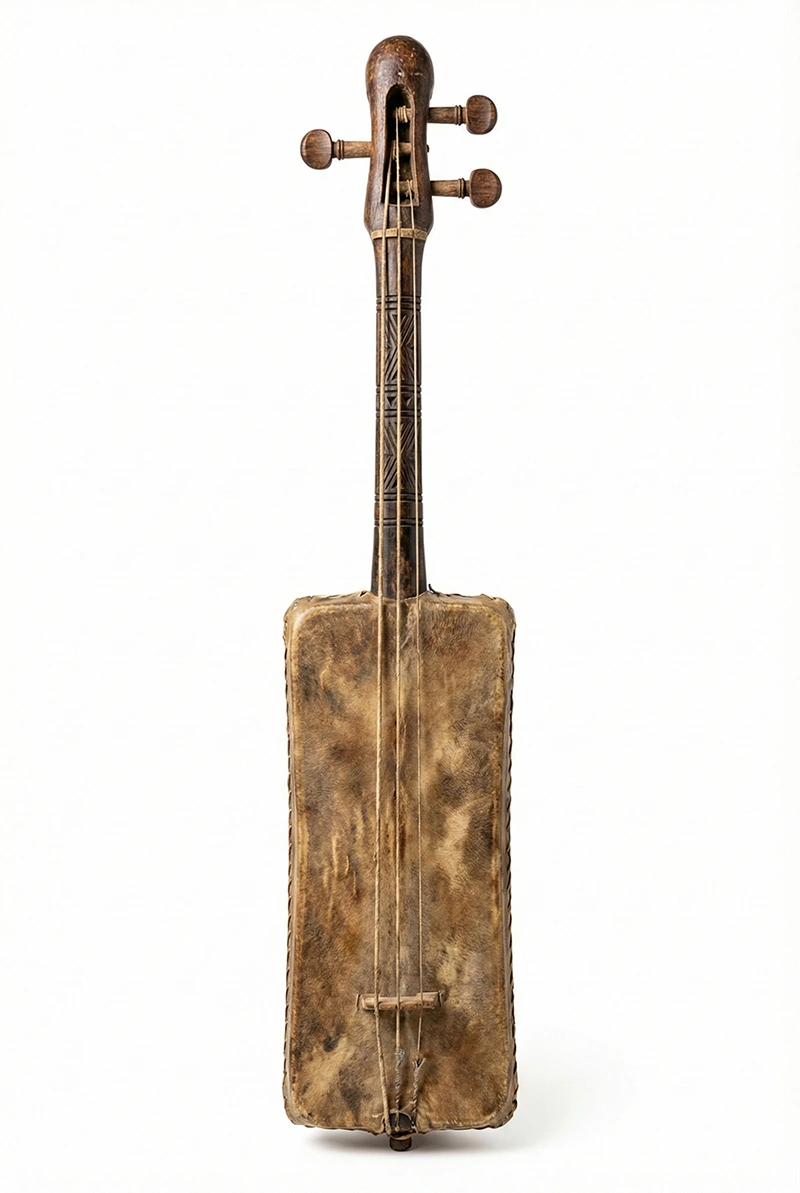
The Guembri is more than an instrument. It is the rhythmic heart and spiritual compass of every Gnawa ritual. A three-stringed bass lute played exclusively by the Maâlem, it acts as the conductor of the trance — not merely accompanying the music, but commanding the spirits to descend.
When the first notes emerge from its camel-skin body, the boundary between the visible and invisible begins to dissolve. The Lila cannot begin, transition, or end without the Guembri’s direct command.
Anatomy of the Sacred
The Body
A hollowed-out log of walnut or apricot wood, representing the boat that carried ancestors across unknown waters.
The Skin
Dried camel neck skin stretched taut over the resonating chamber, giving the instrument its deep, percussive voice.
The Strings
Three thick gut strings, historically made from goat intestines, producing the low frequencies that ground the trance.
The Sarsara
A metal rattle affixed at the neck's tip, adding a metallic "buzz" that echoes the sound of ancient chains.
The Vessel Between Worlds
In Gnawa cosmology, the Guembri is known as “The Vessel.” Its deep bass frequencies connect the dancers’ feet to the earth, grounding them in the physical realm, while its ascending melodies call upon specific spiritual entities known as Mlouk.
Each color ceremony in the Lila corresponds to a family of spirits, and the Guembri’s patterns shift to invoke them by name. The instrument is treated with profound reverence — often perfumed with incense, wrapped in sacred cloth, and never placed directly on the ground.
The relationship between the Maâlem and his Guembri is intimate and lifelong. Many masters speak of their instrument as a living companion, one that responds to their emotional state and spiritual readiness.
Did You Know?
The Rite of Passage: In traditional circles, a musician is not truly considered a "Maâlem" until his master physically gifts him a Guembri. This handover is a silent, unwritten diploma — signifying spiritual maturity, not merely musical skill. The instrument carries the lineage of all who played it before.
The Sound of Memory
Listen to the Guembri and you hear centuries compressed into vibration. The thump of its body recalls the drums of Sub-Saharan homelands. The buzz of the Sarsara whispers of chains transformed into music. The deep voice of its strings speaks a language older than Arabic, older than Berber — the first language of the soul responding to rhythm.
When a Maâlem strikes the first note of the night, he is not beginning a performance. He is opening a door.