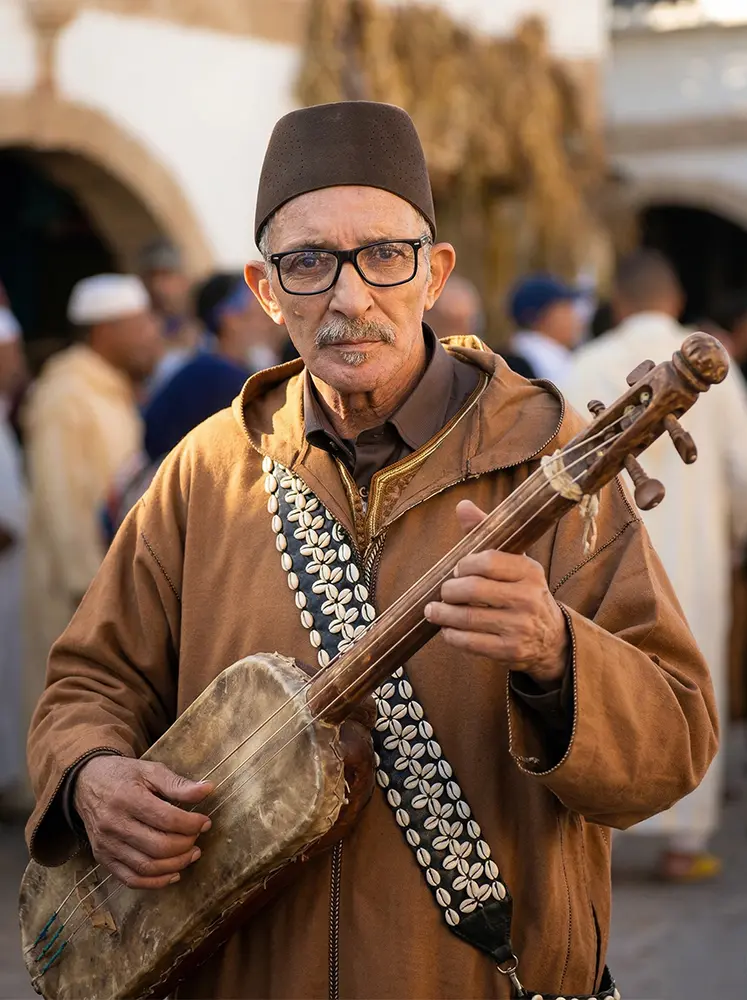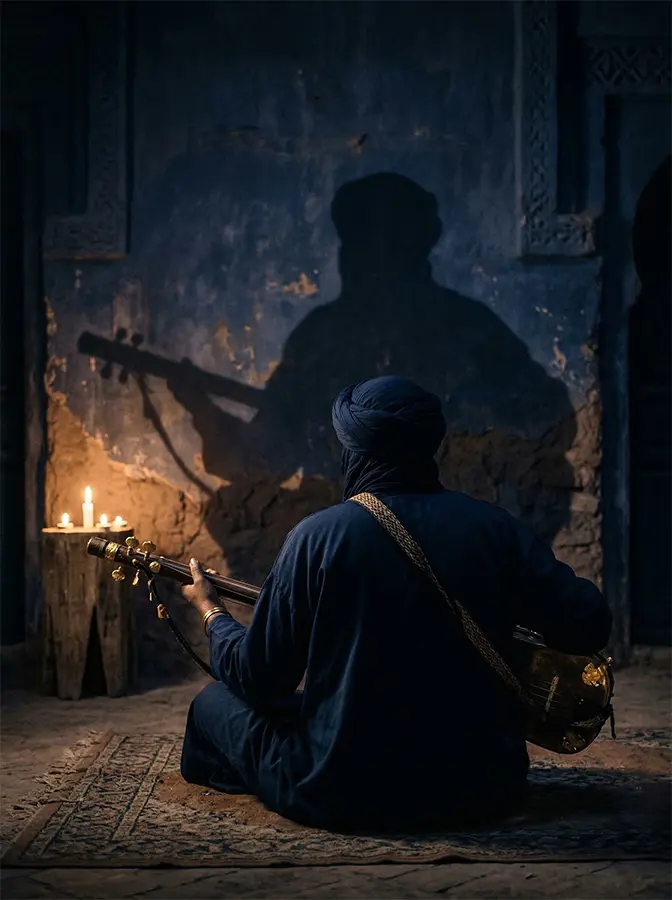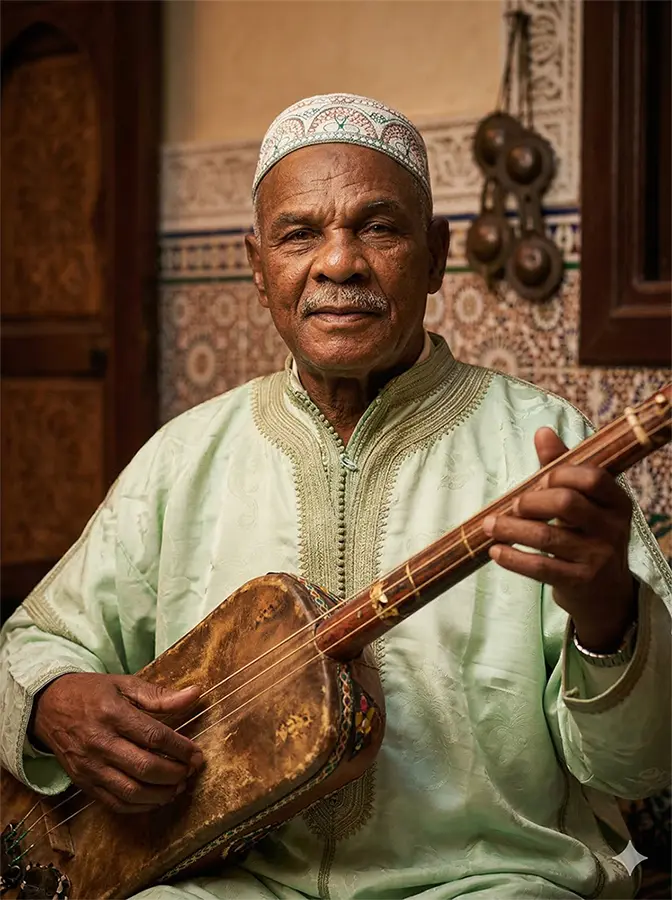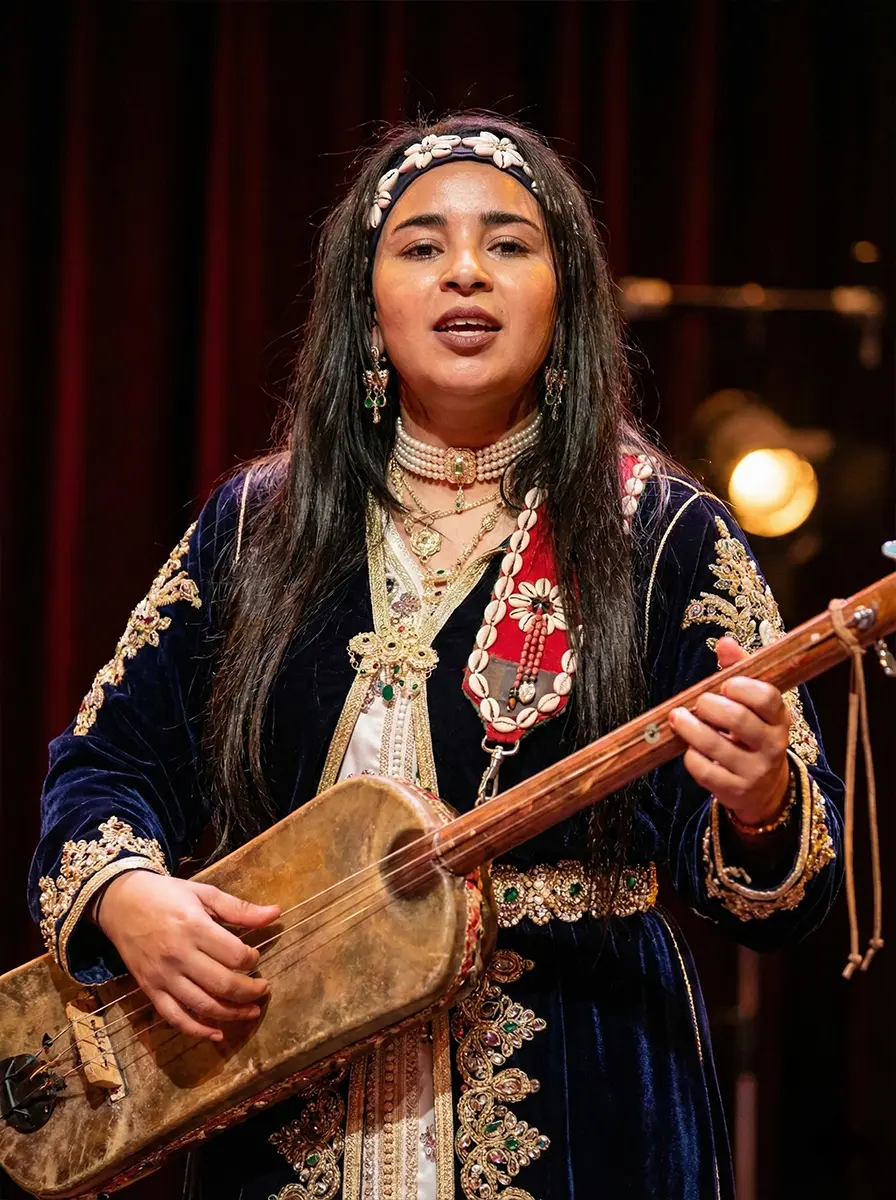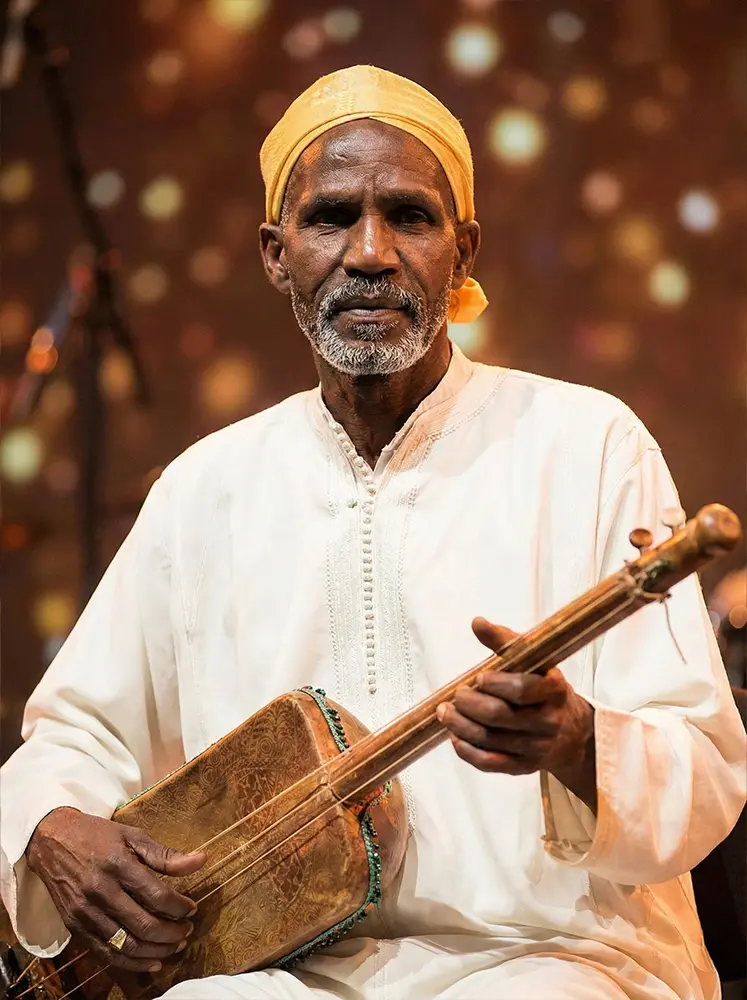
There are names in the world of Gnawa that play music, and there are names that are music itself. Maâlem Hmida Boussou (1939–2007) belonged to the second kind. Born Ahmed Boussou in Marrakech in 1939, he came to Casablanca as a young man and built his career in its popular neighborhoods — becoming the patriarch of the Casablanca school and one of the most authoritative guardians of the Tagnawit in the twentieth century.
He was the guardian of the Casablanca tradition at its most uncompromising, the man who certified a generation of masters without ever abandoning the strictness of the ritual, and the father who handed the lineage to his son Hassan Boussou with the full weight of its history intact. He died on 17 February 2007.
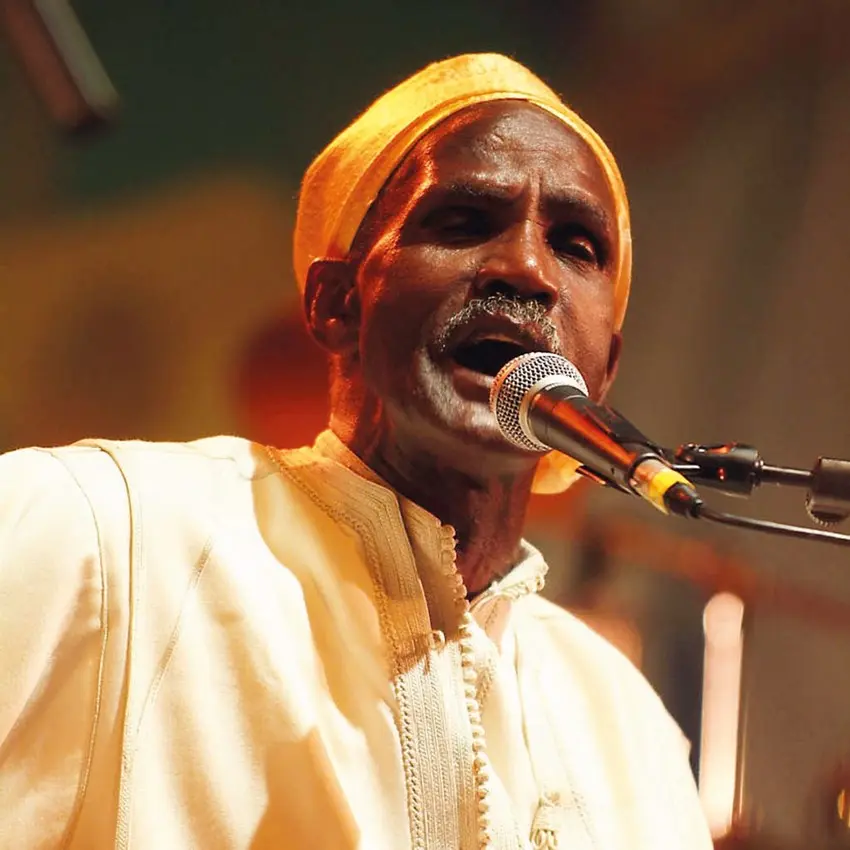
Roots: Marrakech Birth, Casablanca Destiny
The story of Hmida Boussou begins centuries before his birth. The family name “Boussou” carries anthropological weight, tracing a lineage through enslaved ancestors from the Bambara and Fulani peoples of the Western Sudan, carried along the trans-Saharan trade routes into Morocco under the Saadian and Alawi dynasties. These ancestors did not only bring their bodies. They brought their music, their language of spirits, and the ritual architecture of the Lila.
Ahmed Boussou was born in 1939 in Marrakech, in a house where rhythm was not entertainment but a language for communicating with the unseen. He first encountered Gnawa at the age of five through his maternal uncle, and at seven had a visionary dream during a pilgrimage in which a local master gifted him a guembri — in Gnawa culture, not merely a dream but spiritual permission from beyond. As a young man, he moved to Casablanca, settling in the popular neighborhoods of Derb Sultan and Hay Mohammadi where migrants from across Morocco’s south had built zawiyas dense with the full Gnawa ritual tradition. The zawiya in that world was not entertainment. It was a parallel institution for healing, memory, and the metabolizing of collective pain through rhythm.
The Teachers Who Shaped Him
In Gnawa tradition, a person does not choose to become a maalem. The lineage chooses him. Hmida Boussou was identified early and placed under the most demanding masters the Casablanca school had produced.
He apprenticed under two pillars of the Casawi tradition:
Maâlem Ahmed Ould Dij — the founding father of the Casablanca school, whose pedagogy demanded total immersion and absolute respect for the ritual sequence of the mhallat. Under Ould Dij, Hmida learned that the guembri is not an instrument you play for an audience. It is a vessel through which you speak to forces older than the audience itself.
Maâlem Abdelkader Benthami — the dean of Casablanca’s Gnawa scene, whose command of the full Tagnawit sequence was unmatched, and whose severity in transmission was legendary. From Benthami, Hmida absorbed the protocol of the mlouk — the complete ritual logic of which spirit receives which color, which incense, which mhalla, and in which order.
By the age of sixteen, in 1955, Hmida Boussou had mastered the full architecture of the lila. He became a certified maalem, an achievement that spoke both to his extraordinary gift and to the extraordinary severity of those who shaped him. He then collaborated with Maâlem Sam between 1962 and 1968 — a partnership that deepened his command of the full derdeba sequence.
The Casablanca Sound: Weight, Swing, and the Naked Guembri
What made Hmida Boussou’s sound immediately recognizable was a quality his contemporaries described as khmoud — a term for the kind of quiet spiritual weight that commands a room without shouting. The Casablanca school he represented was built around heaviness and deliberateness, and no one embodied that more completely than him.
The Swing
His rhythm was not mechanical. It breathed — slowing into a heartbeat murmur to build anticipation, then accelerating with surgical precision at the moment the ceremony required it, bringing the congregation to jedba without force and without hurry.
The Naked Guembri
Hmida had the artistic courage to let the [guembri](/instruments/guembri) stand exposed in the mix — not buried beneath the crash of the [qraqeb](/instruments/qraqeb), but present and speaking at full power. The bass string drone wept alongside the voice, named the mlouk alongside the voice, dissolved the line between player and instrument.
The Strict Protocol
He never altered the sequence of the mhallat for audience comfort. The [seven mlouk families](/blog/seven-mlouk-colors-spirits-meanings) — white through black — followed their prescribed order for reasons reaching back centuries. To change the order was not adaptation. It was damage to the people who had opened themselves to the ceremony.
The Al Sur Recording: An Ethnographic Monument
The greatest institutional recognition of Hmida Boussou’s authority as a guardian of the Tagnawit came not from festival awards but from scholars. He was selected, alongside Maâlem Sam, to document the complete Gnawa lila for the French label Al Sur — a five-volume series released as “Gnawa Leila” that stands as the most comprehensive ethnographic recording of the full derdeba ever produced.
The selection was deliberate. The researchers trusted Hmida Boussou precisely because they knew he would not deviate by a fraction from the authentic ritual sequence. The result was five hours of uninterrupted ceremony, each volume corresponding to one of the color suites of the mlouk:
| Volume | Suite | Spirits / Context |
|---|---|---|
| Vol. I | Pre-ceremony warm-up | Musicians and congregation before formal rites |
| Vol. II | The White Suite (L'A'ada) | The Prophet's family — the solemn lila opening |
| Vol. III | The Blue Suite | Sidi Moussa (sea) and Sidi Sama (sky) |
| Vol. IV | Red and Green Suites | Sidi Hamou (blood, healing) and the noble Shorfa |
| Vol. V | Black and Yellow Suites | Forest ancestors, female spirits, Lalla Aicha |
His voice was preserved in the world’s sound libraries. His mhallat became the reference against which other recordings are measured.
He also became a fixture at the Essaouira Gnaoua and World Music Festival from its earliest editions in the late 1990s — not as a participant but as the spiritual elder who opened ceremonies and blessed stages. His 1998 performance remains one of the festival’s most cited historical moments.
Between the Zawiya and the World
Hmida Boussou’s approach to the stage was unlike any other master of his generation. His philosophy was precise: he did not go to the audience. The audience came to him.
When he collaborated with jazz or blues musicians — and he did, selectively — he never adjusted his rhythm to accommodate them. He set the anchor and waited for them to find their place within it. He recognized, long before the musicologists, that the connection between Gnawa and blues was not a stylistic accident but a shared history: both traditions carry the weight of enslaved ancestors, both use music as metabolized grief.
His position on fusion was not refusal. It was hierarchy. The guembri leads. The Tagnawit is the trunk. Everything else is branches. Cut the trunk and the branches fall regardless of how far they had extended.
He watched with a careful eye as a new generation moved toward Gnawa fusion in Casablanca’s Nayda movement, and he did not stop it. What he transmitted to his son was not a prohibition but a foundation: know the lila completely before you open it to the world.
The Transmission
Hmida Boussou feared one thing more than death: that Gnawa would become tourist folklore emptied of soul. He feared the day when the Bambara words in the chants would be sung without anyone knowing which spirit they called. When the qraqeb, which carry the memory of the ancestors’ chains, would be treated as simple percussion.
His answer to that fear was transmission. He trained many, but his true heir — the one who carries his exact method, his exact weight — is Maâlem Hassan Boussou, his son, who now leads the Boussou Ganga troupe. Under his father’s guidance, Hassan founded Gnawa Fusion in 1996 and Séwaryé in 2006, extending the tradition outward without loosening its center.
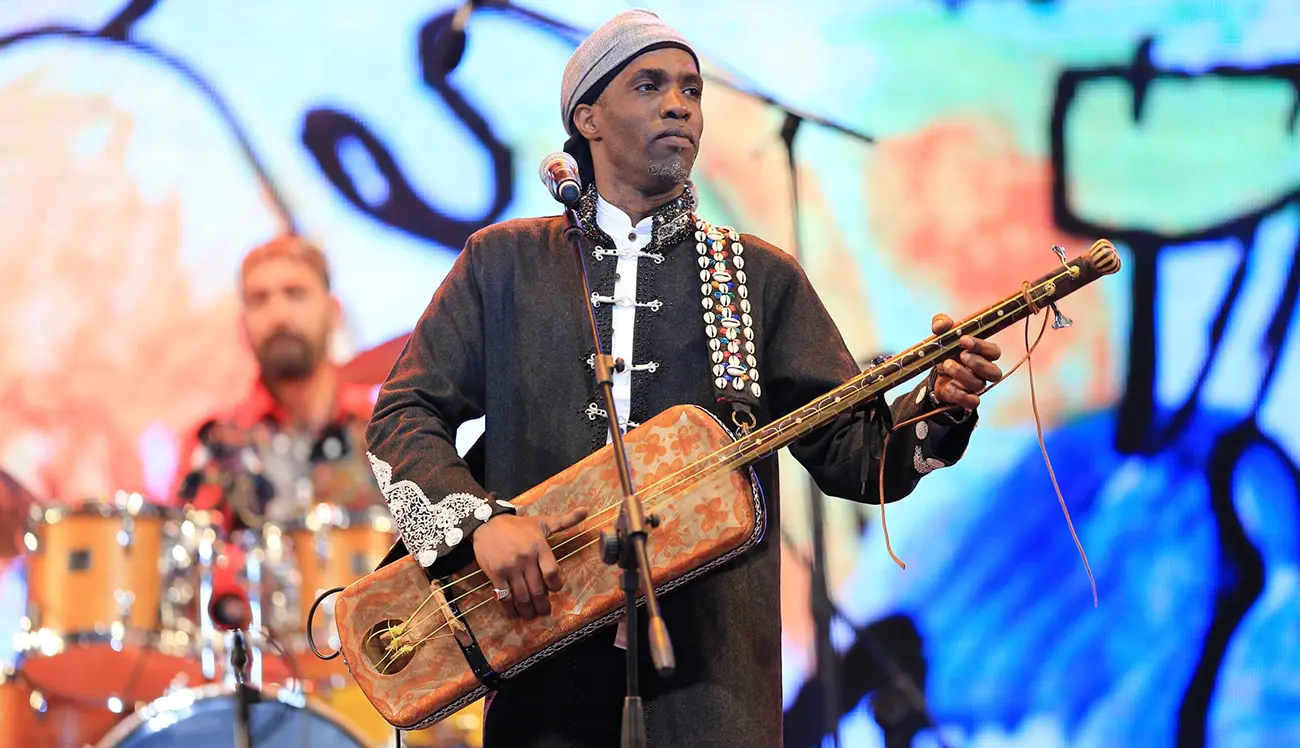
When Hmida Boussou died in February 2007, Hassan Boussou performed at the Essaouira Festival that year in tribute. The Casablanca school did not lose its ground. The root held.
Essential Listening
The White Suite (L'A'ada)
Al Sur Vol. II — Ritual Opening
The lila's solemn beginning — the call to the Prophet's family before any spirit is summoned. Hmida's ability to hold a congregation in reverent suspension before the ceremony formally opens is without equal. The reference recording for the Casablanca derdeba.
Ouled Bambara
Ancestral / Roots
A return to the African origin point. Ancient Bambara words folded into Darija Arabic, carried on the heaviest [guembri](/instruments/guembri) line in the Casablanca tradition. Listen to the "naked" bass drone cutting through the [qraqeb](/instruments/qraqeb) — that is the Boussou signature.
L'Afou Moulana (العفو مولانا)
Personal / Spiritual Peak
Here Hmida makes the defining artistic choice: he replaces the [qraqeb](/instruments/qraqeb) entirely with interlaced handclapping. The metal goes silent. Only his voice and the congregation remain. A prayer for forgiveness stripped of everything except the need itself — the most emotionally direct recording in his entire catalog.
"It is not music of sorcery or witchcraft… Gnawa music is a spiritual expression, and there is no healing except from God."
Maâlem Hmida Boussou
When the guembri fell silent in February 2007, the Casablanca school lost its patriarch. But the Boussou Touch survives — in Hassan Boussou’s hands, in every player Hmida trained, and in the five volumes of Gnawa Leila that will outlast all of us: a complete architecture of a tradition that refused, across centuries of displacement and pressure, to disappear.