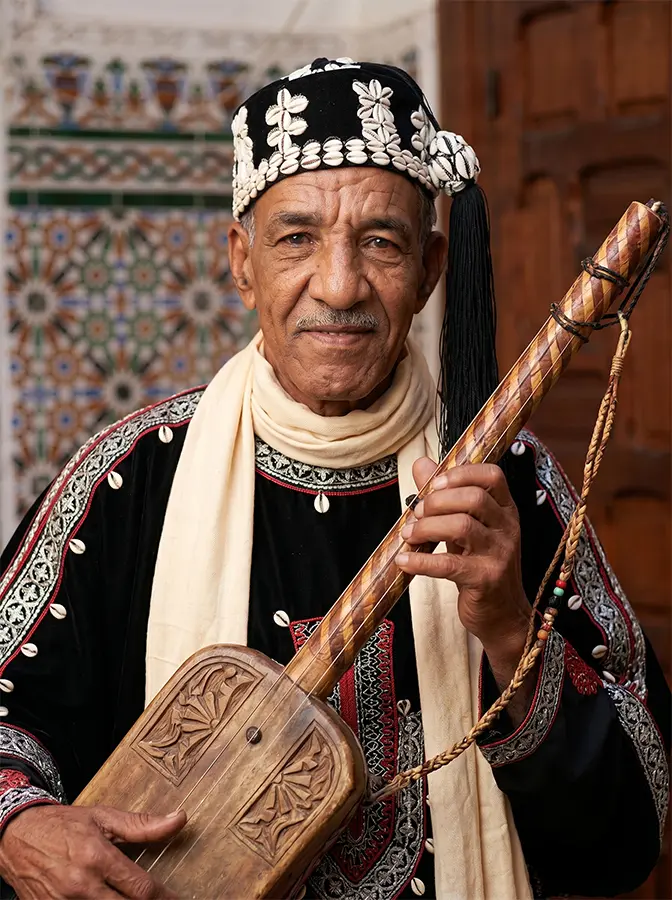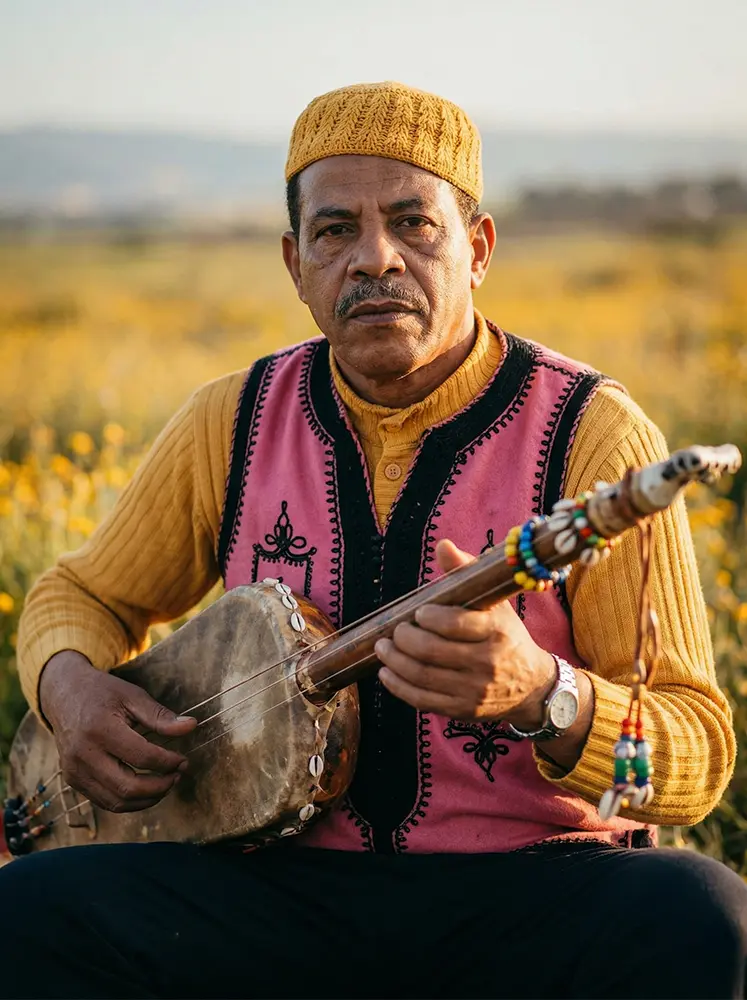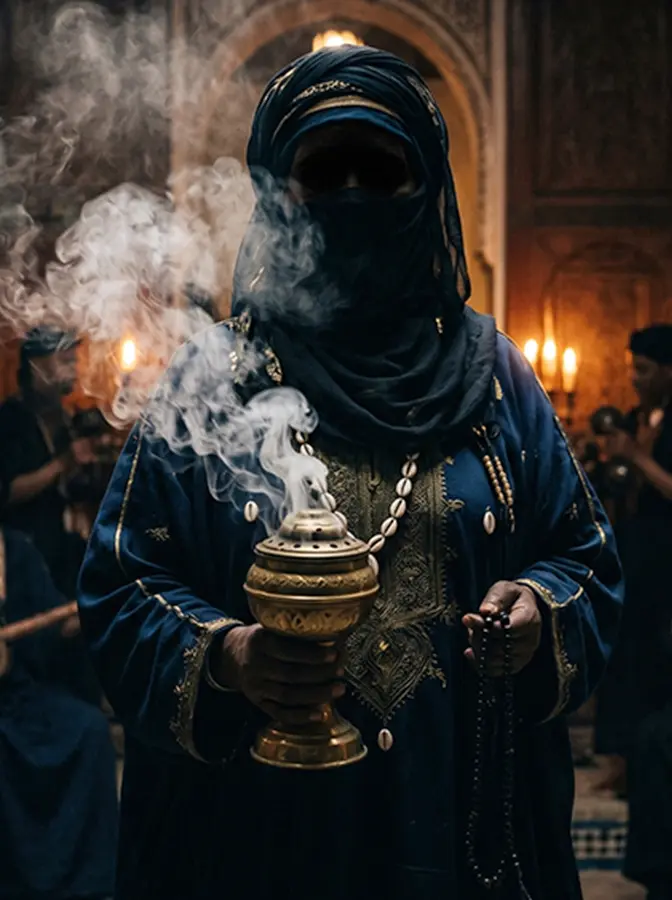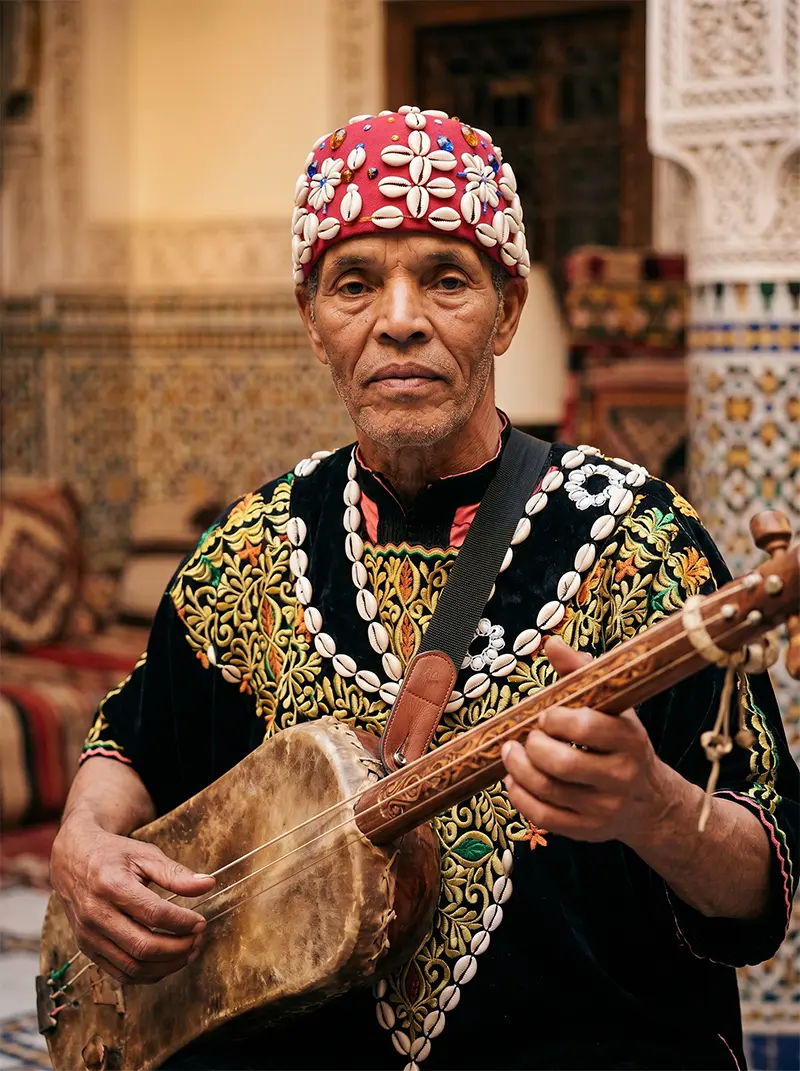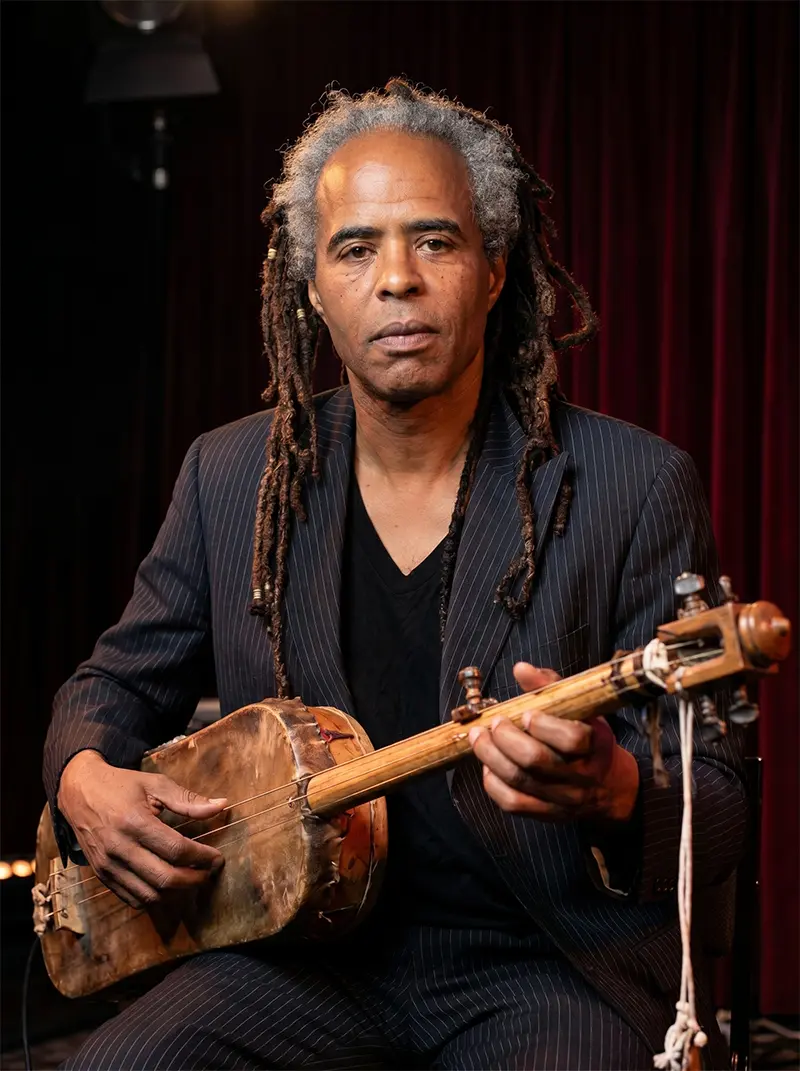
Some artists carry a tradition. Maâlem Hassan Hakmoun carried a civilization. Born in 1963 in the medina of Marrakech, he arrived in New York in 1987 with one Moroccan dirham in his pocket and the full architectural knowledge of a sacred art that had survived slavery, colonialism, and marginalization. What he built from that moment on redefined what Gnawa could mean to the world — without ever compromising what it meant to him.
He is the godfather of Gnawa fusion. He performed at Woodstock ‘94 before hundreds of thousands. He recorded in Peter Gabriel’s Real World studios. He collaborated with Miles Davis, Don Cherry, Kronos Quartet, and Ozomatli. And yet, when asked what he is, he gives the same answer he has given since his first lila in a Marrakech zawiya: a Maâlem. A master of the ceremony. A guardian of the healing function of music.
Roots: Marrakech, the Seven Saints, and the Sacred Household
To understand Hassan Hakmoun, you must understand the Marrakech he came from — not the tourist postcard version, but the city as a living spiritual architecture.
Marrakech sits at the crossroads of trans-Saharan trade routes that carried, across centuries, not only goods but people. The ancestors of the Gnawa were among those people: Bambara, Hausa, Fulani, Songhai — brought by force from West African civilizations as enslaved people, carrying their cosmologies and healing practices in their memory when everything else was taken from them. In Marrakech, these practices fused with Sufi Islam and Berber tradition to produce Tagnawit: a sacred music system organized around seven spirit families, seven colors, seven constellations of incense, and the specific sequence of the lila ceremony in which they are invoked.
Hakmoun was not born near this tradition. He was born inside it. His mother was a renowned moqaddema — a female ritual specialist and spiritual healer whose home was a gathering point for the community’s therapeutic needs. Music in their house was not entertainment. It was medicine. The guembri and the qraqeb were tools of the trade, not hobbies.
The Healing Household
His mother's role as moqaddema meant the lila ceremony was a regular occurrence in their home — not a distant cultural artifact, but a living domestic practice. Hakmoun absorbed the cosmological map of the seven mlouk through childhood proximity, years before he touched an instrument.
The Miracle That Defined Him
When he was young, his two-year-old sister poured boiling water into a drainage channel at midnight — forbidden in Gnawa belief, as it risks harming spirit entities. She woke covered in burns. His mother performed an emergency lila. After the ceremony, the burns had vanished. This was his first proof that music could alter physical reality.
Apprenticed at Seven
He began formal study of Tagnawit at age seven, studying under master teachers including Maâlem Hmida Boussou. His training was comprehensive: the full liturgical text in Moroccan Arabic and Bambara dialect, the color-sequence ordering of the seven mlouk, the choreographic and vocal requirements of each phase of the lila.
The Calling: Leaving School, Becoming a Maâlem
At fourteen, Hassan Hakmoun made the decision that determined the rest of his life: he left formal education to pursue Tagnawit full-time. This was not adolescent rebellion. It was a response to what he experienced as an irresistible inner call — what the tradition itself might describe as the spirits choosing their medium.
He began traveling through Morocco and into Spain and France, finding Gnawa masters scattered across cities, absorbing their knowledge and their regional variations. When he returned to Marrakech, he faced the social stigma that still attached itself to Gnawa practitioners in that era. In some neighborhoods, they were perceived as street musicians dependent on the charity of passersby at Jemaa el-Fna — not the spiritual specialists their tradition claimed them to be.
The night that changed everything came when his family, who had not witnessed the full extent of his development, found themselves in need of a maalem for a ceremony. They turned to him. That night, his mother — the moqaddema, the woman who had led hundreds of ceremonies — watched her son lead a complete Derdeba ritual for the first time. The barrier fell. The vocation was confirmed.
This moment gave him something rare: the psychological resilience to face what came next. He had learned to play in the street for survival and in the zawiya for healing. He understood that music was the force capable of turning marginalization into centrality — of taking what the world dismissed and placing it at the center of the room.
The Unique Style: Marrakchi Power and the Living Guembri
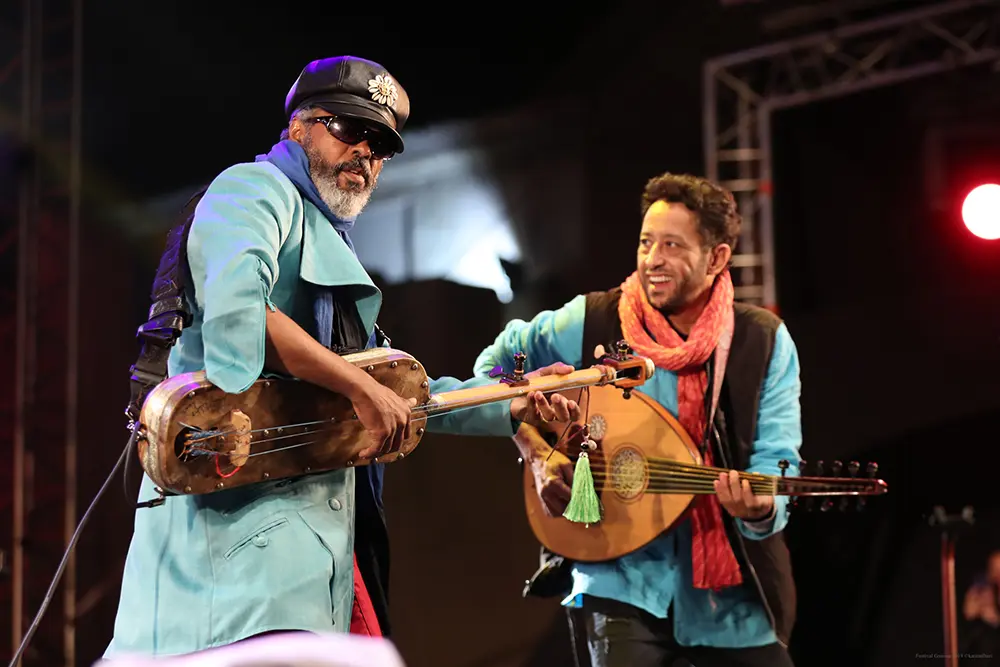
Hakmoun belongs to the Marrakchi school of Gnawa — the school characterized by speed, physical intensity, and a polyrythmic density designed for open spaces and the physical induction of jedba (trance). Where the Marsaoui school of Essaouira tends toward slower, more melodic, contemplative expression, the Marrakchi approach is heavier, faster, and built to move a crowd.
| Technical Element | Hakmoun's Approach | What This Means |
|---|---|---|
| Drop-thumb frailing | Thumb strikes the bass string continuously while fingers pluck the remaining strings in complex patterns. | Creates a self-contained orchestra: simultaneous drone, melody, and percussion from one instrument. |
| Skin percussion | Strikes the camel-skin resonator of the guembri directly, creating a deep drumming layer beneath the string sound. | Grounds the music in the earth-anchoring function that Gnawa assigns to the guembri in ceremony. |
| Sersara (metal buzzer) | A metal attachment on the guembri's neck that adds a rough buzzing resonance to every note. | Connects the instrument tonally to the qraqeb's metallic sound, unifying the ensemble into one sonic body. |
| Physical performance | Known for leaps reaching five feet from the ground during peak moments of ceremony and concert alike. | Reflects the Marrakchi school's belief that the maalem's body must mirror the rising energy of the jedba. |
How does he define his own style? He makes a precise distinction between two modes of performance. When playing for ceremony (the Derdeba), he follows the Treq (the path) with absolute literalism: the seven color sequences in their correct order, the specific liturgical texts for each molk, the timing of transitions between the phases of the lila. No improvisation. No compression. The spirits require precision.
When playing for the stage, he considers himself free to explore the surrounding musical universe — using the Gnawa structure as a gravitational core that can absorb rock, jazz, rap, and funk without losing its identity. The circular polyrhythmic architecture of Tagnawit is the constant. Everything else can orbit it.
Career and Recognition: From Jemaa el-Fna to Woodstock
The pivot came in 1987. A dance company invited him to perform in the United States — his first international appearance. He arrived in New York with one Moroccan dirham and no plan beyond survival.
His survival strategy was the street. He performed in restaurants, alternative clubs, and whatever space would have him. The quality of what he did in these unlikely venues began attracting attention in New York’s experimental music community. The night that crystallized his reputation came at the Knitting Factory — the legendary downtown club that served as the laboratory for New York’s avant-garde jazz scene.
Miles Davis and Canadian musician-producer Daniel Lanois were in the audience. They heard the guembri and were transfixed. Lanois introduced Hakmoun to Peter Gabriel, who immediately brought him into the WOMAD (World of Music, Arts and Dance) network and offered him recording time at Real World Studios in England.
1991: Gift of the Gnawa
His debut international album with Don Cherry and Adam Rudolph. A landmark document of Gnawa in its ceremonial purity, filtered through the sensibility of two jazz masters who understood it as a cousin tradition to their own.
1993: Trance
Recorded at Real World Studios. The album that positioned Hakmoun as a world-music force. A bridge between the traditional ceremony and the contemporary concert stage, with Peter Gabriel's production values preserving the raw authenticity of the guembri.
1994: Woodstock
The performance that sealed his global reputation. Standing before hundreds of thousands at Woodstock '94, he brought the polyrhythmic energy of a Marrakech square into the most famous concert environment of the Western world — and the crowd responded as though the spirits had arrived.
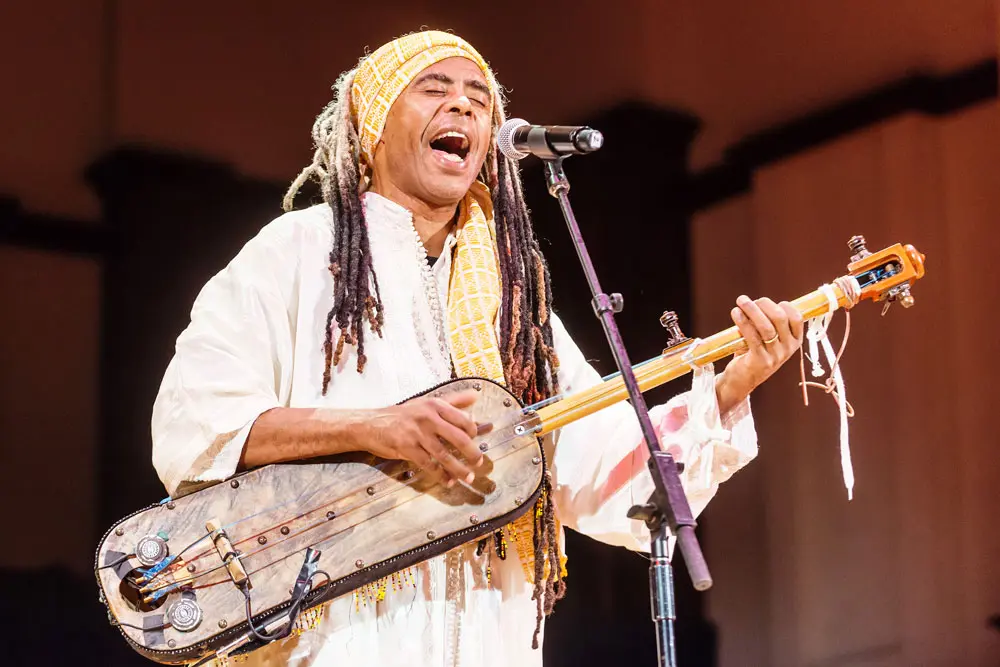
In 1995, at the height of his commercial fusion success, Hakmoun released “The Fire Within” — a purely acoustic album with only guembri, qraqeb, and handclaps. No electric instruments. No Western arrangements. A deliberate signal to critics who questioned whether his fusion work meant he had lost his traditional center: the core was undiminished. The fusion was a choice, not a loss.
The New York Times described his playing as combining past and present to create “the rumble that all great dance and trance music aspires to.”
Fusion and Collaboration: Reuniting the African Family
Hakmoun’s philosophy of musical fusion is grounded in a specific historical argument. Jazz, blues, and funk in America are, in his words, “cousin traditions” to Gnawa — both born from the African diaspora’s experience of forced displacement and slavery, both using rhythm as a form of resistance and spiritual maintenance. When he blends Gnawa with jazz or funk, he is not creating something new: he is reuniting a family separated by the Atlantic.
This is why his collaborations feel like organic encounters rather than calculated experiments:
- Don Cherry and Adam Rudolph — jazz musicians who recognized the African spiritual root that their own tradition shares with Gnawa
- Peter Gabriel — who understood Gnawa as part of a global musical conversation about spiritual experience and ritual function
- Kronos Quartet — a string ensemble whose interest in non-Western musics created a genuinely equal dialogue with the guembri
- Ozomatli — a Grammy-winning Latin hip-hop band whose polyrhythmic base gave Gnawa’s cyclical structure a natural home
- Paula Cole — collaborative work that explored the emotional and spiritual dimensions of the music beyond its ritual context
His ensemble Zahar (meaning “luck” or “chance” in Moroccan Arabic) was the primary vehicle for this cross-cultural exploration. Zahar combined electric guitars, modern drum kits, and violin with the guembri and qraqeb — not as a concession to Western taste but as an extension of the same adaptive intelligence that allowed Gnawa to survive centuries of displacement.
On the relationship between Gnawa and jazz:
"The blues and jazz came from Africa. Gnawa came from Africa. They are brothers and sisters separated by the slave trade. When they meet again, it is not fusion. It is reunion."
Hassan Hakmoun
His student Mike Rivard, bassist and founder of the experimental jazz collective Club d’Elf in Boston, studied guembri and Gnawa technique directly under Hakmoun — becoming one of the most visible examples of the Western musician who entered the tradition with genuine scholarly and spiritual seriousness rather than as a tourist passing through.
Legacy and Transmission: The Academy and the Zawiya
Hakmoun’s legacy operates on two tracks simultaneously, and the tension between them is productive rather than contradictory.
As a transmitter of ritual knowledge, he continues to function as a practicing maalem. Despite decades in New York and global touring, he has never abandoned the therapeutic dimension of his practice. He refuses to perform the sacred ceremonies for private parties or commercial contexts that would reduce them to spectacle. The Derdeba remains, for him, what it always was: a tool for healing, not entertainment.
As a teacher in academic and cultural institutions, he has brought Gnawa’s pedagogical methodology into university workshops and cultural centers through programs such as his work with WMI Plus. His teaching method follows the traditional oral approach: no notation (Gnawa has never been written down), no fixed curriculum, but direct transmission of the feeling of the polyrhythm — how to locate the micro-timing gaps in the cycle, how to allow the body to become a resonator rather than a performer. He explains the historical and metaphysical context of each mhalla before teaching its technical execution, because playing without understanding the pain that produced the music is, in his view, playing without truth.
What he fears losing: the therapeutic core. As Gnawa festivals grow larger — including the Gnawa and World Music Festival in Essaouira, which he helped popularize — he watches with concern the transformation of the Derdeba into a folkloric show. Speed and physical spectacle replace the careful sequencing that makes the ceremony effective. Young practitioners learn how to excite a crowd without learning what the crowd is supposed to receive. The music survives but the medicine disappears.
What he wants to leave behind: a world in which the guembri is accorded the same respect as the piano or the violin. A world in which Gnawa philosophy — of music as a path to internal peace and collective healing — persists across generations without the corruption of pure commodification.
Essential Listening
Saba Atu Rijal
Gift of the Gnawa / 1991 / with Don Cherry
The Seven Saints of Marrakech invoked in pure Marrakchi ceremony. No Western instruments. Only Hakmoun's deep rough voice calling the awliya, the locked qraqeb cycle, and the earth-anchored guembri drone. This is the zawiya before the stage ever existed.
Zidokan (Just Go)
Unity / 2014 / Zahar
Opening track of his most celebrated fusion album. Critics called it "Moroccan trance music meeting Jimi Hendrix." The propulsion is relentless: the guembri's circular rhythm drives electric guitars and modern drums into its own orbit rather than the reverse. The Gnawa center holds.
Bania
Trance / 1993 / Real World Records
Recorded in Peter Gabriel's Real World studios. Begins as a slow, aching vocal invocation saturated with longing and exile, then builds with extreme patience toward a fever-pitch of rhythm. It embodies the immigrant's solitude and the philosophy of music as an alternative homeland.
"My music is a call for love and peace. We are here temporarily, and the prophets were not killers. They delivered one message: love yourself, and love your neighbor."
Maâlem Hassan Hakmoun
From a Marrakech zawiya where his mother healed broken bodies with incense and the guembri, to a New York where Miles Davis stopped to listen, to a Woodstock stage where hundreds of thousands felt the polyrhythm of a West African spiritual tradition enter their bodies for the first time — Hassan Hakmoun’s trajectory is one of the most singular in the history of world music. He did not translate Gnawa for the West. He brought the West to Gnawa, and made it understand, on its feet and in its chest, what the music had always been saying.