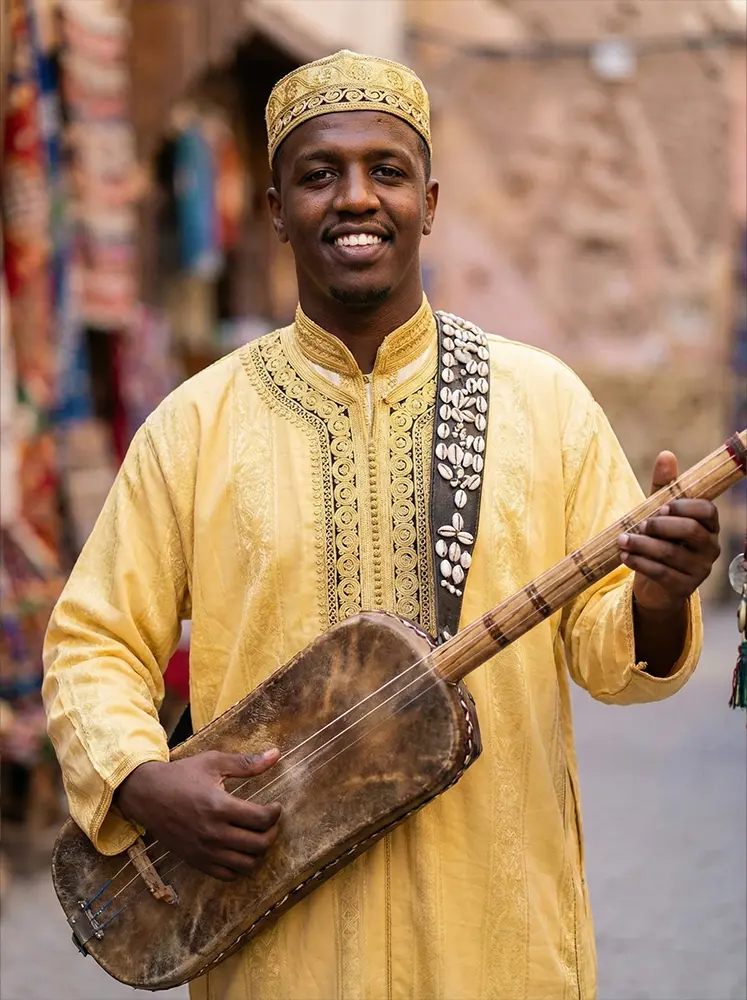
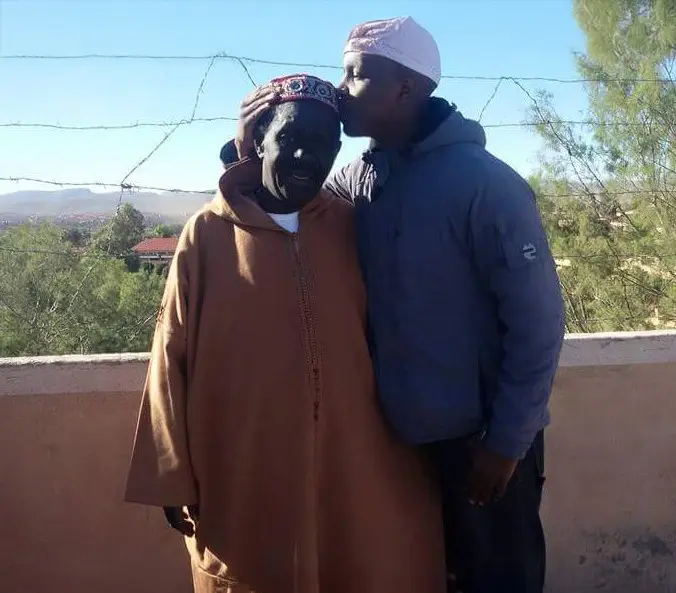
There is a moment that defines a life. For Maâlem Houssam Gania, it came on a night in Essaouira in 2015, when his father — the legendary Mahmoud Gania, body ravaged by illness but spirit unbroken — removed the guembri from his own shoulders and placed it around his son’s neck. Before thousands of witnesses, tears streaming down his gaunt face, Mahmoud pressed a kiss of blessing to Houssam’s forehead.
No words were needed. The lineage was transferred. The torch was passed.
Today, Houssam carries the red guembri that belonged to his father, continuing a dynasty that stretches back through Boubker Gania, through Da Samba, all the way to the enslaved ancestors who brought this sacred music from sub-Saharan Africa to Morocco. He did not choose Gnawa. Gnawa chose him.
The Royal Family of Gnawa
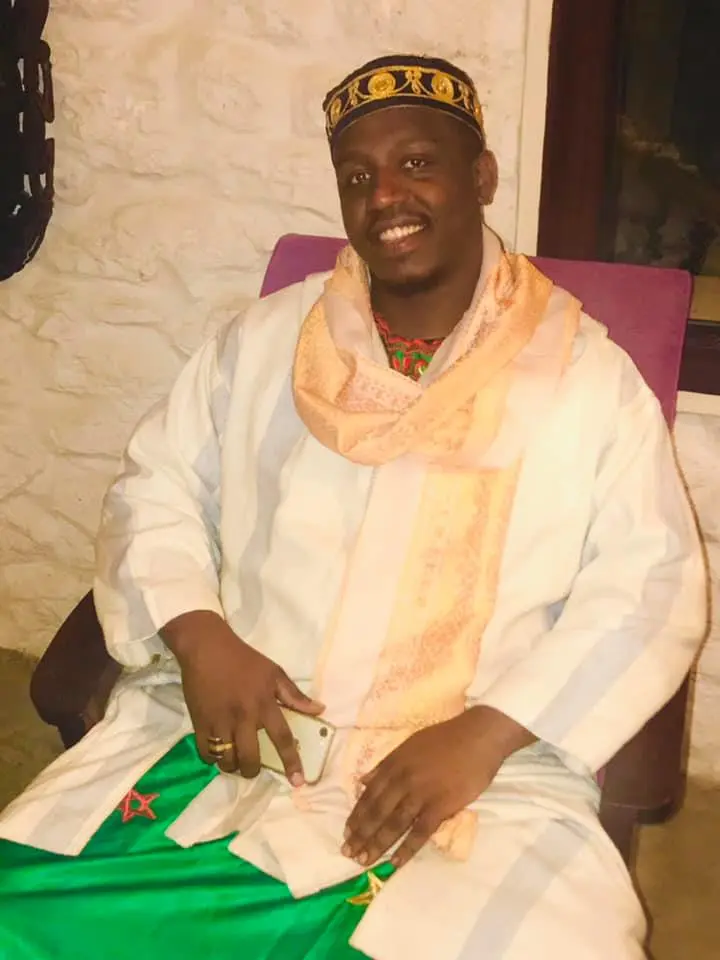
To understand Houssam Gania, you must understand the family he was born into. The Gania clan is not merely a Gnawa family — they are Gnawa royalty, a dynasty whose roots reach deeper into this tradition than almost any other.
His grandfather Boubker Gania was a legendary master. His father Mahmoud Gania became perhaps the most internationally celebrated Gnawa musician in history, “The Smiling Saint of Essaouira.” His uncle Mokhtar Gania carries the tradition. His older brother Hamza plays alongside him.
The family’s origins tell the story of Gnawa itself: Mahmoud’s paternal grandfather came from Sudan, his maternal grandfather from Ghana. The Gania style — the “Sudani” approach — reflects this dual African heritage, expressed through seven distinctive Sudanese pieces that no other family plays quite the same way.
Growing Up Inside the Music
Houssam was born in Marrakech but raised in Essaouira, the wind city that has been the spiritual home of the Gania family for generations. His childhood was not ordinary. While other children played in the streets, Houssam sat in the zawiya, watching his father lead lilas, feeling the guembri’s vibrations in his chest before his hands ever touched the strings.
The lila ceremonies inside the Gania home were not performances — they were daily rituals, as natural as breathing. Houssam understood from his earliest memories that Gnawa was not entertainment. It was healing. It was connection to ancestors across the ocean and across the centuries.
“I didn’t choose Gnawa,” he says. “It chose me.”
By the time he was old enough to hold a guembri, he already knew its language. The spiritual lineage — from Ba Massoud through generations to Gania — had already made him a Maâlem in spirit. The instrument was merely confirmation.
The Night of Transfer
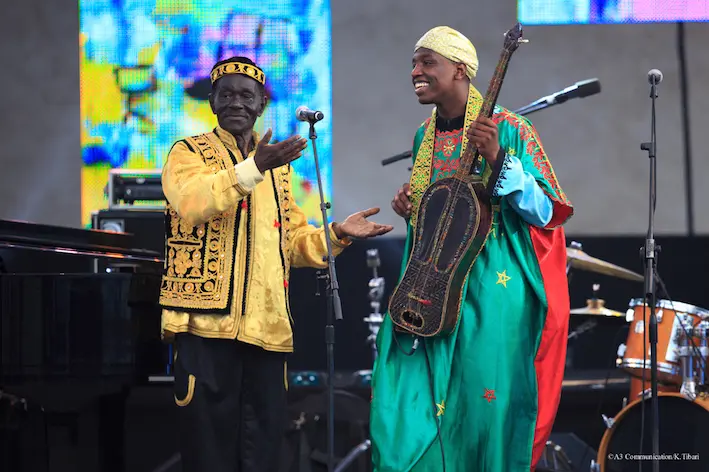
Essaouira, 2015. The 18th edition of the Gnaoua and World Music Festival.
Mahmoud Gania climbed the stage at Place Moulay El Hassan with heavy steps and a withered body. The disease had aged him ten years in months. Thousands of fans who had come to celebrate were shocked into silence — many could not recognize the master they loved.
But when his fingers touched the guembri, when his deep, cavernous voice rose into the night air, he was himself again. He sang “Moulay Ahmed” as only he could sing it — a performance he had abandoned for years because others had commercialized it, stripped it of spiritual depth. His eyes held both sorrow and transcendence, as if he were saying goodbye.
Then, in the middle of his performance, Mahmoud did something no one expected.
He removed his guembri — the instrument that had been his voice for decades — and placed it around Houssam’s neck. He kissed his son’s forehead. Tears ran freely down both their faces.
The crowd understood. They were witnessing the transfer of a dynasty.
Carrying the Legacy
The weight of being Mahmoud Gania’s heir could crush a lesser musician. The comparisons are inevitable, the expectations impossible. But Houssam has navigated this burden with grace, honoring his father’s style while developing his own voice.
The Sudani Style
The distinctive Gania approach — heavy, circular rhythms rooted in Sudanese and Ghanaian heritage.
The Essaouira Sound
Pure *tagnawit* of the wind city — the traditional *lila* as practiced in the Gania zawiya for generations.
The Bridge
Faithful to tradition in ritual, yet capable of translating the sacred to international stages.
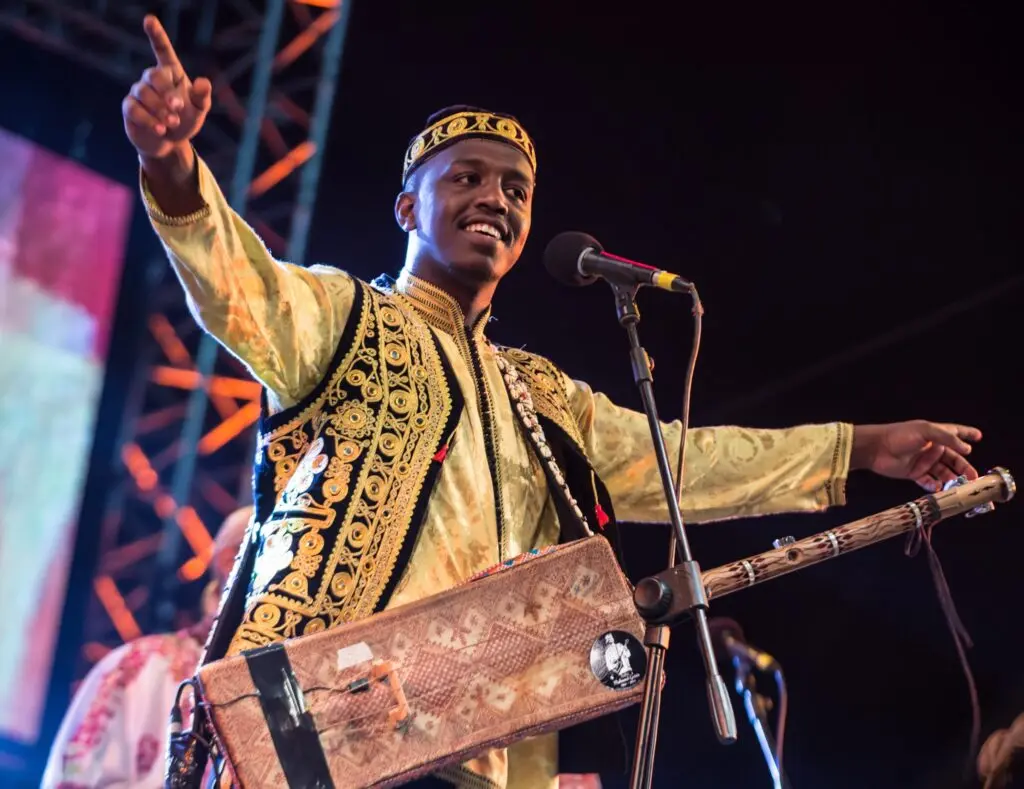
His playing echoes his father’s depth while adding theatrical touches that make the ancient rituals breathe on modern stages. He plays for the spirits and for the audience, never sacrificing one for the other.
The International Stage
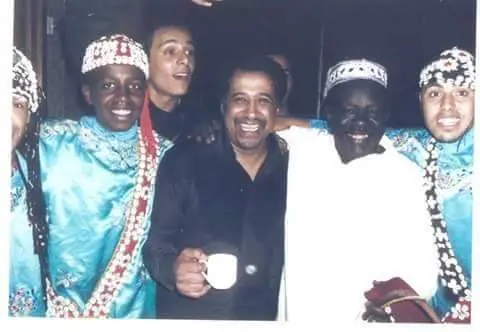
Houssam’s journey to the world stage began in 2012, when he accompanied his father to a concert in Belgium. It was a baptism by fire — performing alongside the greatest Gnawa master of his generation, under the eyes of European audiences hungry for authentic African spirituality.
Two years later, he founded his own group in Essaouira and began performing independently in Morocco, England, and the Netherlands.
2016 marked his emergence as a star in his own right. At the Gnaoua Festival, he performed in the tribute concert for his late father and Senegalese drumming legend Doudou N’Diaye Rose. The same year, at the massive Mawazine Festival, he shared the stage with Cuban jazz pianist Omar Sosa and rising star Mehdi Nassouli, proving his ability to transcend genre boundaries.
Building Bridges
Like his father before him, Houssam embraces collaboration with musicians from other traditions — particularly jazz, which shares Gnawa’s African roots. His work with drummers like Marcus Gilmore explores the common heritage that connects sub-Saharan rhythms to American jazz.
But Houssam is clear about his boundaries. Fusion must enhance the sacred, not dilute it. “The African root is shared,” he explains. “Jazz and Gnawa are cousins. But the spiritual core of the lila cannot be compromised.”
Passing the Flame
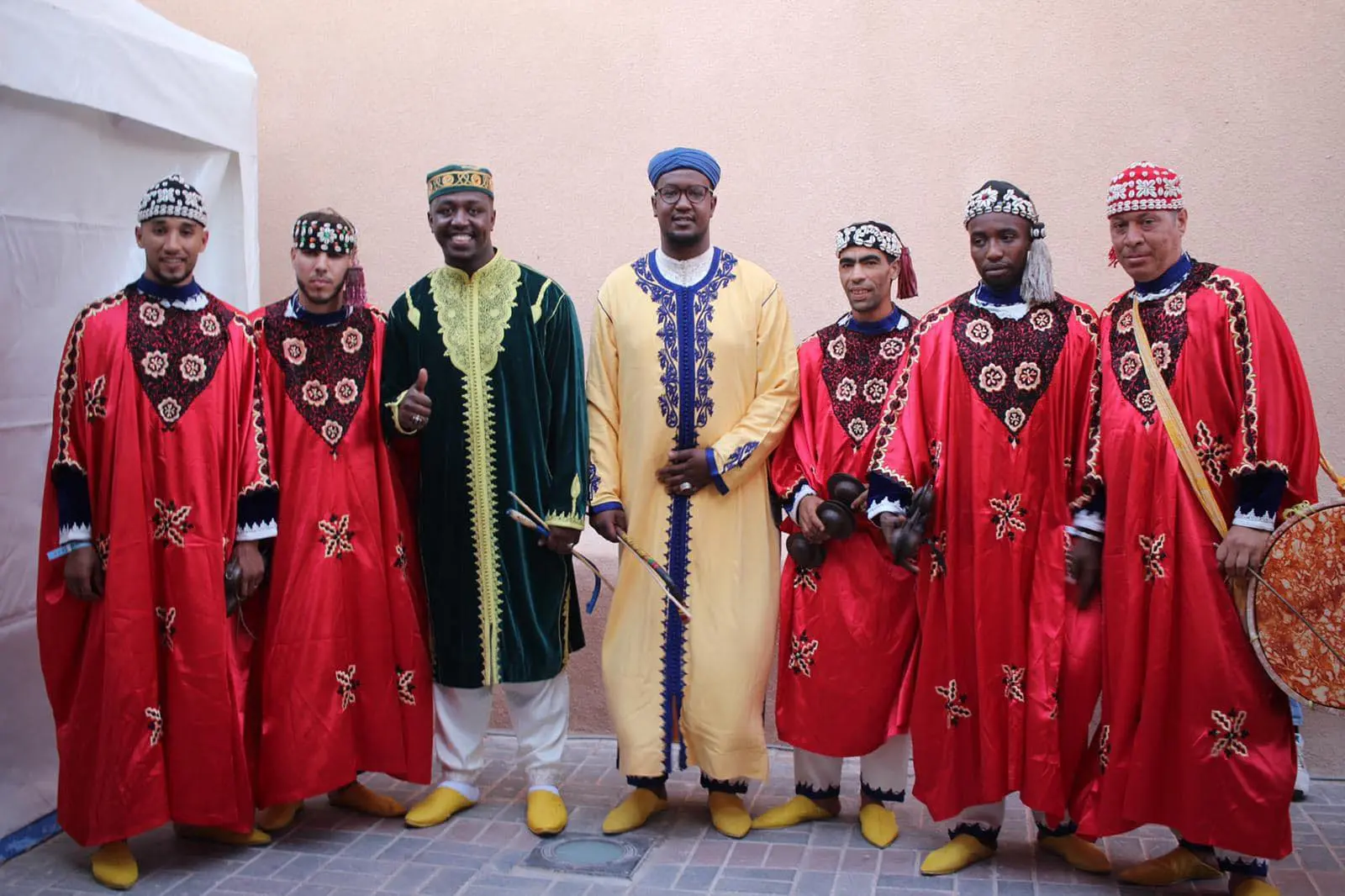
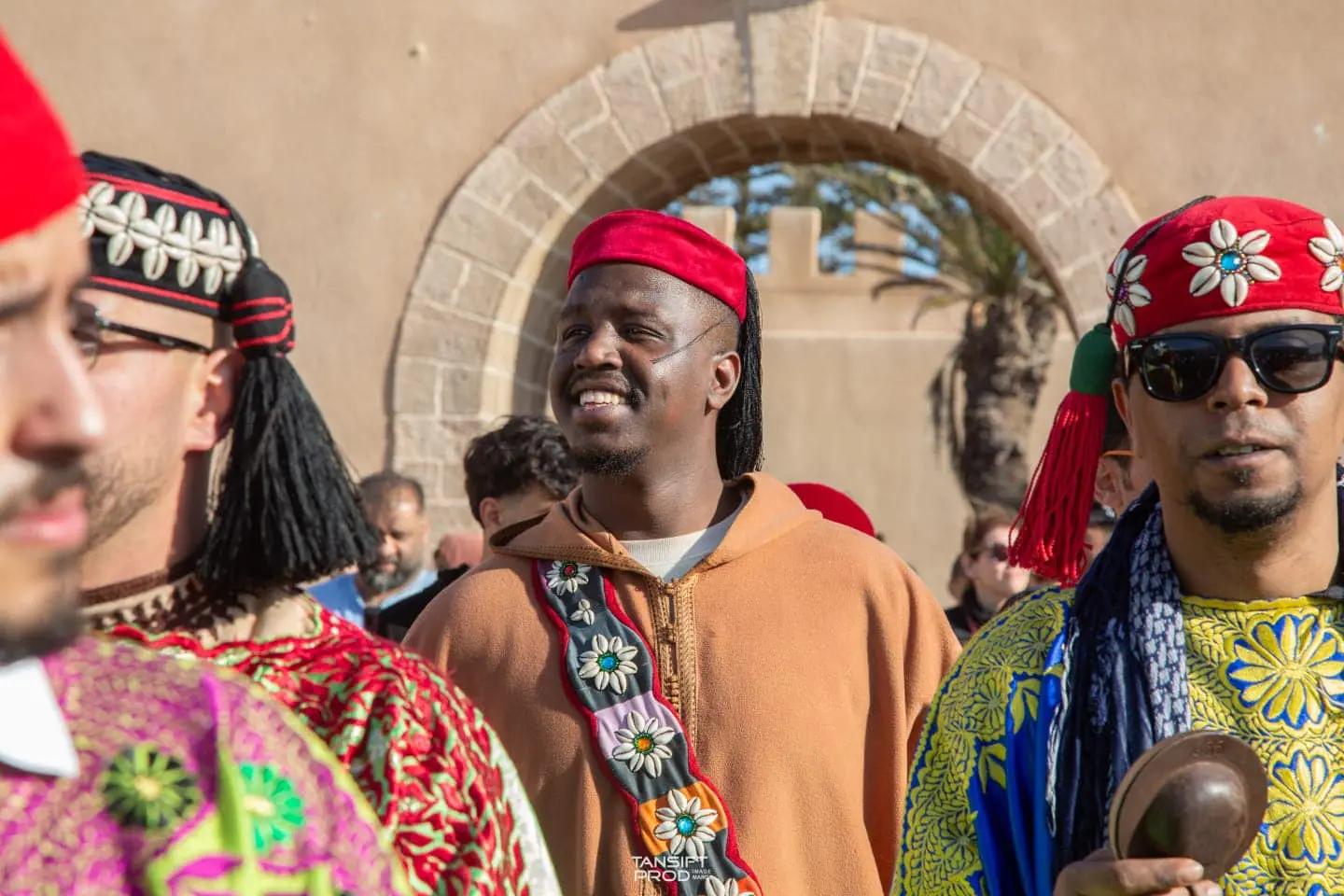
Now Houssam faces the same responsibility his father faced: ensuring the Gania lineage continues, that the sacred knowledge passes to the next generation. He teaches in Essaouira, not through lectures but through living — young musicians learning by participating in real lilas, absorbing the tradition through experience rather than instruction.
His fear is the same fear that haunted his father: that the secret rituals will be lost, that Gnawa will become mere entertainment, stripped of its healing power. His mission is to ensure that when he passes the guembri — as his father passed it to him — the recipient will understand not just how to play, but why.
Essential Listening
Smaoui
Ritual Recording
Deep traditional ceremony — the Gania style in its purest form, igniting the spiritual night.
Jangari
Festival Performance
The theatrical side — rhythmic power that commands festival stages while honoring tradition.
Jouf El Lil
Intimate Session
"Heart of the Night" — raw, intimate Gania sessions as played in the family home.
"Gnawa comes from the depths. It is not magic — it is a spiritual encounter."
— Maâlem Houssam Gania
The Tree Continues
In his final years, Mahmoud Gania watched as critics worried about the commercialization of Gnawa, the rise of “pseudo-maâlems” who could perform the movements but not channel the spirit. He saw his tradition threatened by spectacle and marketing.
But he also saw his son.
The Gania tree — that ancient, deep-rooted family that has given Gnawa some of its greatest masters — continues to bear fruit. Houssam carries his father’s guembri, his father’s style, his father’s blessing. But he also carries his own fire, his own vision, his own contribution to a lineage that stretches back centuries and, God willing, will continue for centuries more.
When Mahmoud Gania pressed that kiss to Houssam’s forehead in 2015, tears streaming down both their faces, he was not saying goodbye. He was saying: Continue.
And Houssam has.