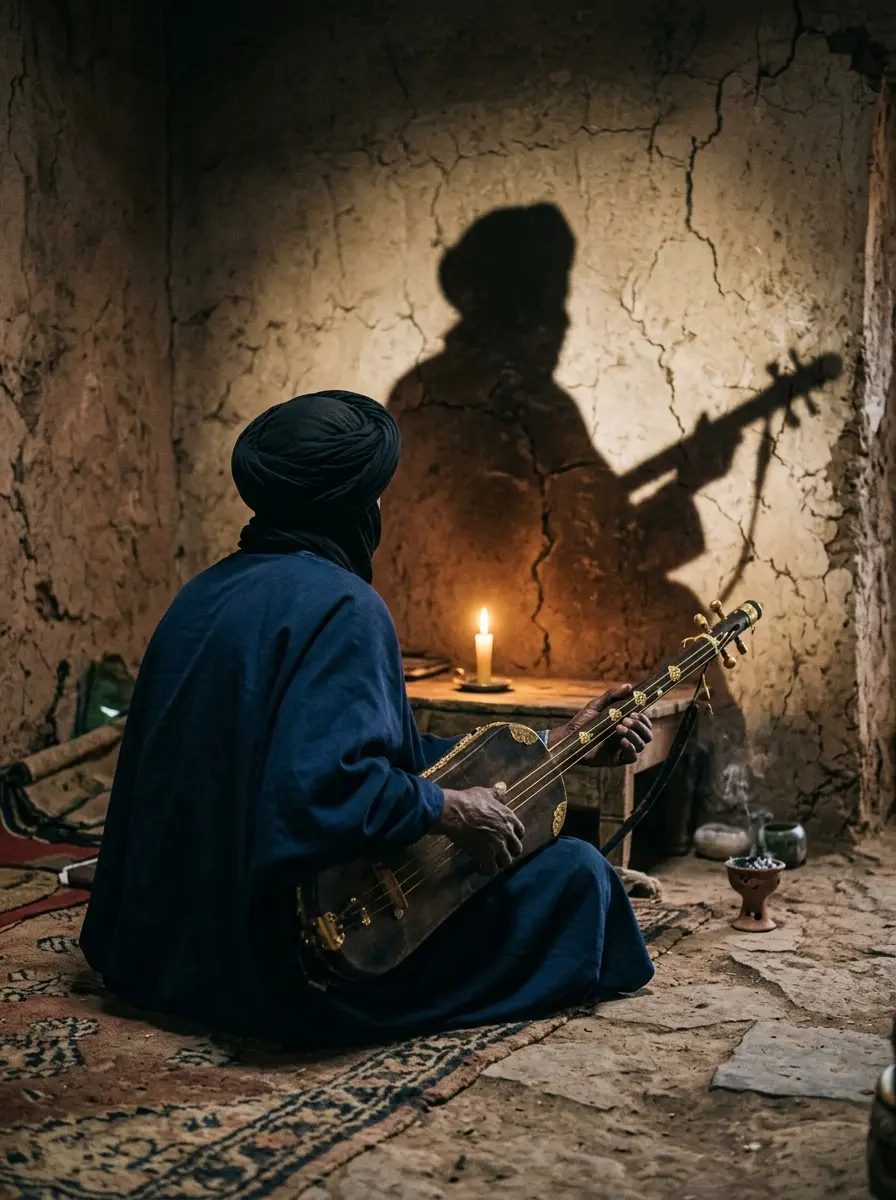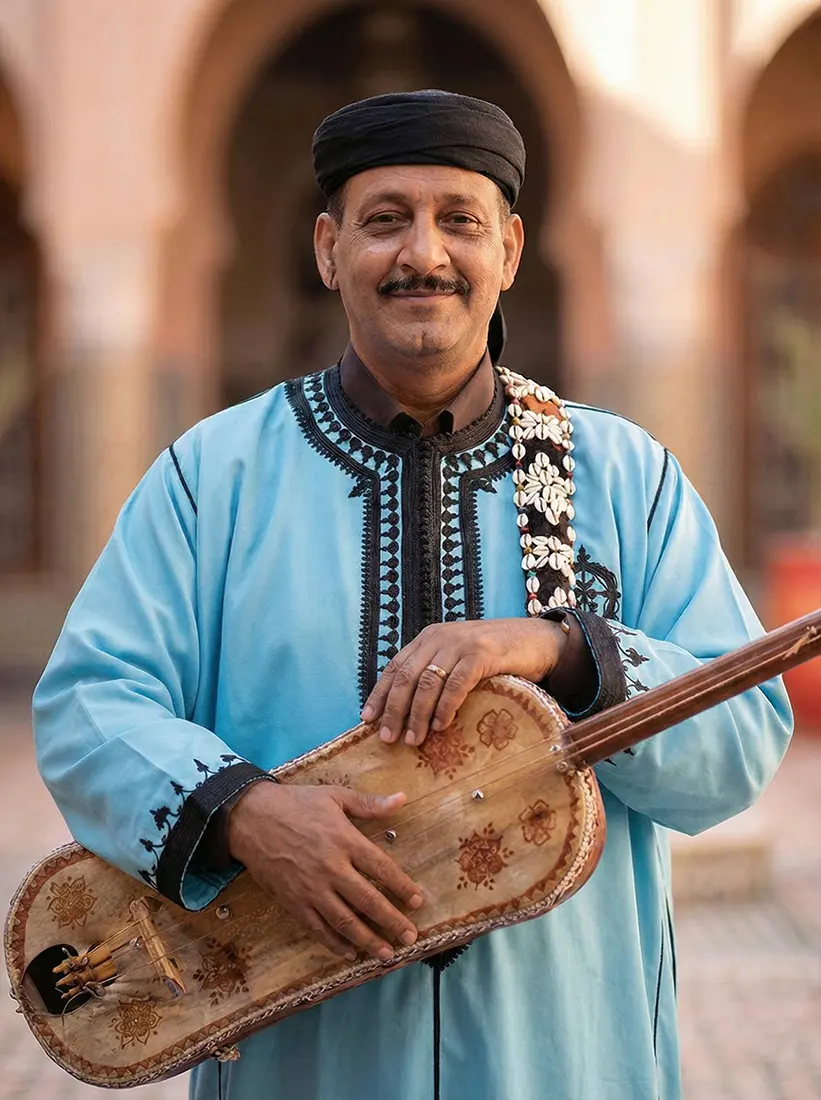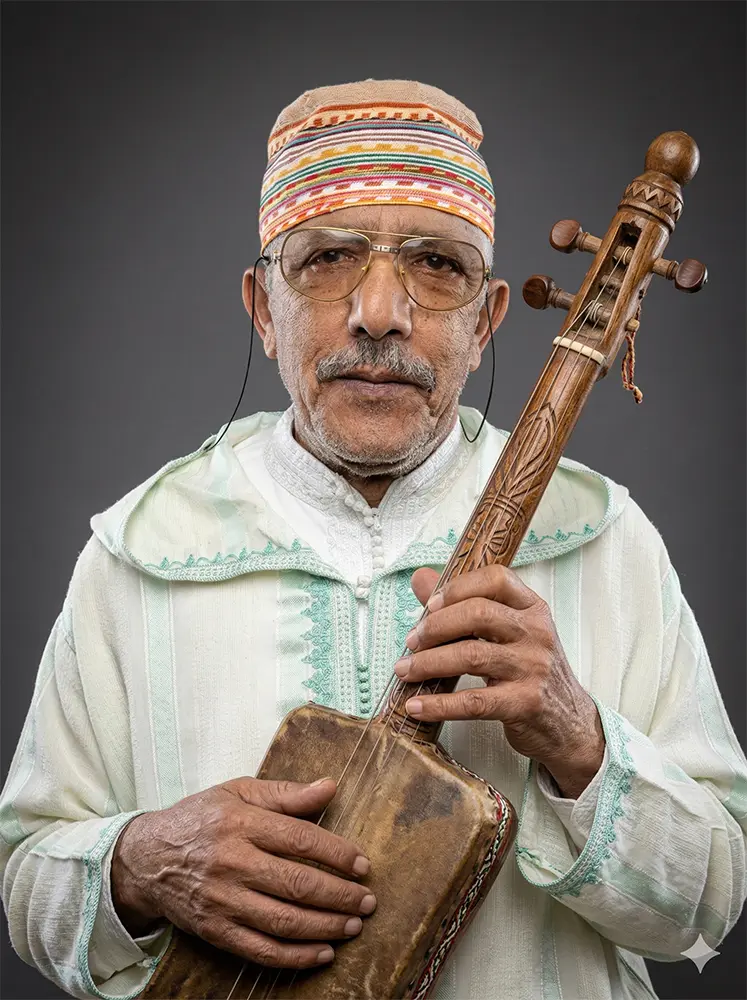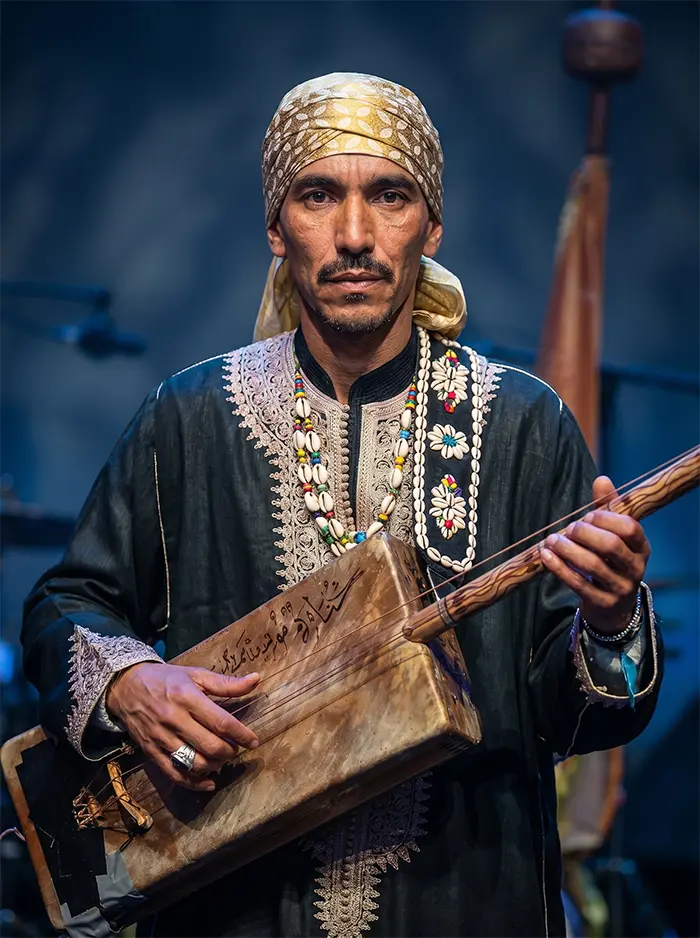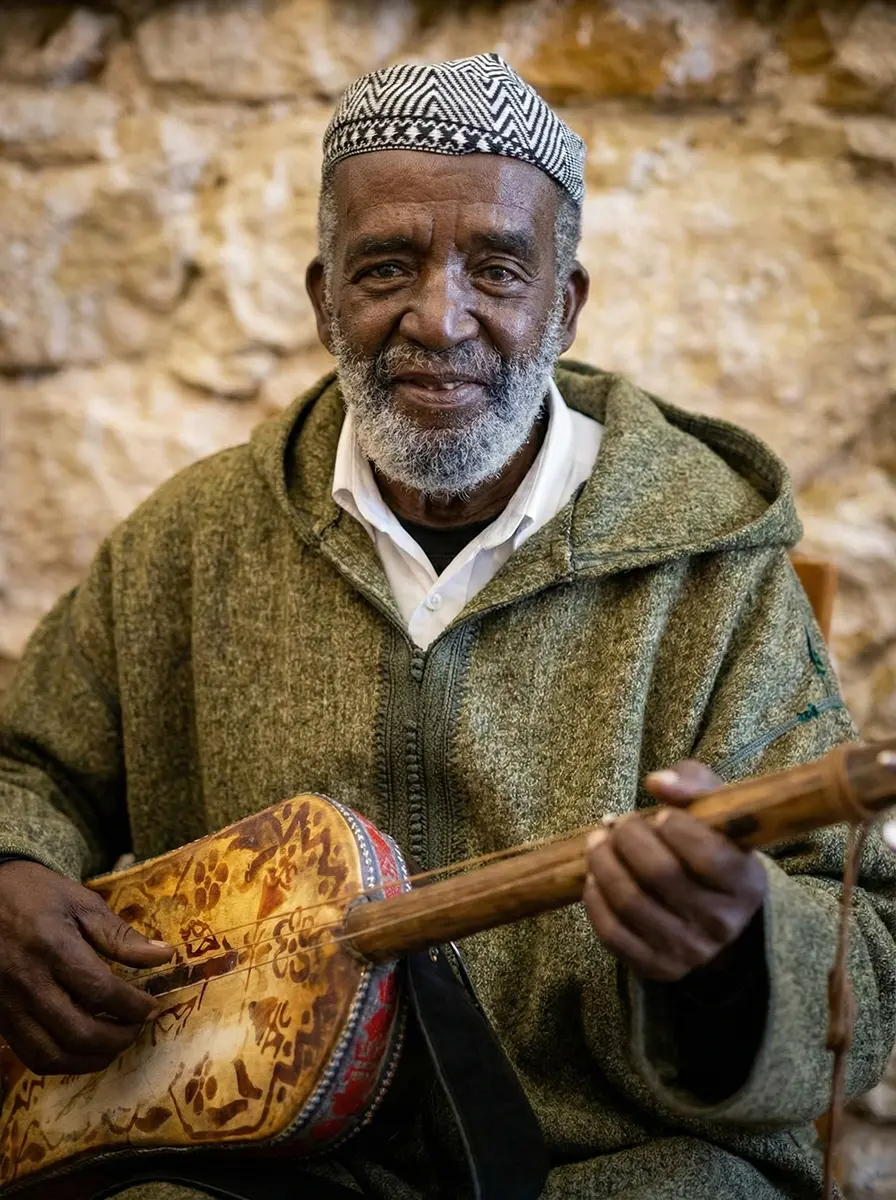
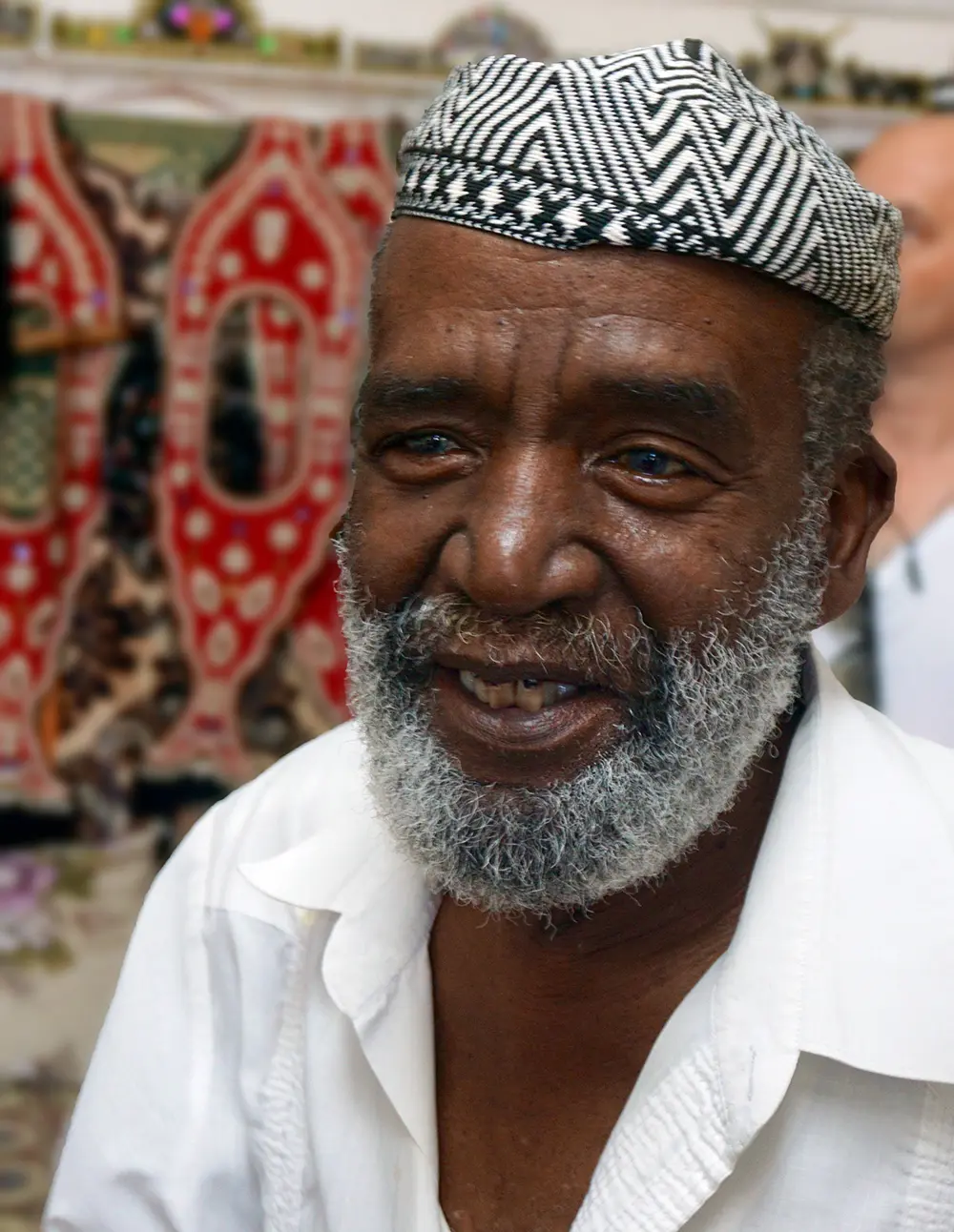
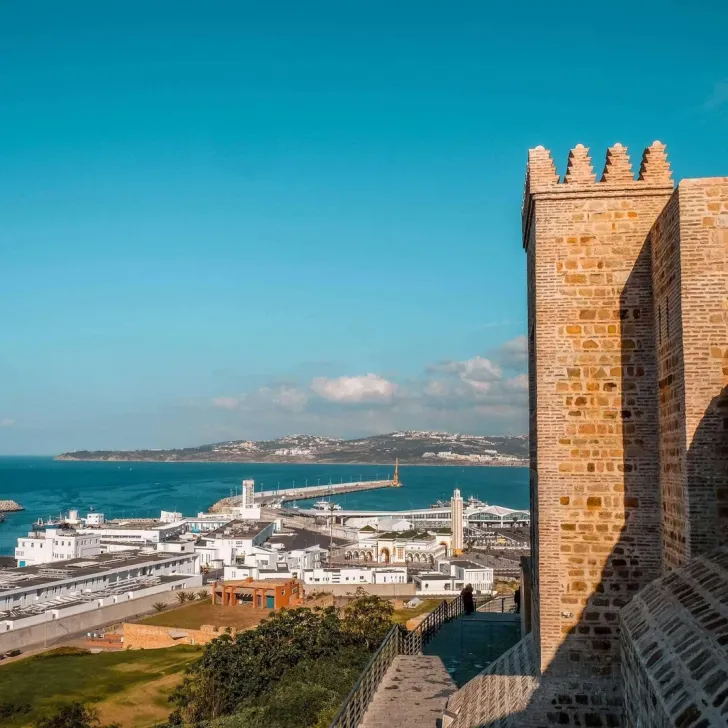
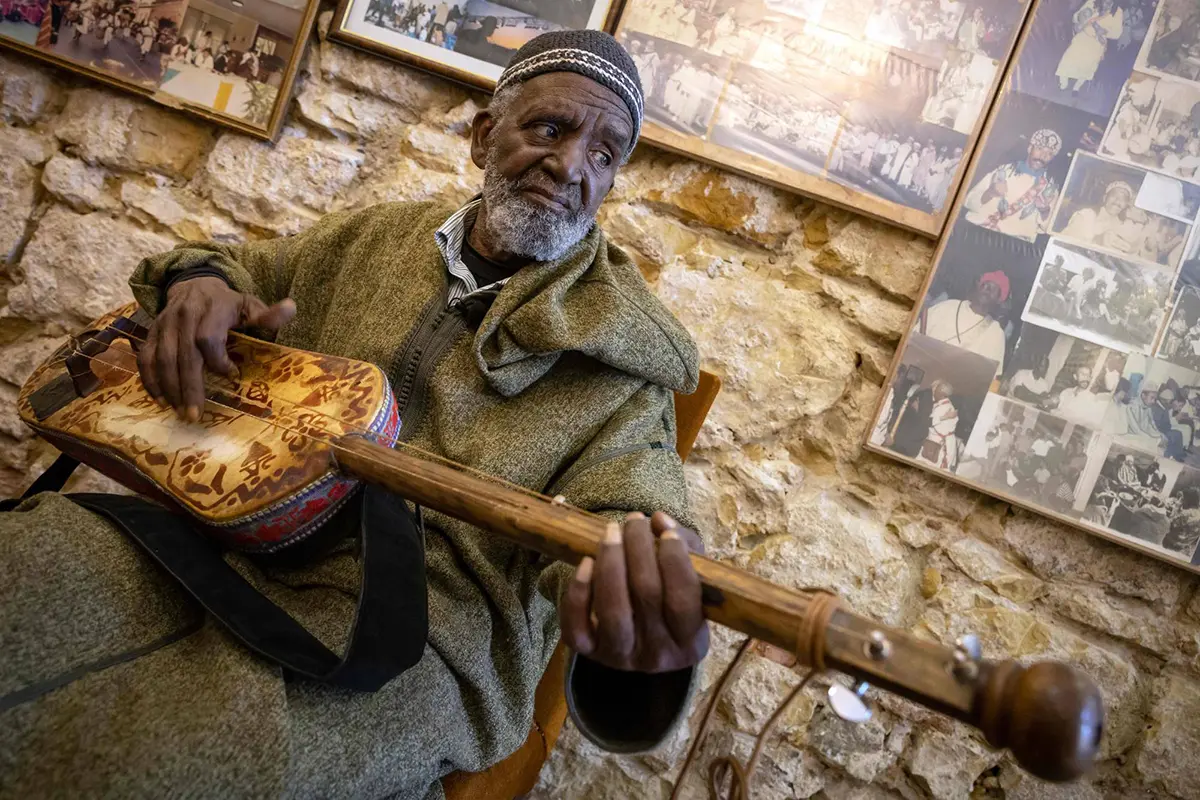
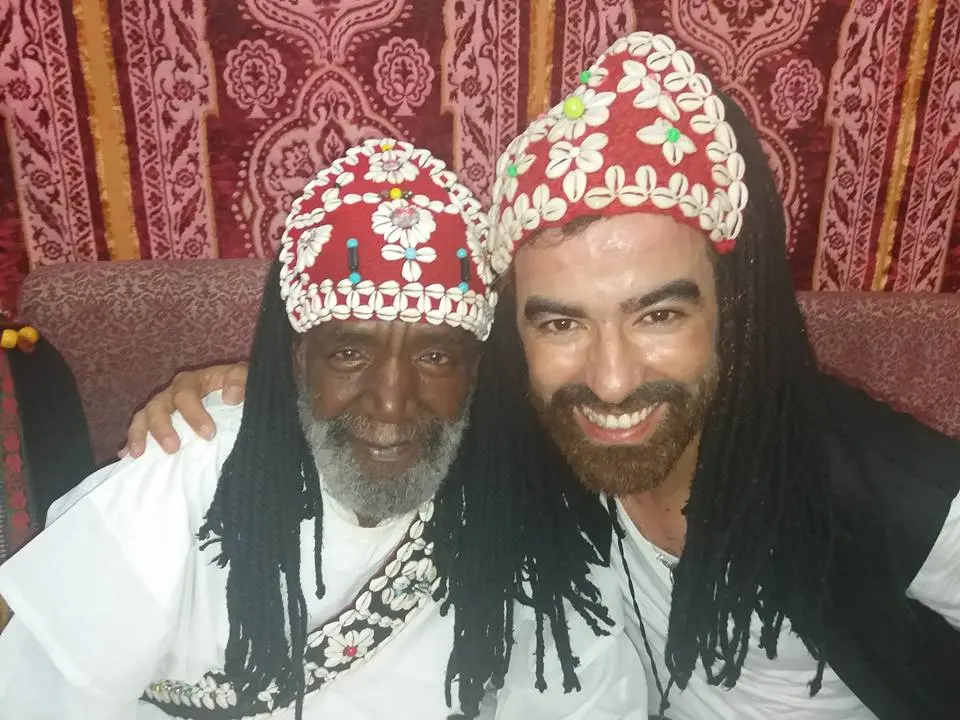
In the ancient alleys of Tanger’s Kasbah, where Atlantic winds collide with Mediterranean waves, stands a man whose features have been carved by time and salt. He holds his guembri the way an engineer holds precision instruments. Maâlem Abdellah Boulkhair El Gourd is the electrical engineer who discovered that true light does not flow through copper wires, but through hemp strings and human souls.
Born in 1947, he became not merely a musician but a healer — a living bridge connecting the deep Sufism of Gnawa with the freedom of American jazz. His legendary partnership with Randy Weston changed the face of world music forever.
A Childhood in Jnan Kaptan
Abdellah was born in the heart of old Tanger, in the Jnan Kaptan neighborhood. He did not need to search for Gnawa — Gnawa was the air he breathed. He grew up in a true Gnawa household, where music was not performed for entertainment but practiced as a daily ritual of life and death, joy and healing.
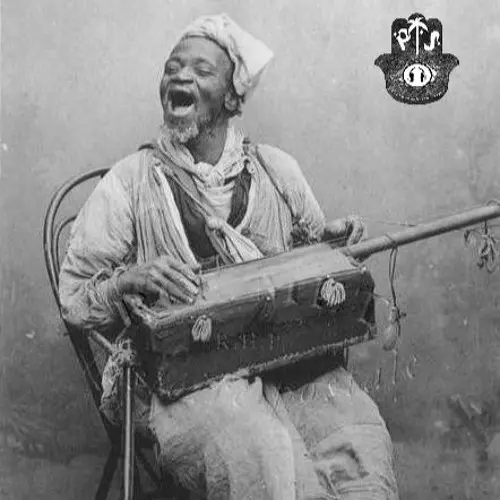
From childhood, he sat in the presence of elder masters, watching how a small room transformed into a vast universe the moment the qraqeb began to spin. There he learned the first and most important lesson: “Gnawa is not spectacle. Gnawa is faith.”
The Mystical Engineer
While studying electrical engineering, Abdellah simultaneously studied the engineering of souls. This dual formation gave him a unique advantage: an organized mind that understands structure, and a wandering spirit that comprehends the metaphysical.
He saw no contradiction between science and Sufism. Both, he believed, search for hidden truth.
1967: When Jazz Met Gnawa
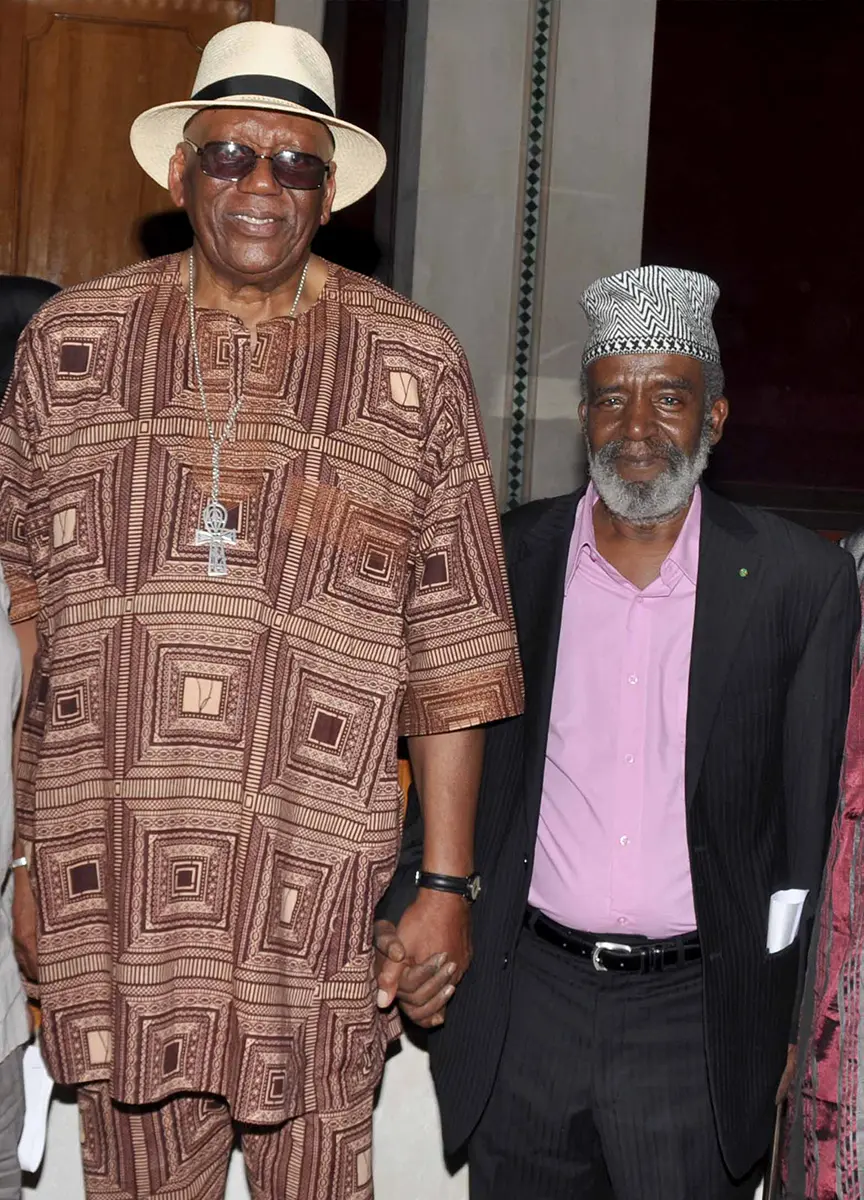
The moment that divided El Gourd’s life into “before” and “after” came in 1967. In a Tanger café, he met an American jazz giant named Randy Weston. It was not a passing encounter — it was a cosmic collision.
Randy saw in Abdellah “the source” he had been searching for. Abdellah saw in Randy “the branch” returning to its roots. The Gnawa master realized his mission was not only preserving Tanger’s heritage, but transmitting it to the world — healing the severed memory between Africans and Black Americans.
At that time, Gnawa was viewed as marginal folklore. But Abdellah insisted it was sacred music deserving study in universities and performance in opera houses.
The Tanger Sound: Circular Waves
Abdellah El Gourd’s style differs from Essaouira or Marrakech. It is a “northern” (Tanjawi) approach — precise and rigorous, yet carrying the sea’s flexibility. His rhythm is circular and heavy, revolving around the listener to create a halo of protection.
The Generator
He uses the guembri not just as rhythm, but as an energy generator — his electrical background showing — tuning the frequencies of space itself.
The Precision
Northern style demands exactitude. Every note placed with mathematical certainty, yet flowing with oceanic grace.
The Wisdom
His voice is not thunderous but wise — telling stories rather than shouting them, guiding rather than commanding.
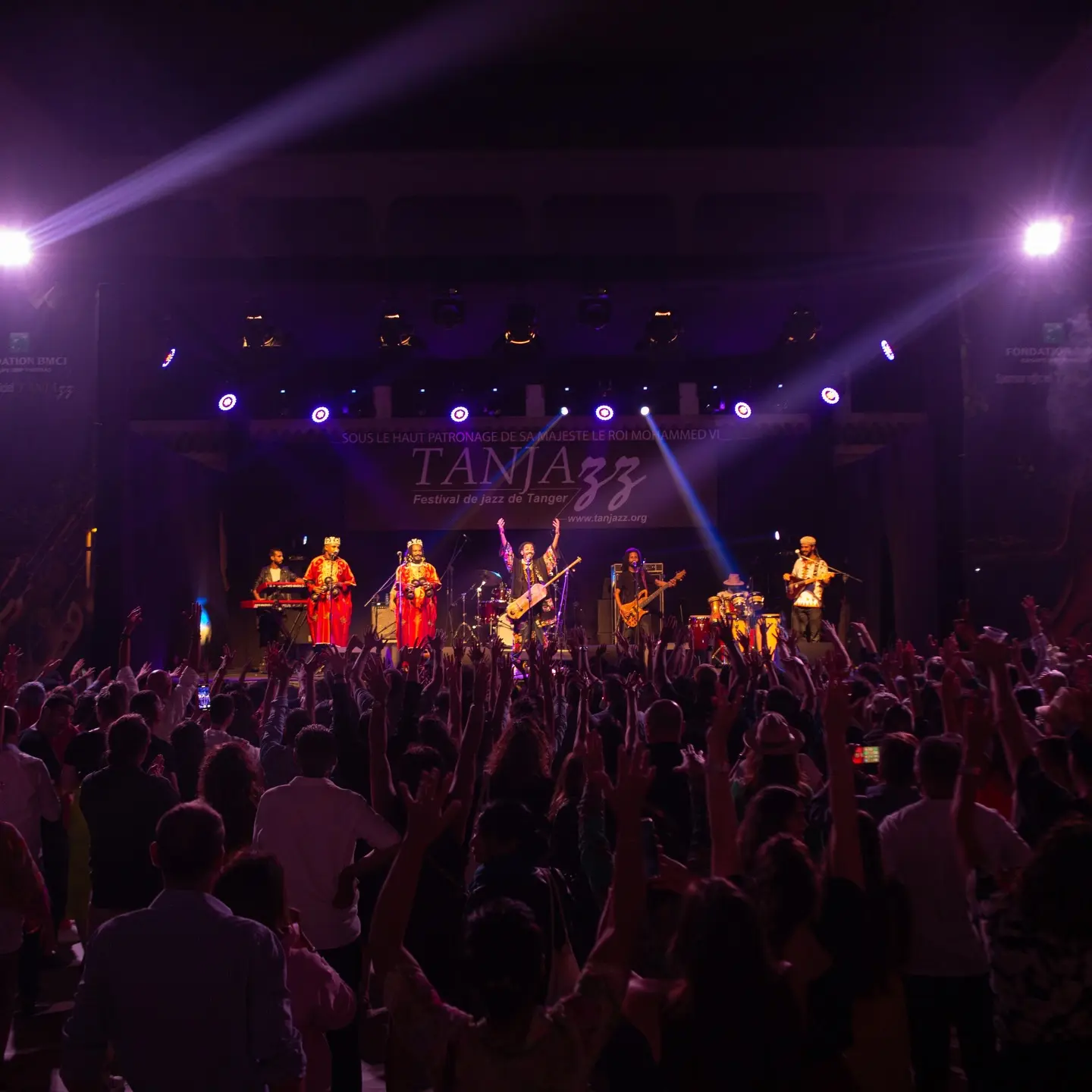
When he takes the stage, he does not transform into a showman. Even at international jazz festivals, he maintains the structure of the lila: the opening, the warming, then the gradual ascent toward jedba. He plays to heal, whether the audience sits in a Tanger zawiya or a Paris concert hall.
Ambassador of African Spirit
His global journey began early. In 1972, he participated with Randy Weston in the first Jazz Festival in Tanger — a historic moment documenting the official marriage between jazz and Gnawa. From there, his travels expanded: Europe, America, Canada.
He never traveled as a tourist, but as a cultural ambassador. In 1996, their collaborative album “The Splendid Master Gnawa Musicians of Morocco” received a nomination for Best World Music Album — recognition that his work was not folklore, but high art.
Dar Gnawa: The Living Museum
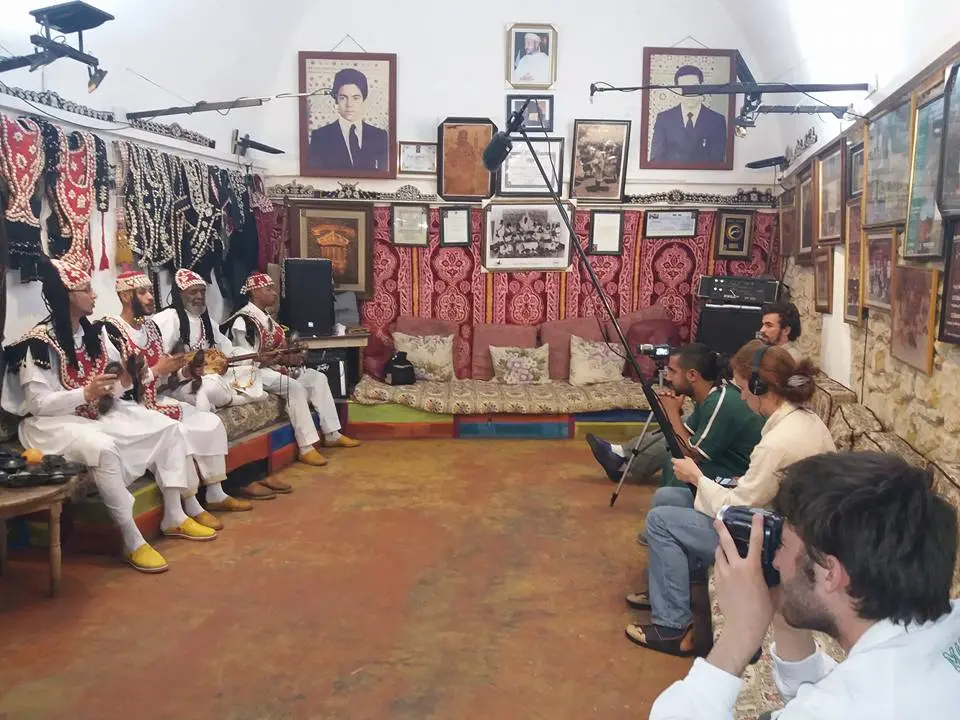
In 1980, Abdellah realized his greatest dream: founding “Dar Gnawa” in Tanger. He did not want a formal school, but a cultural center, museum, and sanctuary. Today it remains one of the few places in the world where researchers and musicians can find authentic Gnawa knowledge, far from tourist consumption.
Engineer of Human Bridges
El Gourd’s fusion philosophy is simple and profound: “We do not mix music. We unite souls.”
With Randy Weston — A partnership spanning 50 years. Together they produced masterpieces like “Spirit! The Power of Music.” Randy played piano as if it were a guembri; Abdellah played guembri as if it were a piano.
With Archie Shepp — Collaboration with the saxophone giant proved that free jazz’s scream could be embraced by Gnawa’s calm.
With Akosh S — Avant-garde experiments demonstrated El Gourd’s ability to adapt to the most complex musical forms.
He refuses fusion that touches the essence. He always says: “You can change the clothes, but you cannot change the body.” Jazz, for him, is not an intruder — it is a prodigal son returning to his African mother’s embrace.
The Teacher Who Teaches Life
At Dar Gnawa, Abdellah does not only teach students to play. He teaches them the ethics of Gnawa: humility, patience, and service to others. He fears deeply the “touristification” of Gnawa and its transformation into commodity, so he insists on strict traditional teaching.
His true legacy is not only in albums, but in the young generations who graduated from his house and now carry the torch in Tanger and beyond. His participation in International Jazz Day 2024 was a message of continuity: the master is still here, still giving.
Essential Listening
Chalabati
With Randy Weston
A stunning dialogue between Weston's piano and El Gourd's guembri. Not just music — a conversation between continents.
Lalla Mira
Ritual Recording
Experience the healing power. Abdellah in his role as master of the lila. Rhythm ascending slowly, taking you on an inner journey.
Blue Moses
Jazz-Gnawa Version
Randy Weston's famous song reimagined by El Gourd — a global anthem uniting jazz harmony with desert rhythm.
"Gnawa music is a healing force that unites the body and soul, connecting us to our African ancestors."
— Maâlem Abdellah El Gourd
For the engineer Abdellah, music is not for dancing. It is maintenance — necessary servicing for the human soul, recharging its energy and reconnecting it to its original source.
His words are few but precise as mathematical equations. In Dar Gnawa, surrounded by instruments and incense, he continues to wire ancient souls to modern hearts — proving that the truest current flows not through copper, but through the strings of a guembri held by steady hands that have never stopped healing.