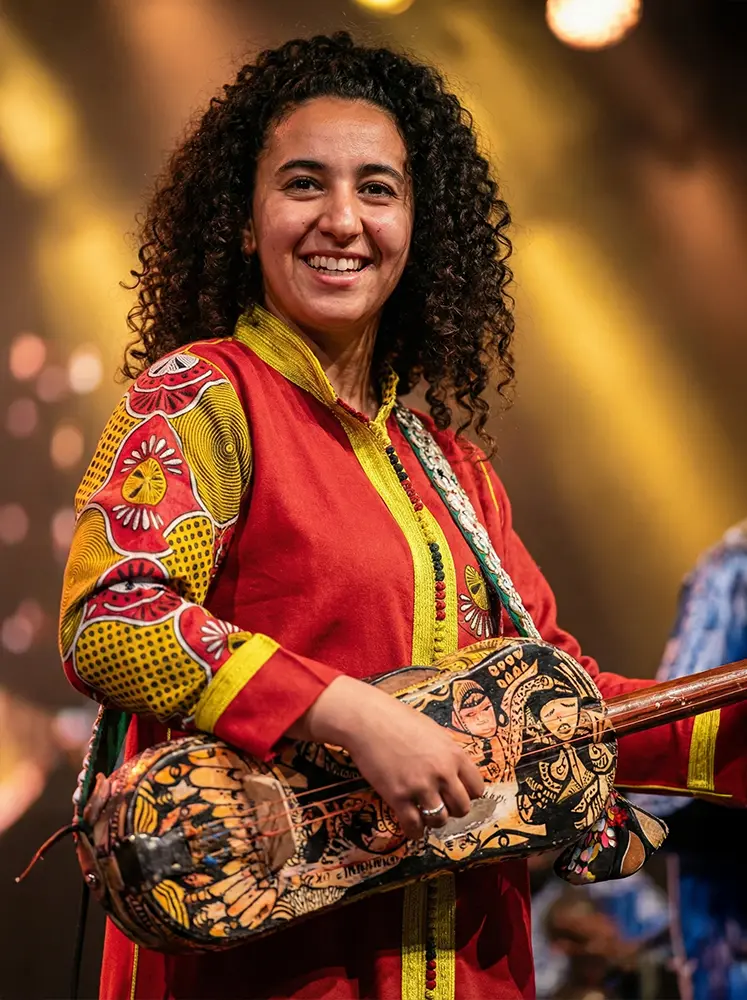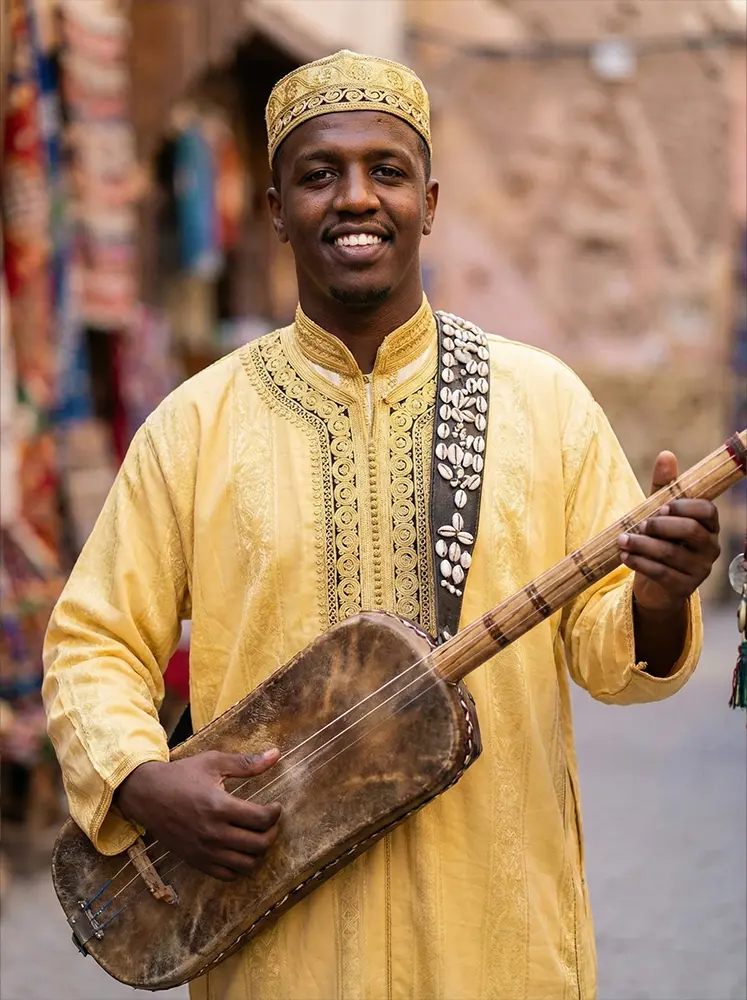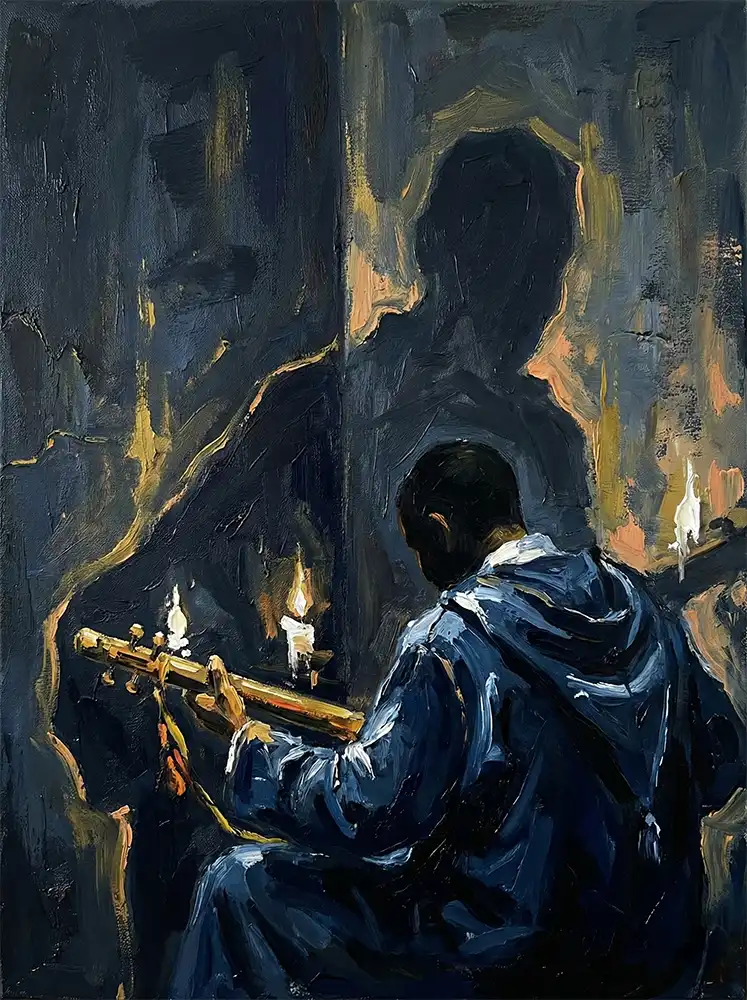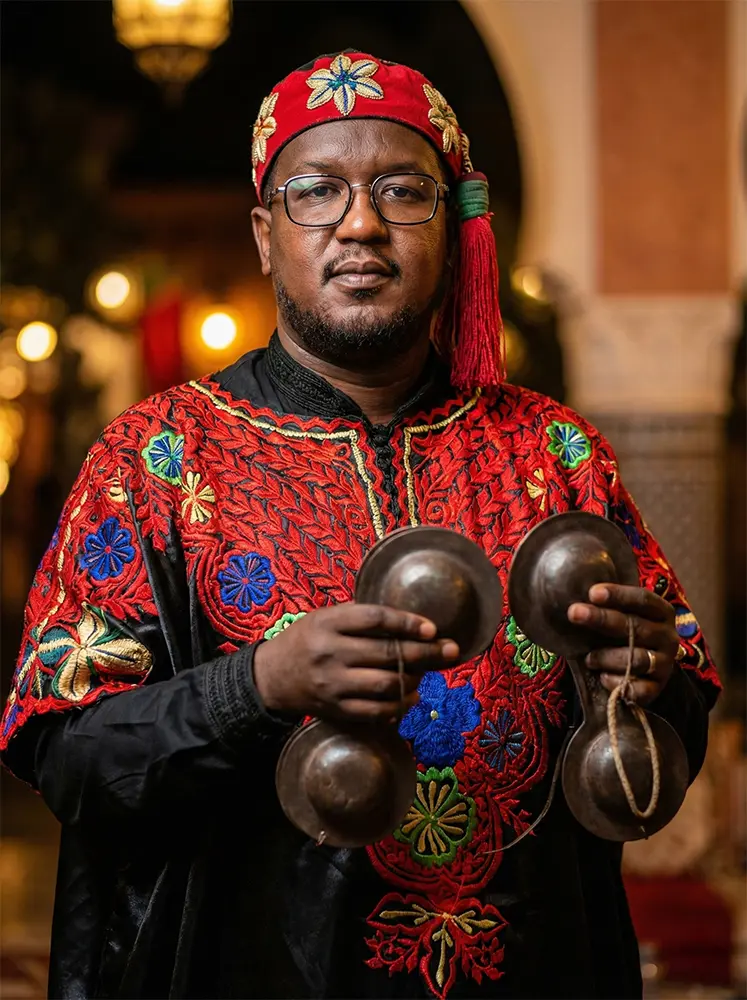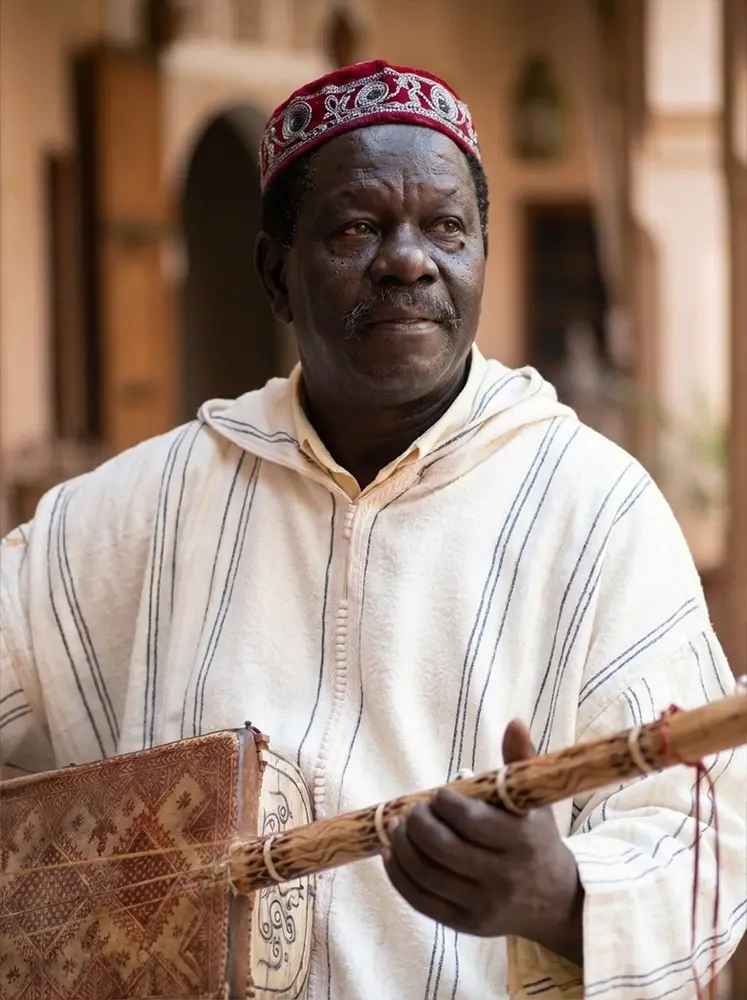
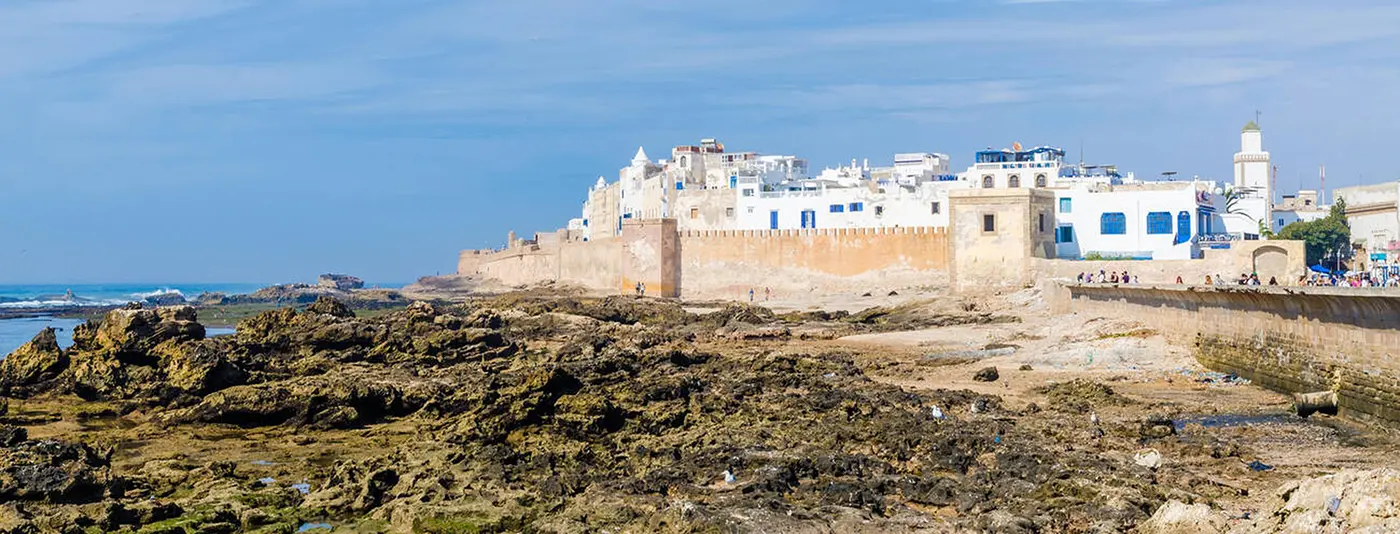
In the windswept city of Essaouira, where the Atlantic crashes against ancient ramparts and the cry of gulls mingles with the clatter of qraqeb, one face became synonymous with Gnawa itself. Maâlem Mahmoud Guinea (1951-2015) was not merely a musician. He was the axis around which the modern Gnawa world revolved. With his serene dark features, his ever-present smile, and a guembri that seemed to grow from his body, he represented the purest expression of the Essaouira school: deep, unhurried, and infinitely spiritual.
He was the godfather who opened the gates of Essaouira to the world, and in doing so, carried Gnawa from the shadows of the zawiya to the spotlights of global stages, without ever losing the thread of the sacred.
Blood and Memory: The Guinea Lineage
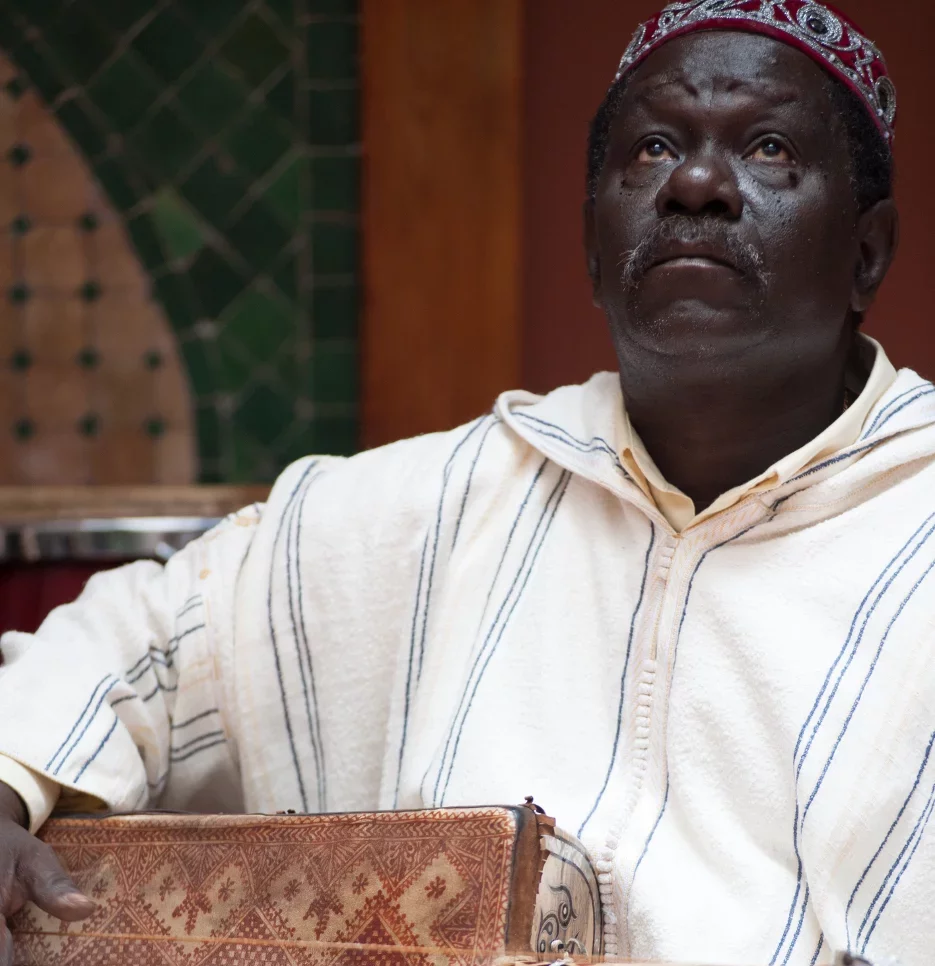
The story of the Guinea family is the story of Gnawa compressed into three generations. Mahmoud’s grandfather was a slave, sold in the Saharan trade routes, brought from Mali carrying nothing but the rhythms of Black Africa in his memory. The family settled in Essaouira, becoming one of the city’s great Gnawa dynasties.
Mahmoud was born in 1951 into a household saturated with spirit and sound. His father, Maâlem Boubker Guinea, was a legend in his time. His mother, Aicha Qebral, was a renowned moqaddema, a spiritual overseer who conducted the healing dimensions of the lila. In this home, there was no boundary between daily life and music. The rhythm of the qraqeb was the household’s heartbeat; the scent of incense was the air of childhood.
The Boy Who Inherited the Guembri
Mahmoud began playing the guembri at twelve years old. He learned not in a school but in the rahba — the ceremonial space — surrounded by living ritual. He watched his father, stealing notes with his eyes and ears, absorbing the tagnaouitt (the secrets of the craft) not as musical notation but as states of being.
By twenty, he had mastered the demanding repertoire, and began leading lilas as a young maâlem, carrying the weight of his Malian ancestors as a beautiful burden on his shoulders. But in a family crowded with masters, his brothers Mokhtar and Abdellah were also maâlems, and Mahmoud had to find his own voice.
He decided his voice would be the voice of Essaouira itself.
The Essaouira Sound: Heavy Velvet
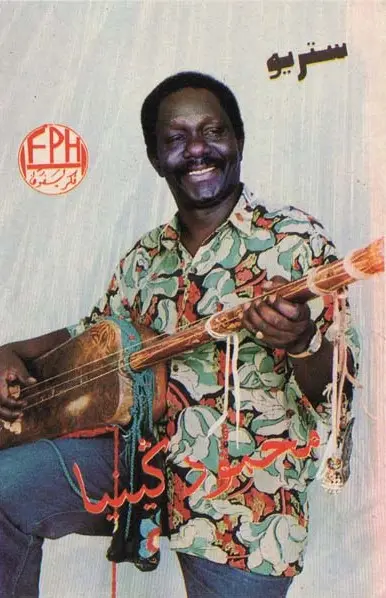
The Essaouira school, as embodied by Mahmoud Guinea, is unmistakable. Where the Marrakech school tends toward speed and virtuosity, the Saouiri style favors depth, weight, and unhurried spirituality.
The Voice
A husky, deep guembri tone paired with vocals that chanted rather than shouted, as if whispering to the spirits rather than summoning them.
The Rhythm
Circular patterns that expand and contract, creating the hypnotic state of jedba (trance) through patient, inexorable repetition.
The Clarity
Exceptionally clean playing, every note audible and distinct, which made him the favorite of sound engineers and Western producers.
Master of Fusion: The Open Door
Mahmoud Guinea did not change tradition. He made it flexible. When playing with Western musicians, he held the core rhythm, the spine, and allowed them to improvise around it. He was the fixed earth; they were the birds circling above.
His philosophy was simple: Gnawa is a mother, and a mother welcomes everyone.
His landmark collaborations became masterclasses in cross-cultural dialogue:
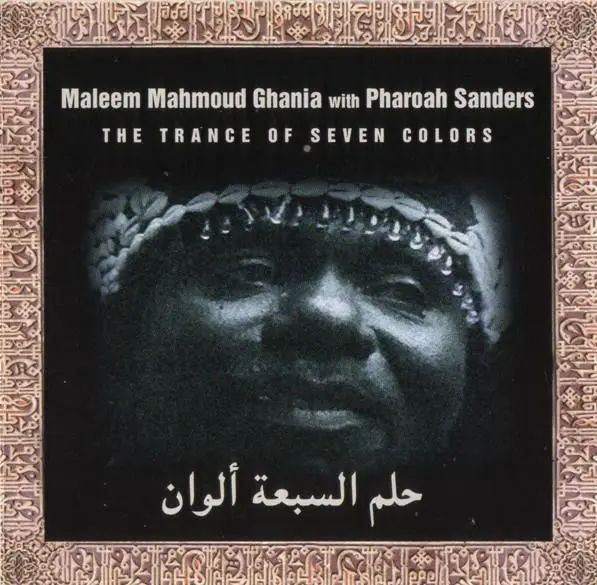
With Pharoah Sanders (1994) — On The Trance of Seven Colors, American free jazz met African spirituality. The saxophone screamed; the guembri answered with calm.
With Peter Brötzmann and Hamid Drake (1996) — The Wels Concert proved Gnawa could match avant-garde jazz note for note.
With Floating Points and James Holden (2015) — On Marhaba, recorded shortly before his death, he merged his ancient art with modern electronics, proving his music could never age.
King of the Festival
Mahmoud Guinea’s name became inseparable from the Essaouira Gnaoua and World Music Festival. For two decades, he was its face, its host, its soul. He welcomed giants like Carlos Santana, Randy Weston, and Will Calhoun, not as a subordinate meeting stars, but as a king receiving guests in his own palace.
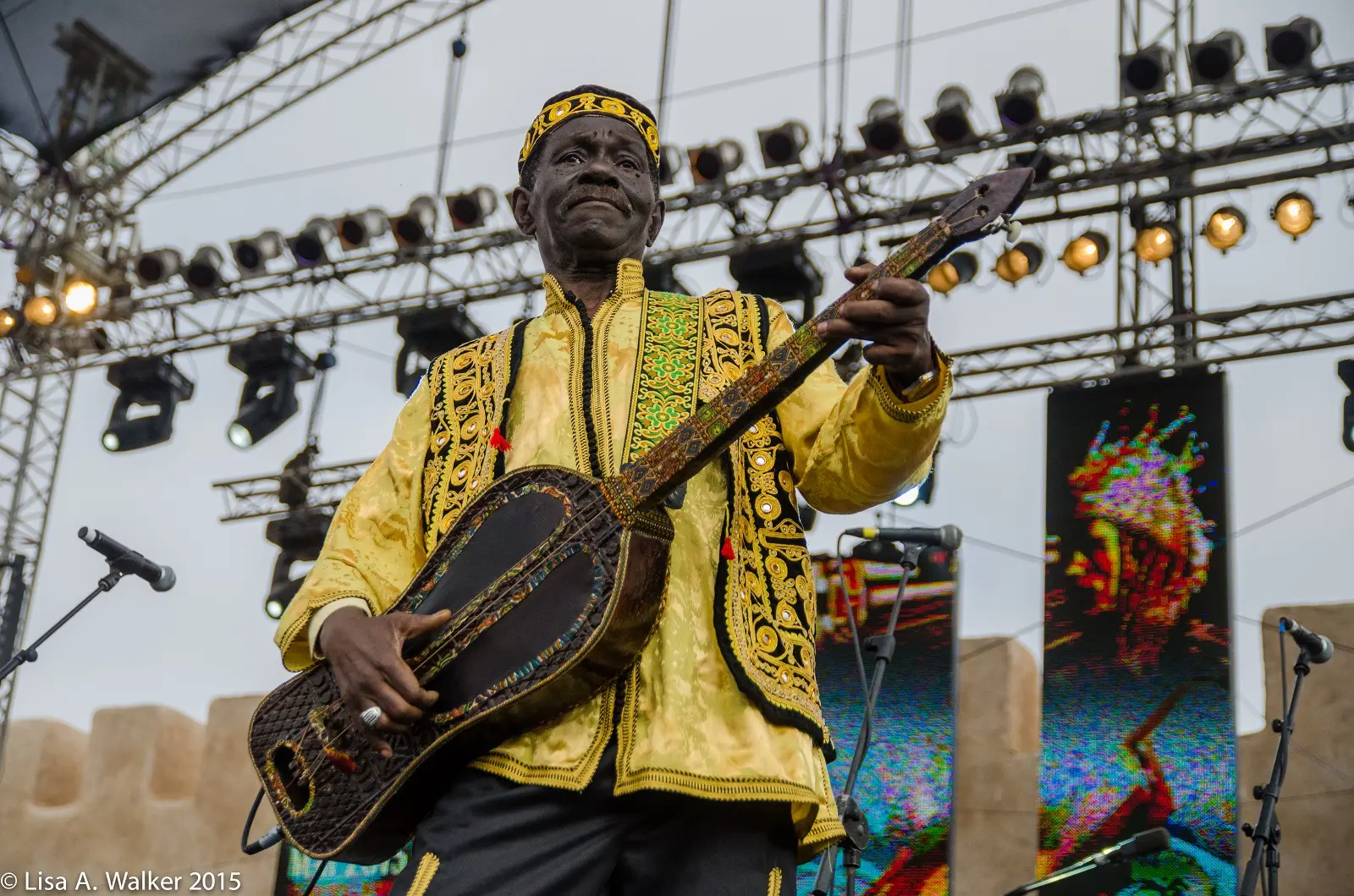
In 2015, months before his death, ravaged by prostate cancer, he climbed onto the festival’s closing stage. His body was frail, but his spirit soared. The crowd chanted his name. He delivered one of the most emotional performances in festival history, a farewell disguised as a concert.
The Passing of the Torch
Mahmoud Guinea died on August 2, 2015. His funeral in Essaouira was attended by the King’s advisor, the city’s mayor, and artists from across the globe. King Mohammed VI sent a condolence message describing him as “the accomplished master” and “the pioneer”, recognition unimaginable for Gnawa artists just one generation earlier.
But the most immortal moment came before his death, on stage. In his final concert, before thousands, Mahmoud handed his guembri to his son Houssam Guinea. It was not a theatrical gesture. It was a public ritual of transmission, the passing of ta’amalimt.
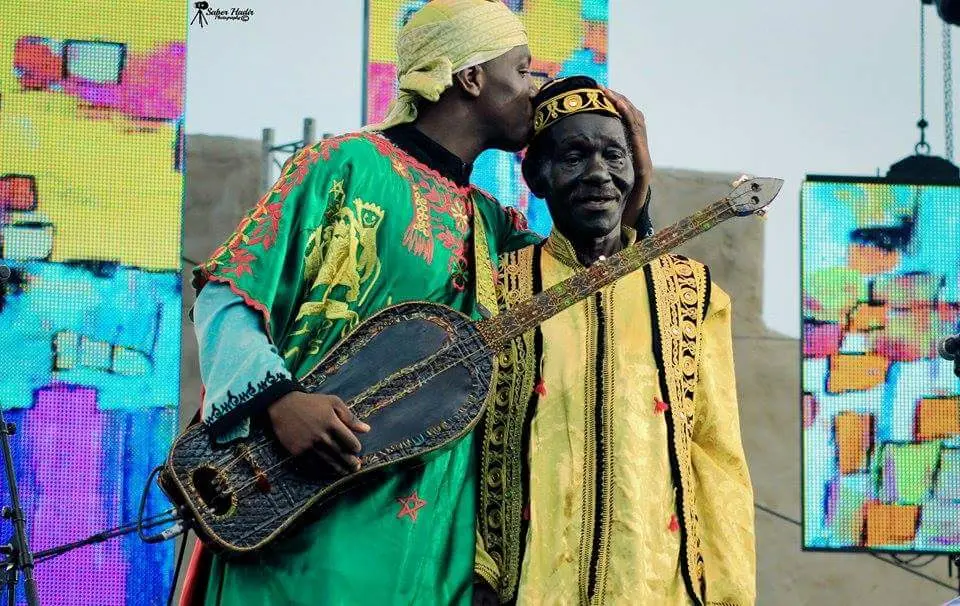
Today, his sons Houssam and Hamza carry the flame. The Guinea dynasty continues. Mahmoud left behind a clear message: Gnawa is not a museum. It is a living tradition, and a bridge open to all the world.
Essential Listening
The Trance of Seven Colors
1994 • With Pharoah Sanders
The album that introduced Gnawa to global music libraries. A masterpiece of spiritual fusion.
La Ilaha Illa Allah
Live Recording
Pure, traditional Mahmoud. Clear voice, precise qraqeb, and spiritual atmosphere straight from the zawiya.
Marhaba
2015 • With Floating Points
The modern farewell. Ancient rhythms meeting electronic synthesis in stunning harmony.
"We do not change Gnawa to please the world. We invite the world to enter our state."
Maâlem Mahmoud Guinea
His smile was his philosophy. In the depths of pain and at the heights of glory, he wore the same serene expression. He did not speak much, but his music said everything. He lived and died believing that his music was medicine, and that his mission was to heal hearts, whether in a private lila in Essaouira or on a world stage in Tokyo or Paris.
When the guembri fell silent on that August day in 2015, the world lost a master. But the door he opened remains wide open, and through it, the spirits of Africa continue to dance.