Discover how Gnawa music varies across Morocco's regions — from the coastal rhythms of Essaouira to the deep spiritual trance of Marrakech and the Andalusian-influenced north.
To the untrained ear, all Gnawa music might sound the same — the deep pulse of the guembri, the metallic chatter of qraqeb, voices calling to spirits across centuries. But spend time with the masters, travel from Essaouira’s windswept coast to Marrakech’s ancient medina to Tangier’s northern hills, and you will discover a truth that transforms your listening: Gnawa is not one tradition, but many.
Each major city has developed its own “school” — distinct approaches to rhythm, melody, and spiritual practice that reflect local history, geography, and the personalities of the great Maâlems who shaped them. Understanding these differences is like learning to distinguish Burgundy from Bordeaux, Chicago blues from Delta blues. The family resemblance is clear, but the nuances are everything.
Are All Gnawa Styles the Same?
The short answer: absolutely not.
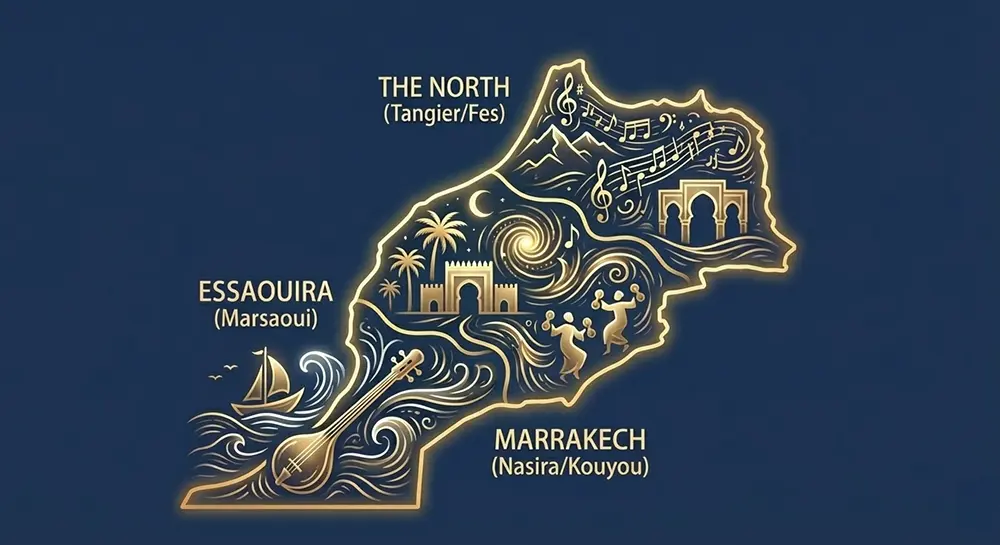
Gnawa music varies significantly across Morocco’s regions, reflecting centuries of local development, different relationships with neighboring traditions, and the unique spiritual geography of each area. The major “schools” are:
- Marsaoui — The coastal style of Essaouira (and Casablanca)
- Marrakchi — The deep, trance-focused style of Marrakech
- Shamali/Gharbaoui — The northern style of Tangier, Fez, and Rabat
These aren’t arbitrary categories. They represent genuine differences in how the guembri is played, how rhythms are structured, which songs are emphasized, and even how the spiritual ceremonies unfold.
The Marsaoui Style: Essaouira & Casablanca
The Sound of the Atlantic
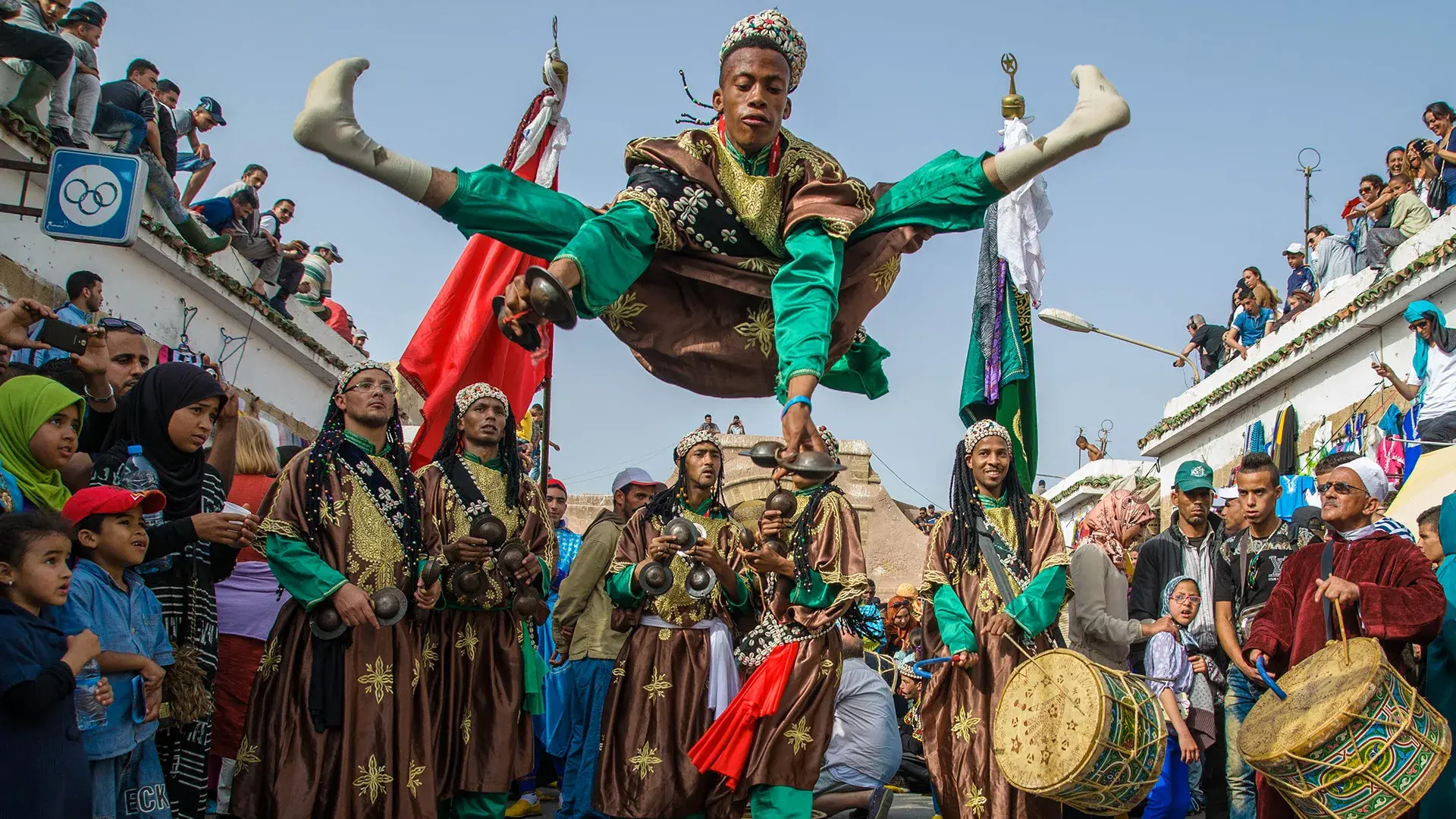
Essaouira — the wind city, the port once called Mogador — is the spiritual capital of Gnawa. The Marsaoui style that developed here carries the energy of the ocean, the legacy of the slave trade that once passed through its harbor, and the influence of the legendary Gania family whose name has become synonymous with Gnawa excellence.
What Makes Marsaoui Distinctive?
Rhythmic Energy: Marsaoui tends toward faster, more energetic rhythms. The Atlantic wind seems to blow through the music — there’s a brightness, an openness, a forward momentum that distinguishes it from inland styles.
Melodic Guembri: The guembri playing emphasizes melody alongside rhythm. Maâlems like Mahmoud Gania developed intricate melodic patterns that dance above the bass pulse, creating a more “singing” quality to the instrument.
Festival Spirit: Essaouira’s role as host of the annual Gnaoua World Music Festival has shaped its style toward accessibility. Marsaoui performances often have a celebratory, inclusive energy that welcomes newcomers while satisfying traditionalists.
The Gania Legacy: The Gania family — Mahmoud, Mokhtar, Abdellah, and now Houssam — has defined Marsaoui for generations. Their approach emphasizes the Sudani repertoire, reflecting the family’s heritage from Mali and Senegal.
Key Marsaoui Maâlems
- Mahmoud Gania (1951-2015) — The legendary “Smiling Saint”
- Mokhtar Gania — Mahmoud’s brother, keeper of traditions
- Houssam Gania — The next generation
- Abderrahman Paco (1948-2012) — Founder of Nass El Ghiwane
- Hassan Boussou — Casablanca virtuoso
- Asmâa Hamzaoui — Female pioneer from Casablanca
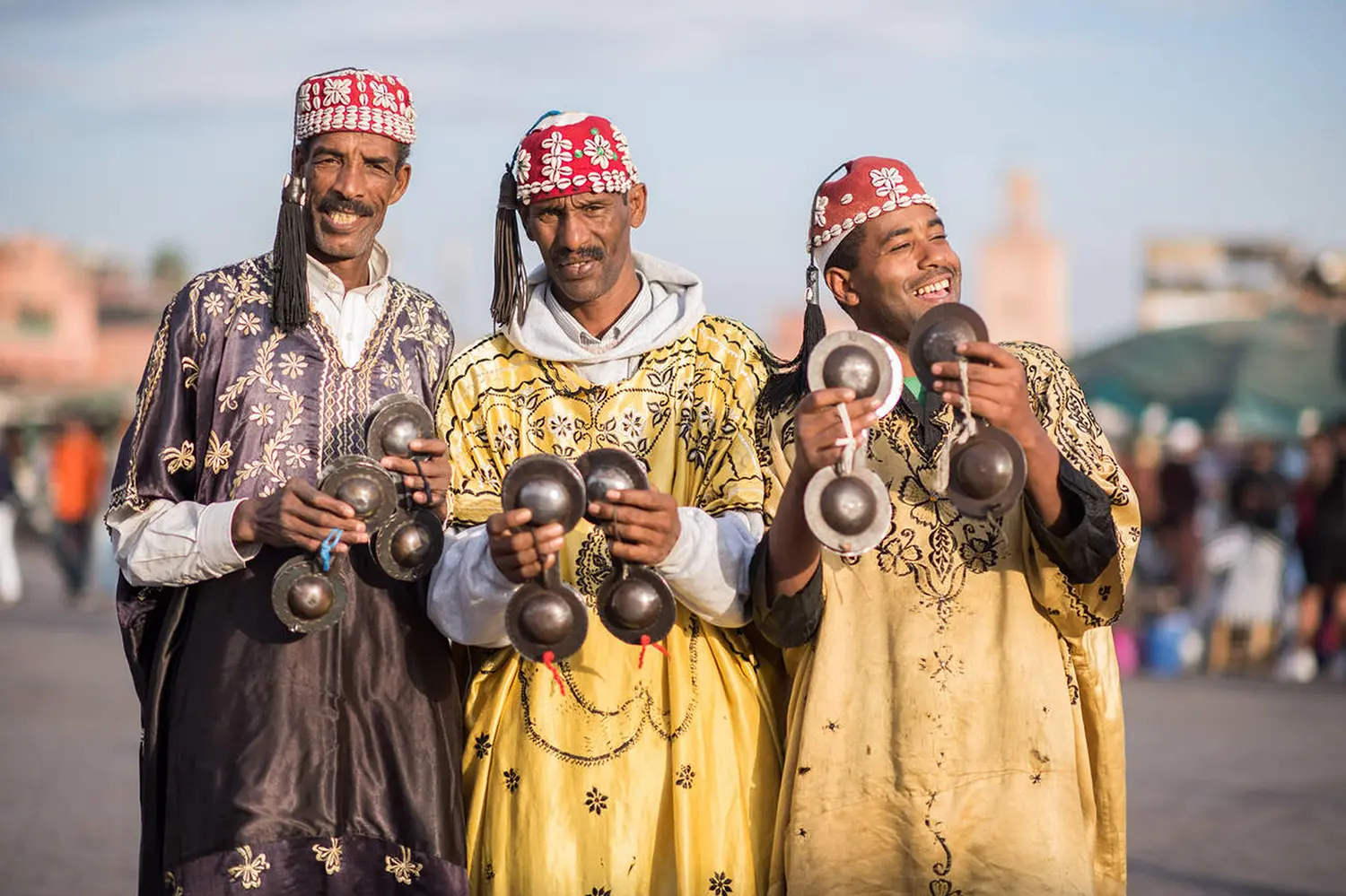
The Marrakchi Style: Deep Trance of the Red City
The Sound of the Desert Gate
Marrakech sits at the crossroads — the historic gateway between the Atlantic coast and the Sahara, between Arab Morocco and Amazigh territories, between the material world and the spirit realm. The Marrakchi style reflects this position: deeper, heavier, more explicitly focused on trance and healing.
What Makes Marrakchi Distinctive?
Heavy, Slow Rhythms: Where Marsaoui dances, Marrakchi pounds. The rhythms are weightier, more deliberate, designed to pull listeners down into trance states rather than lift them into celebration.
Spiritual Intensity: Marrakchi style prioritizes the healing function of Gnawa. Performances often feel more like ceremonies than concerts, even in public settings like Jemaa el-Fna square.
The Kouyou Dance: Marrakech is associated with the Kouyou (or Kuyu) — a specific dance style featuring acrobatic movements and the distinctive “Nasira” rhythm. The Ganga tradition, which uses large drums (tbel/ganga) without guembri, is also strong here.
Zawiya Connections: Marrakchi Gnawa maintain strong connections to local shrines, particularly the sanctuary of Moulay Brahim in the Atlas Mountains and Moulay Abdullah bin Tsain in Tamesloht. Annual pilgrimages to these sites reinforce the spiritual depth of the style.
Key Marrakchi Maâlems
- Mustapha Bakbou (1953-2025) — Zawiya master
- Ahmed Bakbou — Brother and collaborator
- Abdelkebir Merchane — Powerful traditionalist
- Abbas Baska — Festival performer
- Abdenbi El Gadari — Originally from Marrakech, later Casablanca
The Daqa Marrakchiyya
A distinctive element of Marrakchi performance is the Daqa Marrakchiyya — a style of rhythmic clapping and brass instruments (particularly the ghayta/oboe) that adds layers of intensity. When you hear brassy, almost military fanfares mixed with Gnawa rhythms, you’re hearing Marrakech.
The Shamali Style: The Northern Schools
The Sound of the Straits
In Tangier, Fez, and Rabat, Gnawa developed differently — influenced by proximity to Al-Andalus (Spain), the sophisticated urban culture of Morocco’s imperial cities, and different migration patterns from sub-Saharan Africa.
What Makes Shamali Distinctive?
Melodic Emphasis: Northern Gnawa tends toward more melodic, less percussive arrangements. The call-and-response patterns are more elaborate, with longer melodic phrases that show Andalusian influence.
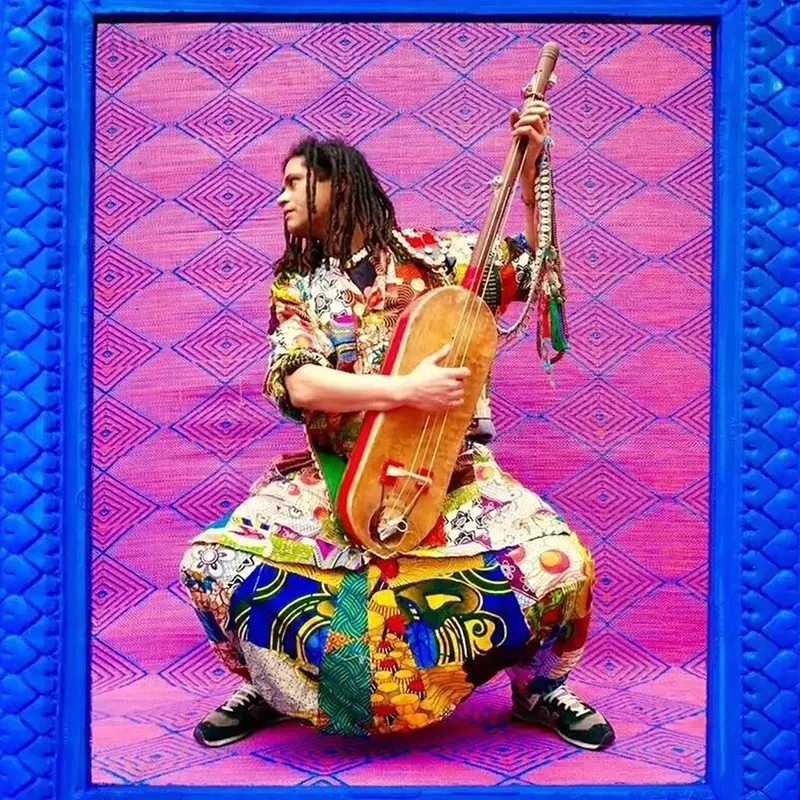
Higher Registers: The guembri playing often explores higher notes more frequently, creating a lighter, more “singing” quality compared to Marrakchi’s bass-heavy approach.
Intellectual Tradition: Fez, as Morocco’s intellectual capital, developed a more “refined” approach to Gnawa. The style is sometimes described as more “cultivated” — closer to the Sufi traditions of the learned zawiyas.
Different Drums: Northern style makes greater use of the tbel (large drums), creating a different textural balance between percussion and the guembri.
Key Northern Maâlems
- Abdellah El Gourd (b. 1947) — Tangier engineer and preservationist
- Hamid El Kasri (b. 1961) — Studied in Tangier under Stitou school
- Abdelouhed Stitou — Founded the Tangier/Tetouan school
- Rida Stitou — Son of Abdelouhed, continues tradition in Belgium
- Abdelkader Amlil — Rabat master
- Si Mohamed Chaouqi — Rabat traditionalist
- Simo Errebbaa — Contemporary Rabat practitioner
The Soussia Style: Southern Traditions
Beyond the three major schools, the Soussia style of the Draa Valley and Souss region deserves mention. This is where Gnawa meets Amazigh (Berber) culture most intensely.
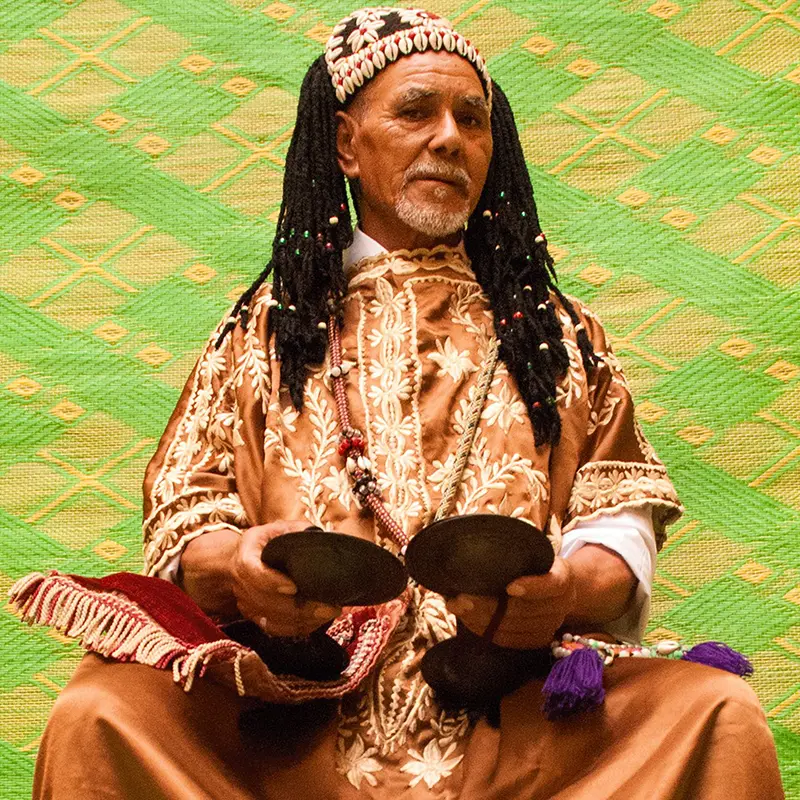
The Ismkhan — darker-skinned Amazigh communities in areas like Khamlia, Merzouga, and Errachidia — practice a form of Gnawa associated with Lalla Mimouna rather than Sidi Bilal. The Ganga tradition is strongest here, emphasizing large drums and the kouyou dance over guembri melodies.
How to Distinguish Regional Styles
For the developing listener, here are key markers to identify each school:
🌊 Marsaoui
- • Faster, brighter rhythms
- • Melodic guembri lines
- • Celebratory energy
- • Strong Sudani repertoire
- • Festival-ready sound
🏜️ Marrakchi
- • Heavy, slow rhythms
- • Deep bass emphasis
- • Trance-focused intensity
- • Kouyou/Nasira elements
- • Ghayta brass additions
🕌 Shamali
- • More melodic, less percussive
- • Higher guembri registers
- • Andalusian influence
- • Elaborate call-response
- • "Refined" arrangements
Masters Who Blend Styles
Many great Maâlems have absorbed multiple regional influences:
Hamid El Kasri learned the Shamali style from Maâlem Abdelouhed Stitou in Tangier, but his powerful voice and theatrical presence show influences from across Morocco. He’s often described as synthesizing north and south.
Abderrahman Paco was born in Essaouira (Marsaoui) but learned tourka (Gnawa custom) from Maâlem Benthami of Casablanca, blending coastal and urban traditions.
Asmâa Hamzaoui and her father Rachid Hamzaoui play a Casablanca style that draws on northern, central, and southern influences — a contemporary synthesis.
The Living Conversation
These regional distinctions are not rigid barriers but living conversations. Maâlems travel, collaborate, and learn from each other. The Essaouira festival brings all schools together annually, creating opportunities for cross-pollination.
What matters is not categorizing every performance but developing ears that can appreciate nuance — hearing how one Maâlem’s guembri technique differs from another’s, noticing when a rhythm carries the weight of Marrakech or the brightness of the coast.
The diversity of Gnawa styles is not a problem to be solved but a richness to be celebrated. Like the multiple dialects of Arabic across Morocco, or the regional variations of Amazigh language, these differences reflect the complex history and geography of a tradition that has survived for centuries.
When you hear Gnawa now, listen for the geography. Is this the Atlantic wind or the desert gate? The intellectual north or the spiritual south? The answer is in the rhythm.
"Each city has its own tagnawit. The guembri speaks the language of its homeland."
Continue Your Journey
Explore more about Gnawa’s diversity:
- Best Gnawa Artists to Listen To: A Complete Guide — Discover the essential artists from every regional school.
- What Is Gnawa? Origins, History & African Roots — Understand the deep history behind these regional variations.
- Gnawa Festival Essaouira: The Complete Visitor’s Guide — See all schools come together at Morocco’s legendary festival.
Discover the Instruments
- The Guembri — How this sacred bass lute sounds different across each regional school.
- The Tbel — The large drum that plays a more prominent role in some schools than others.
Meet the Masters
- Mahmoud Guinea — The defining voice of the Marsaoui (Essaouira) school.
- Mustapha Bakbou — The Zawiya master who embodied the Marrakchi tradition.
- Hamid El Kasri — The superstar who synthesizes northern and southern styles.