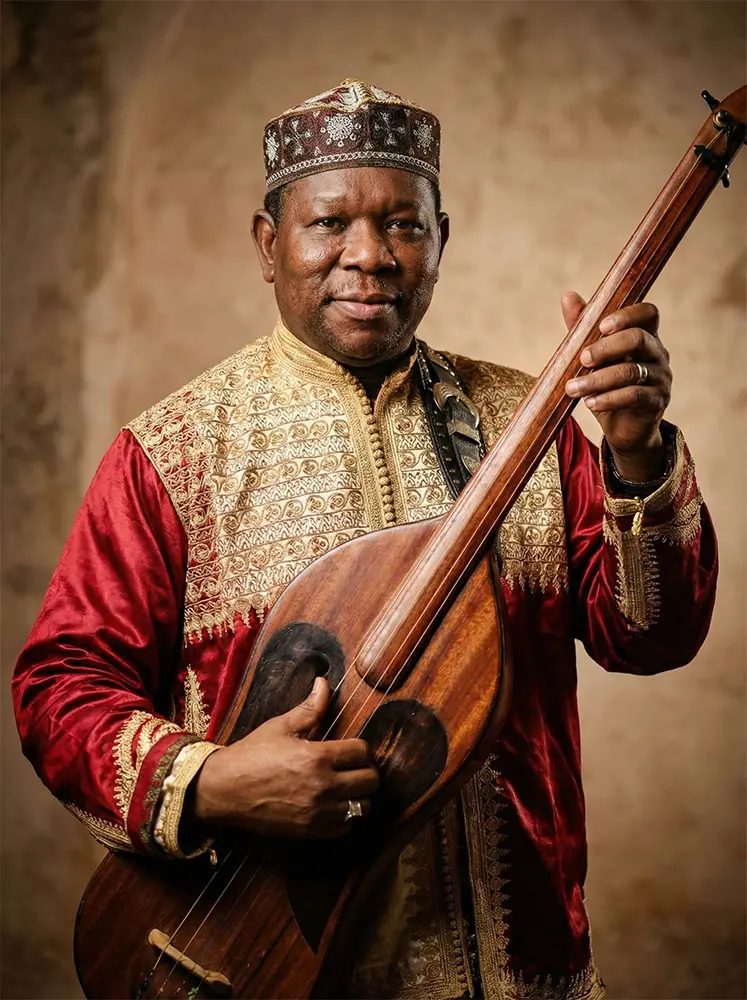
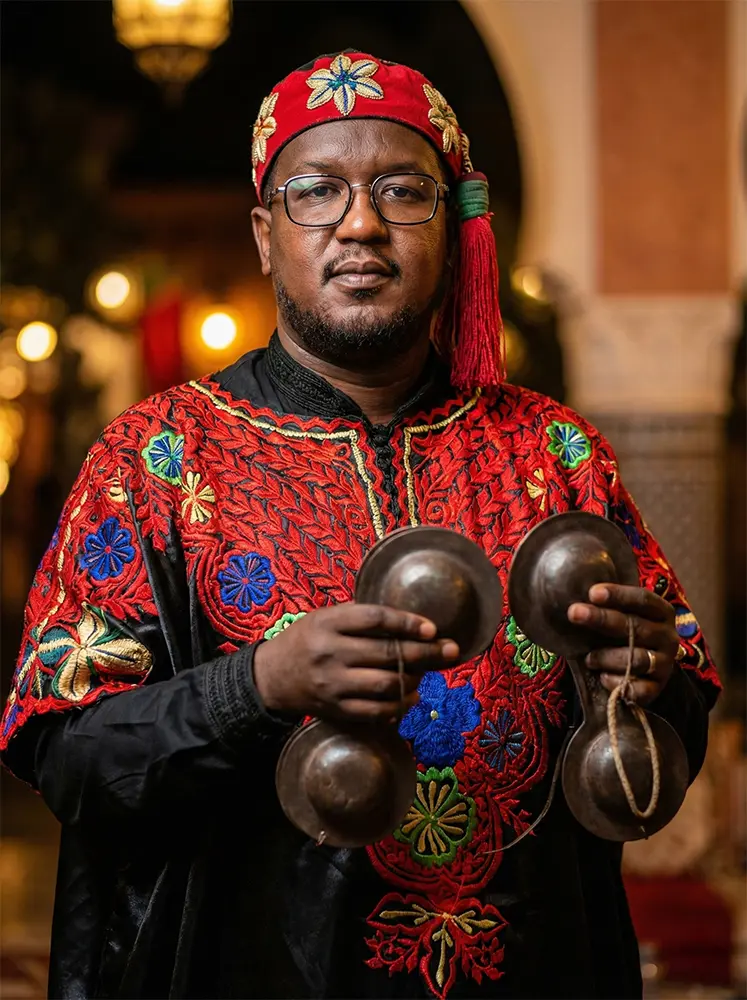
Some carry the rhythm; Maâlem Mohamed Boumzough carries the sanctuary. A pivotal figure in the “Releve” (rising generation) of Essaouira, Boumzough embodies the institutional and spiritual response to the commodification of sacred art. He stands precisely at the crossing point between the shadowy, incense-filled stillness of the Zawiya and the luminous, global stages of contemporary world music.
A traditionalist who never compromises on the sanctity of the Gnawa Lila, yet a visionary who deconstructs rhythms alongside jazz and rock legends — Boumzough is living proof that a culture forged in the crucible of forced displacement can become a universal language of healing in the 21st century.
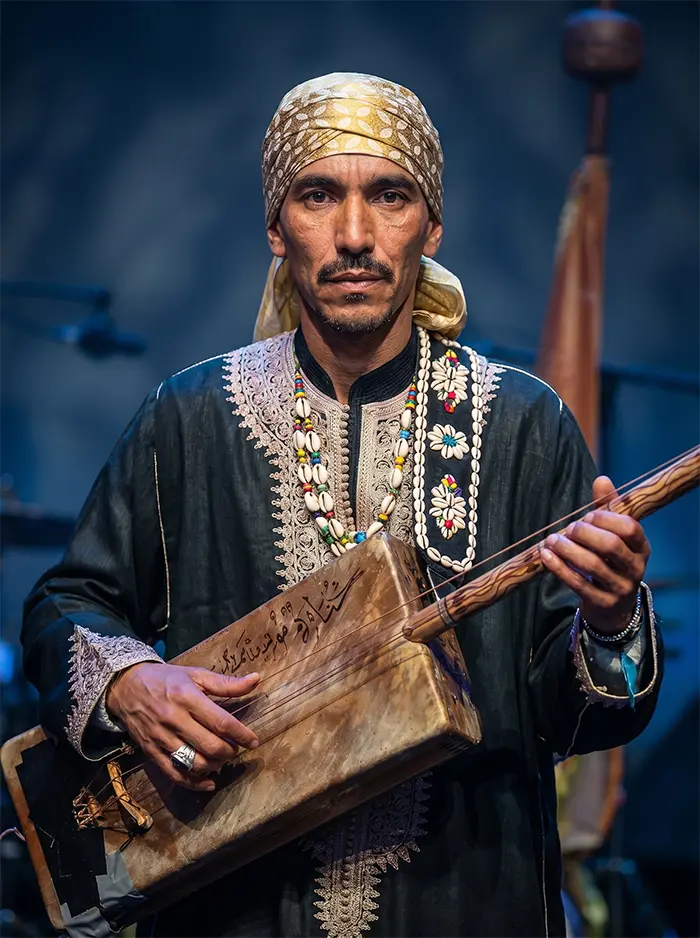
Roots and Lineage: The Anthropology of the Zawiya
The roots of Mohamed Boumzough plunge into the soil of Essaouira (ancient Mogador). This coastal fortress served for centuries as a vital crossroads for trans-Saharan caravans — a sanctuary where those carried through the gates of slavery preserved their cosmologies through music. In the winding alleys of Essaouira, music was never mere entertainment; it was a mechanism of survival and a spiritual medicine.
In 1998, a 12-year-old Boumzough witnessed the spark that would ignite his destiny: the inaugural edition of the Gnawa and World Music Festival. He discovered that the rituals performed in the private intimacy of households possessed a cosmic power capable of moving thousands in open squares. This founding moment made him understand that Gnawa “is not just music” — it is a universal language and a ritual mechanism demanding discipline and precise knowledge of psychological and spiritual phenomena.
The Foundation
Mastering the Qraqeb (iron castanets), learning the physical and rhythmic endurance required for hours of uninterrupted ritual -- understanding that the body itself must become an instrument before the hands can lead.
The Masters
Formation under the late Maâlem Abdellah Guinea and absorption of the stylistic "touch" of the Bakbou and Soudani families, inheriting a rich and diversified palette spanning multiple Essaouira lineages.
The Refinement
Integration into "Tyour Gnawa" under the direct mentorship of Maâlem Abdesslam Alikan, one of the foremost guardians of the Essaouira heritage and artistic director of the festival, where craft became responsibility.
The Calling: From Koyo to Maâlem
In Gnawa culture, one does not simply decide to become a “Maâlem.” This title demands an inner calling and a communal, ritual validation from the fraternity. The transition from koyo (percussionist) to the master who grips the guembri involves assuming responsibility for the spiritual and psychological health of those present at a Lila.
The Maâlem is the captain who guides the possessed through their journey toward “Hal” (the state of trance). He must know when to raise the rhythm and when to lower it, to ensure the return of souls to their serenity without causing harm. The young Boumzough had to demonstrate not only technical mastery, but the spiritual maturity to bear this weight.
His “license” arrived through his victory at the Young Talents Festival of Essaouira. This was more than a musical competition; it was a modern Ijaza — a public and institutional recognition that he had absorbed the secrets and crossed the threshold from reception to leadership.

Technical Mastery: The Boumzough Style Dissected
Boumzough approaches the Gnawa rhythm with surgical precision that marries the academic rigor of heritage with the dynamism demanded by live performance. His style is defined by the Circular Escalating Polyrhythm:
- The Broul (Meditative Intro) — The guembri weaves pentatonic tonalities steeped in melancholy and depth, establishing the frequency of spiritual dialogue.
- The Circular Acceleration — Progressively, in an infinite circular motion, the rhythm intensifies and the strikes of the qraqeb thicken in the background, mimicking the human heart in states of tension and ecstasy.
- The Paroxysm — The sonic density reaches its apex, driving the body toward a calculated collapse and liberation: trance.
| Environment | Rhythmic Approach | Goal |
|---|---|---|
| The Ritual (The Lila) | Heavy, circular, open-ended in time. Raw acoustic resonance between guembri, qraqeb and collective chant. | Healing, invoking the Mlouk, discharging trauma, reaching Hal. |
| The Concert (The Stage) | Condensed, faster, structured within a scenic time frame. Highlighting pauses and propulsive releases. | Aesthetic celebration, collective ecstasy, transmitting Moroccan spiritual energy to the world. |
In the ritual context, Boumzough practices dogmatic literalism: he observes the order of the seven colors, the mahallat (sequences), and never deviates from the path of Istichfa (healing). He describes his art as being “therapeutic trance music first and foremost.” On stage, he deploys a remarkable capacity for spatial sound engineering, adapting the resonant frequencies of the guembri to pierce through other instruments while preserving the spiritual message.

Fusion and Collaboration: The Chemistry of Intercultural Dialogue
Boumzough is a son of the Essaouira Festival’s vision: musical hybridization is not a threat to purity, but a vital necessity for the survival of the Gnawa pulse. He rejects superficial mixing in favor of an Organic Dialogue between instruments and cultural references that genuinely respect one another.
The Rock Bridge (Band of Gnawa)
In 2007, for the festival's 10th anniversary, he joined "Band of Gnawa" with Loy Ehrlich, Cyril Atef, and Louis Bertignac. Deconstruction of 70s rock classics (Beatles, Hendrix, Led Zeppelin), injecting the raw lifeblood of Gnawa rhythms -- proving Gnawa could lead rock, not merely accompany it.
The Afro-Jazz Dialogue
Recent projects with Malian Balafon master Aly Keïta and a jazz ensemble (Anas Chlaih, Tao Ehrlich, Martin Gjerban on saxophone, Quentin Goumari on trumpet). A reinvention of "Gnaoua trance" as a universal Afro-jazz language of freedom.
Breaking Gender Barriers
Active support for the new generation of female practitioners, notably sharing the stage with Hind Ennaira, helping to dismantle the historic male monopoly on the guembri and presenting the radiant feminine face of Tagnawit.
Legacy and Transmission: The Fight for Legitimacy
As a guardian of the Marsaoui (Essaouira) tradition, Boumzough’s greatest fear is the “digital dilution” of Gnawa. During a roundtable at the Institut Francais d’Essaouira in 2022 — entitled “Words of Gnawa: UNESCO Intangible Heritage, Stakes and Perspectives” — he launched a direct attack on the phenomenon of “YouTube Maâlems”.
On the legitimacy of the Maâlem:
"How can someone proclaim themselves a Maâlem without passing through the trials of the ritual and the hardship of training inside the Zawiya? Gnawa music is first and foremost a therapeutic trance music. Gnawa is the ritual above all else. These people may be musicians, but they are not Maâlems."
Mohamed Boumzough, Institut Francais d'Essaouira, 2022
What he wants to transmit is not only a repertoire of songs and rhythms, but the consciousness that the guembri is a vessel carrying the pains and dreams of ancestors, and that the Gnawa Lila is a social institution of healing that must not be profaned by superficial consumption.
Essential Listening
The Ritual Evening (Sehrat)
Live at Essaouira Festival 2022
A sonic document of his deep commitment to the traditional ritual structure. His mastery of "Call and Response" technique builds a spiritual atmosphere that transports the listener directly into the heart of the Lila.
Fusion with Aly Keïta
Gnawa Festival 2025 / Jazz Orchestra
The pentatonic connection between the Sahara and the West African balafon. The guembri and balafon converse as two cousins separated by the desert, reunited through jazz and the freedom of improvisation.
Band of Gnawa (Come Together)
Live 2007 / with Louis Bertignac
A rebellious demonstration of the guembri's ability to anchor and drive global rock rhythms. The qraqeb become rock instruments in their own right, proving this art's capacity to rebel and renew itself across any genre boundary.
"Gnawa music is first and foremost a therapeutic trance music... Gnawa is the ritual above all else."
Maâlem Mohamed Boumzough
From a Zawiya in Essaouira where the walls absorb the salt of the ocean and the incense of Jawi, to a rock project with Louis Bertignac, to a pentatonic dialogue with a Malian Balafon master — the trajectory of Mohamed Boumzough traces the fullest arc of what Gnawa can become in the 21st century without betraying what it has always been. He did not modernize Gnawa. He proved that Gnawa was already modern — always has been — because music that heals the soul never ages.