Discover the two figures at the heart of every Gnawa ceremony — the master musician who calls the spirits and the priestess who guides the healing. A journey into Gnawa's spiritual leadership.
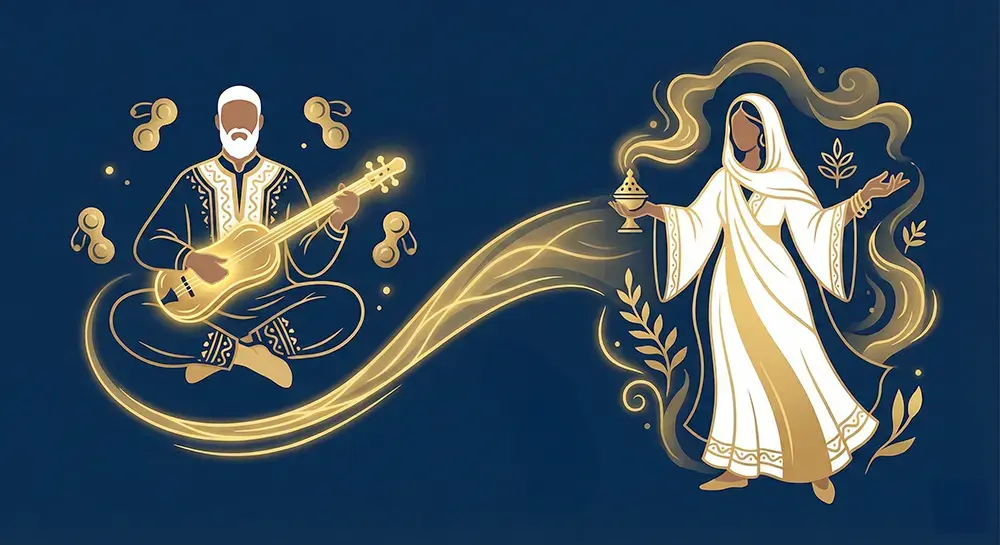
In the darkness of the lila ceremony, two figures hold the threads of the spiritual world. One sits with the guembri across his lap, calling spirits with bass notes that seem to rise from the earth itself. The other moves through the space with incense and colored fabrics, reading bodies and souls, guiding the possessed safely through their trance.
These are the Maâlem and the Moqaddema — the master musician and the therapeutic priestess. Together, they form a partnership as old as Gnawa itself, each incomplete without the other. Understanding their roles is understanding how Gnawa healing actually works.
Who Is the Maâlem?
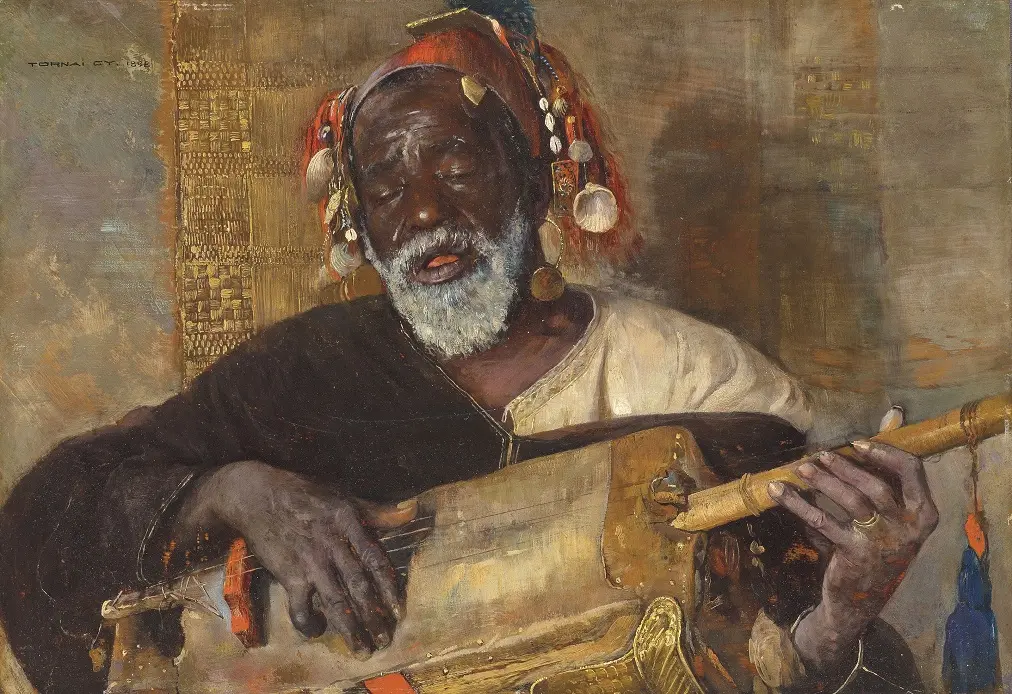
The word Maâlem (معلم) means “master” or “teacher” in Arabic. In Gnawa context, it refers specifically to the lead musician who commands the guembri and directs the musical dimension of the ceremony.
But “musician” is too small a word. The Maâlem is simultaneously:
- A spiritual leader — He opens the path (treq) to the spirit world
- A musical director — He controls rhythm, tempo, and song selection
- A keeper of tradition — He preserves repertoire passed down for centuries
- A caller of spirits — His guembri summons the Mlouk to attend
The Maâlem sits at the center of every lila, his guembri the axis around which the entire ceremony revolves. Without him, there is no path to the spirits. Without his music, there is no trance.
The Maâlem’s Responsibilities
During a lila ceremony, the Maâlem must:
Open the Sacred Space — The ceremony begins with Al-Fatiha and consecrating prayers. The Maâlem’s voice and guembri transform ordinary space into a container for spiritual encounter.
Lead the Musical Journey — The Maâlem controls the treq — the strictly encoded sequence of songs, rhythms, and invocations that guide participants through the seven realms of the Mlouk. He must know exactly which songs belong to which spirits, played in the proper order.
Call the Spirits — Using the guembri’s bass notes and burning specific incenses, the Maâlem invokes each Melk in turn. The deep vibrations of the instrument are believed to speak directly to the spirit world.
Read the Room — The Maâlem must sense when to intensify the music to push someone deeper into trance, and when to pull back to bring them safely home. This requires reading bodies, breaths, and energies in real time.
Maintain the Ensemble — The Maâlem leads a troupe of kouyou (qraqeb players) who provide the metallic rhythm that sustains the ceremony. He signals changes, controls dynamics, and holds the group together through hours of performance.
Preserve the Tradition — Every song, every rhythm, every invocation has been passed down through generations. The Maâlem carries this repertoire and transmits it to the next generation of practitioners.
Who Is the Moqaddema?
If the Maâlem is the voice that calls the spirits, the Moqaddema (مقدمة) is the hand that guides the humans who encounter them.
The word means “the one who presents” or “the one who leads forward.” In Gnawa tradition, the Moqaddema is a female spiritual leader — a clairvoyant, healer, and ceremonial director who manages everything the music cannot.
She is also called Shuwafa (شوافة) — “the one who sees” — reflecting her role as a visionary who can perceive the spiritual dimension.
The Moqaddema’s Responsibilities
During a lila ceremony, the Moqaddema must:
Prepare the Sacred Space — Before the ceremony begins, she cleanses the area with incense and prayers, driving away negative energies and creating a safe container for the work ahead.
Manage the Ritual Objects — The Moqaddema controls the Tbaq (ceremonial plate) containing incenses, colored fabrics, candles, and other ritual items. She determines when each element is needed.
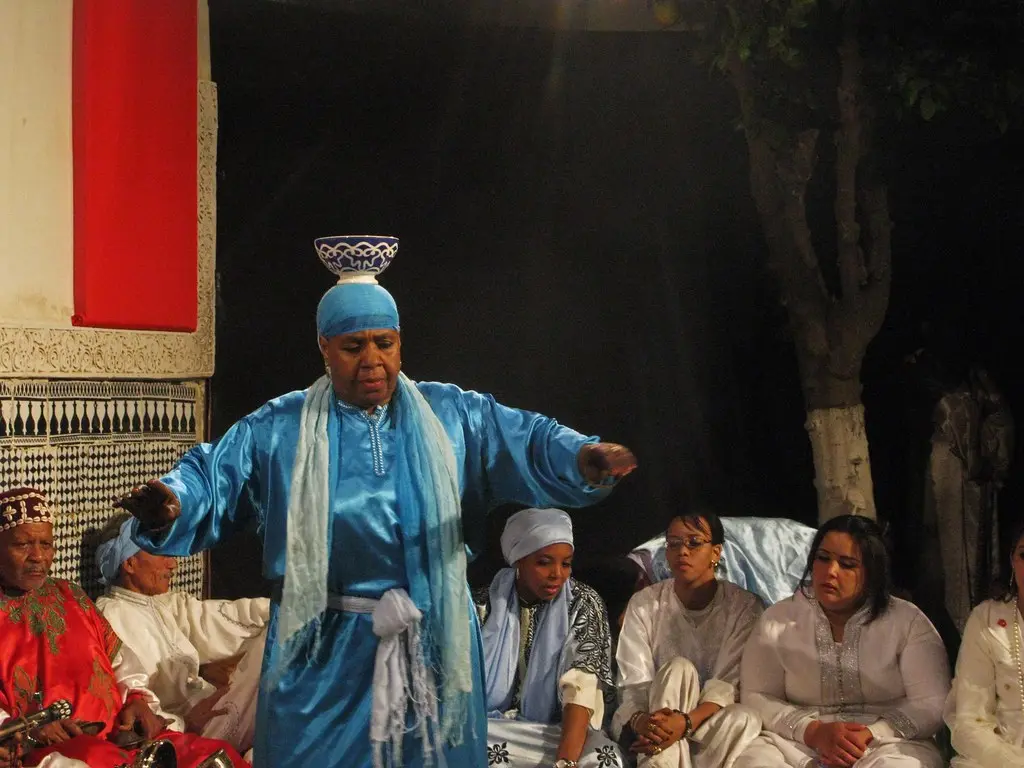
Dress the Possessed — When someone enters trance, the Moqaddema identifies which spirit has taken hold and drapes the person in the appropriate color. A person possessed by Sidi Moussa receives blue; one taken by Lalla Mira receives yellow.
Guide the Trance — She stays close to those in jedba (trance), ensuring their safety, reading their movements, and helping them negotiate their encounter with the spirits. If someone falls, she catches them. If someone needs grounding, she provides it.
Lead the Ecstatic Dance — In some phases of the ceremony, particularly during Sidi Moussa’s invocation, the Moqaddema herself may dance — sometimes balancing a bowl of water on her head to demonstrate her spiritual authority.
Interpret and Heal — After the ceremony, the Moqaddema may interpret what occurred, advising participants on what offerings or practices their spirits require. She is the bridge between the ritual experience and daily life.
Why Don’t Women Traditionally Play the Guembri?
One of the most frequently asked questions about Gnawa concerns gender: Why is the Maâlem almost always male? Why don’t women play the guembri in traditional ceremonies?
The answers are complex, rooted in history, social structure, and spiritual belief.
Historical Reasons
The Gnawa tradition emerged from communities of enslaved Africans, many of whom served as soldiers in the Abid Al-Bukhari army. The musical and spiritual leadership roles developed within male social structures — military units, trade guilds, and religious brotherhoods that were historically male-dominated.
Spiritual Beliefs
In traditional Gnawa cosmology, the guembri is considered sacred — a living object that houses spiritual power. Some practitioners believe that certain spiritual responsibilities are assigned by gender, with men holding the role of calling spirits through the guembri and women holding the role of managing the human encounter with those spirits.
This is not about capability but about complementarity — each role is considered essential, and neither is superior to the other.
Social Traditions
The path to becoming a Maâlem requires years of apprenticeship, often beginning in childhood. Historically, boys were apprenticed to master musicians in ways that girls were not, creating a self-perpetuating tradition of male guembri players.
The Changing Present
Today, these boundaries are being challenged. Asmâa Hamzaoui leads the all-female group Bnat Timbouktou, playing guembri on international stages. Hind Ennaira has performed as a guembri soloist at the Essaouira Festival. Hasna El Becharia from Algeria became famous as a female guembri master.
These pioneers face criticism from some traditionalists but also support from those who see Gnawa as a living tradition capable of evolution. The question of women and the guembri remains one of the most debated topics in contemporary Gnawa culture.
How Does One Become a Maâlem?
The path to becoming a Maâlem is not a school curriculum or a certification program. It is a lifelong apprenticeship rooted in family, community, and spiritual calling.
The Traditional Path
Childhood Immersion — Most Maâlems grow up in Gnawa families or communities. They attend lilas from infancy, absorbing the music, the rhythms, and the spiritual atmosphere before they can even speak. The tradition enters them through the skin before it enters through the mind.
Early Apprenticeship (Age 7-10) — A boy showing aptitude and interest may begin formal training around age seven. He starts not with the guembri but with the qraqeb (iron castanets), learning the rhythmic foundation that underlies all Gnawa music.
Years of Service — The apprentice serves an established Maâlem, accompanying him to ceremonies, carrying instruments, learning by observation and imitation. This is not classroom learning but embodied transmission — watching hands, feeling rhythms, absorbing the unspoken knowledge that cannot be written down.
Guembri Introduction — Only after years of qraqeb mastery does the apprentice begin learning the guembri. He starts with basic patterns, gradually building the repertoire of songs, invocations, and spiritual knowledge that a Maâlem must command.
Spiritual Development — Technical skill is not enough. The apprentice must develop his own relationship with the spirits, often through personal experiences of trance, illness, or spiritual crisis. Many Maâlems describe a moment of calling — a dream, a vision, or a profound experience that confirmed their path.
Recognition — There is no formal examination or certificate. A man becomes a Maâlem when established Maâlems recognize him as one — when he is trusted to lead ceremonies independently, when his spiritual authority is acknowledged by the community.
The Length of Training
The apprenticeship typically lasts from childhood into the late teens or early twenties — approximately 10 to 15 years of immersion before being recognized as a Maâlem. Even then, learning continues throughout life. The greatest Maâlems speak of still discovering new depths in songs they have played for decades.
Family Lineages
Many of the most respected Maâlems come from established Gnawa families where the tradition has been passed down for generations:
- The Gania family of Essaouira — Mahmoud, Mokhtar, and now Houssam
- The Bakbou family of Marrakech — Mustapha and Ahmed
- The Boussou family of Casablanca — H’mida and Hassan
But family lineage is not required. Outsiders can enter the tradition through apprenticeship with a Maâlem willing to teach them — though this path is typically longer and more difficult.
The Relationship Between Musician and Healer
The Maâlem and Moqaddema are not competitors or hierarchical figures. They are complementary partners whose collaboration makes Gnawa healing possible.
Two Dimensions of One Work
Think of the lila ceremony as having two dimensions:
The Vertical Dimension — The Maâlem’s music creates a ladder between worlds. His guembri opens the path upward to the spirits, calling them down into the ceremonial space. This is the cosmic dimension.
The Horizontal Dimension — The Moqaddema manages the human participants. She moves through the space, tending to bodies, reading energies, guiding individuals through their encounters. This is the earthly dimension.
Neither dimension works without the other. The spirits may arrive, but without guidance, participants cannot safely navigate the encounter. The Moqaddema may prepare everything perfectly, but without the music, the spirits do not come.
Communication During Ceremony
The Maâlem and Moqaddema communicate constantly during the lila, though often without words:
- A gesture from the Moqaddema signals that someone is entering trance
- The Maâlem responds by adjusting the music to support or deepen the state
- The Moqaddema drapes the appropriate color, signaling which spirit has arrived
- The Maâlem shifts to that spirit’s songs, confirming and strengthening the connection
This is a dance of attention — each reading the other, reading the room, reading the spirits, constantly adjusting to serve the healing.
Mutual Respect
In traditional settings, Maâlems and Moqaddemas treat each other with profound respect. Each recognizes that they cannot do their work alone. The greatest ceremonies occur when a skilled Maâlem works with a powerful Moqaddema — when both dimensions of the work are fully activated.
Some Maâlems have worked with the same Moqaddema for decades, developing a partnership so refined that communication becomes almost telepathic. These pairings are treasured in Gnawa communities, known to produce the most powerful healing ceremonies.
The Living Partnership
In an age when Gnawa music increasingly appears on concert stages, separated from its ritual context, it is worth remembering what the tradition is actually for: healing.
That healing requires both the Maâlem and the Moqaddema — the one who calls the spirits and the one who guides the humans who meet them. Neither is complete without the other. Neither can do the work alone.
When you hear a guembri playing, remember that somewhere there should be a Moqaddema — the unseen partner who makes the music’s work possible. And when you see incense rising in ceremony, remember the musician whose notes opened the path for the spirits to travel.
This partnership — ancient, complementary, essential — is the beating heart of Gnawa.
"The Maâlem calls the spirits down. The Moqaddema guides the humans up. Where they meet, healing happens."
Continue Your Journey
Explore more about Gnawa’s sacred world:
- The Gnawa Lila Ceremony: Full Ritual Explained — See the Maâlem and Moqaddema in action during the all-night healing ceremony.
- The Guembri: Sacred Heart of Gnawa Music — Understand the instrument that gives the Maâlem his spiritual authority.
- Best Gnawa Artists to Listen To: A Complete Guide — Discover the greatest Maâlems, past and present.
The Maâlem’s Instruments
- The Guembri — The three-stringed bass lute that only the Maâlem plays.
- The Qraqeb — The iron castanets played by the kouyou ensemble he leads.
The Great Maâlems
- Asmâa Hamzaoui — The barrier-breaking female Maâlem.
- Mahmoud Guinea — The King of Gnawa whose apprenticeship defined the tradition.