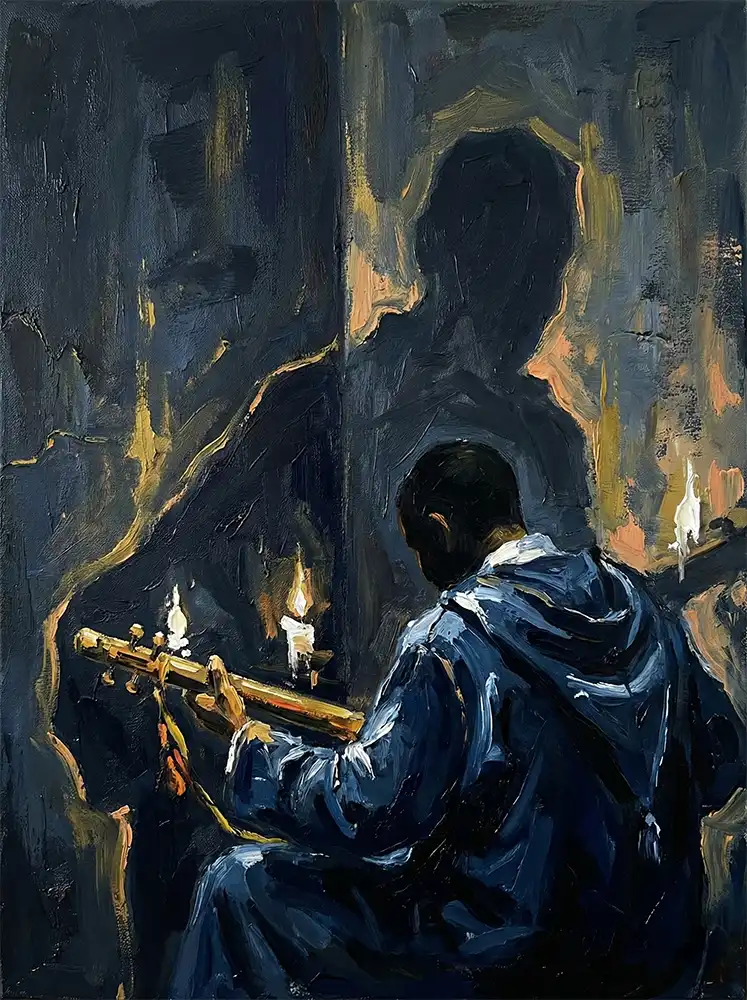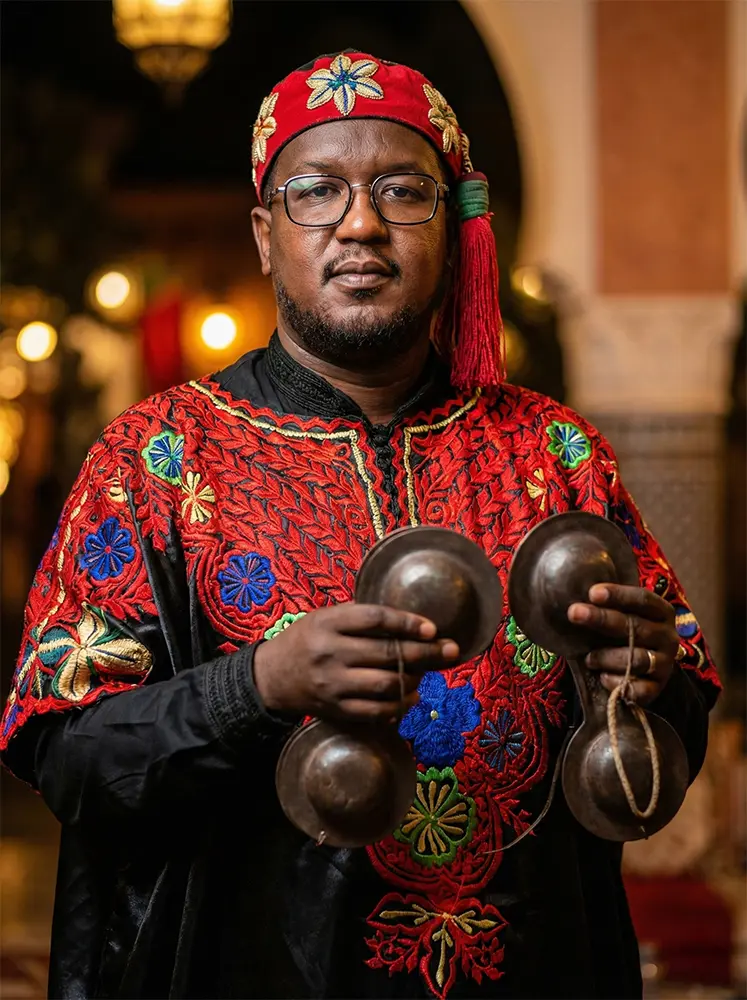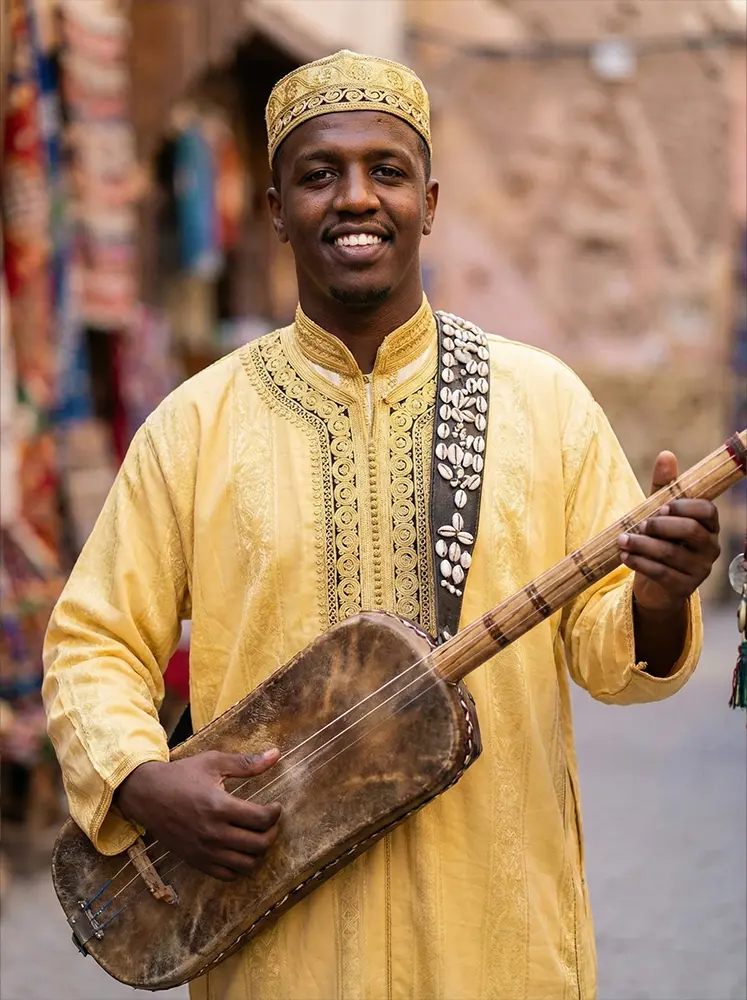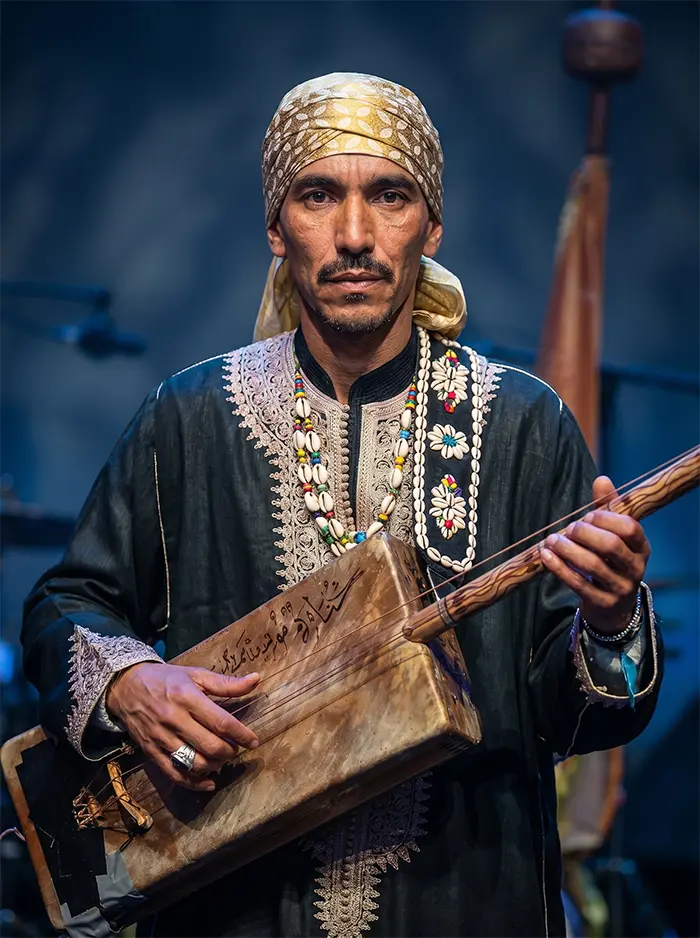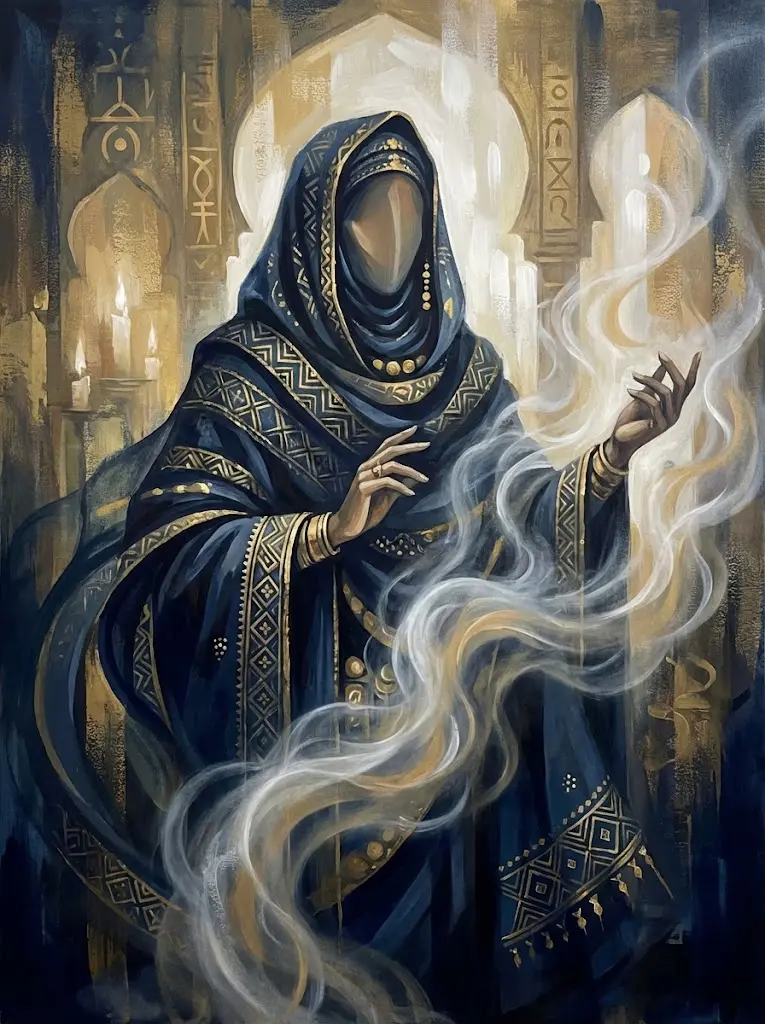
Behind every great Maâlem, there stands a great Moqaddema — not in his shadow, but as the very foundation upon which his music is built. In the history of Gnawa music, no single woman embodies this truth more powerfully than Moqaddema Aicha Qebral: the spiritual mother of the Guinea dynasty, wife of Maâlem Boubker Gania, mother of Mahmoud, Mokhtar, Abdellah, and the moqaddema Zaida — and grandmother of Houssam and Hamza Guinea. She was the spiritual womb (al-rahm al-roohi) that gave birth to the most important Gnawa lineage of the modern era.
Aicha Qebral was not a musician in the conventional sense. She never played the guembri. She never stood on a concert stage. Yet without her, the guembri would have no soul, the lila would have no direction, and the Guinea family would have no anchor. She was the Shawwafa (clairvoyant healer), the ritual architect, and the supreme spiritual authority who engineered every lila from behind the veil of incense smoke — the most respected Moqaddema in the history of Essaouira.
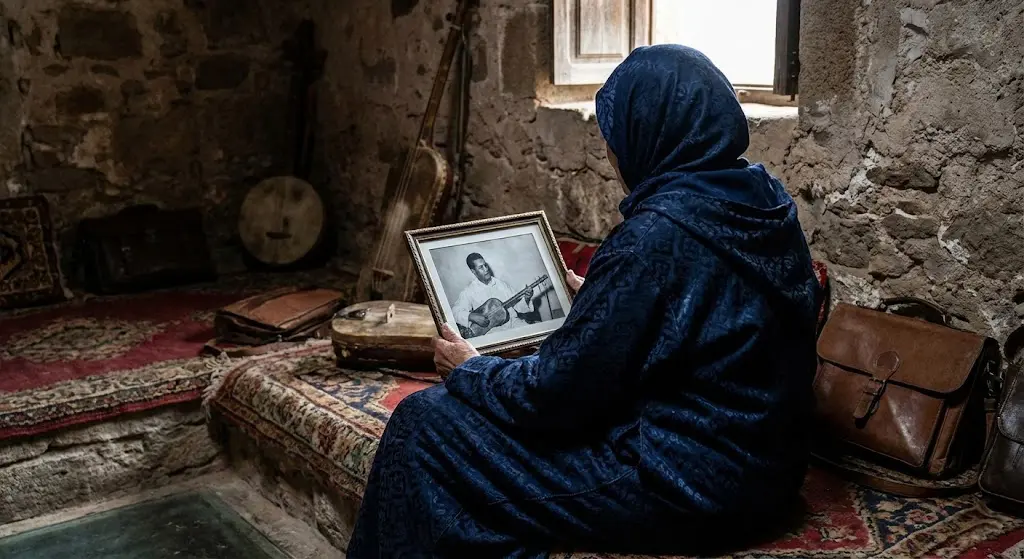
Understanding the Moqaddema: The Hidden Power of Gnawa
To understand Aicha Qebral’s importance, one must first understand Gnawa’s dual authority structure — a system invisible to most Western audiences who only see the Maâlem on stage:
| Role | Authority | Responsibilities |
|---|---|---|
| Moqaddema (Aicha Qebral) | Supreme spiritual authority, Shawwafa | Diagnosing spirits, selecting incense, managing trance states, protecting participants, directing the Maâlem's musical choices |
| Maâlem (Boubker / sons) | Musical authority | Playing the guembri, leading the rhythm, invoking the Mlouk through melody and voice |
| Kouyou (assistants) | Rhythmic support | Playing qraqeb and drums, physically supporting participants in trance |
| Majdoubeen (participants) | Recipients of healing | Entering jedba (trance) to release psychic tensions and reconcile with inner entities |
In this hierarchy, the Moqaddema is not secondary to the Maâlem — she is his spiritual commander. While the Maâlem engineers sound and vibrations, the Moqaddema engineers souls and energies. The lila cannot achieve its healing purpose through music alone; it requires precise guidance of psychic energies, strict management of symbols — colors, scents, sacrifices, body movements — that only the Moqaddema controls.
Aicha Qebral was the executive and legislative authority in the Guinea family’s jedba rituals. She alone possessed the secret knowledge to identify which of the seven Mlouk was possessing a suffering body, and she alone determined which bakhour was required to calm or summon each spirit.
Roots: The African Lineage and the Power of Baraka
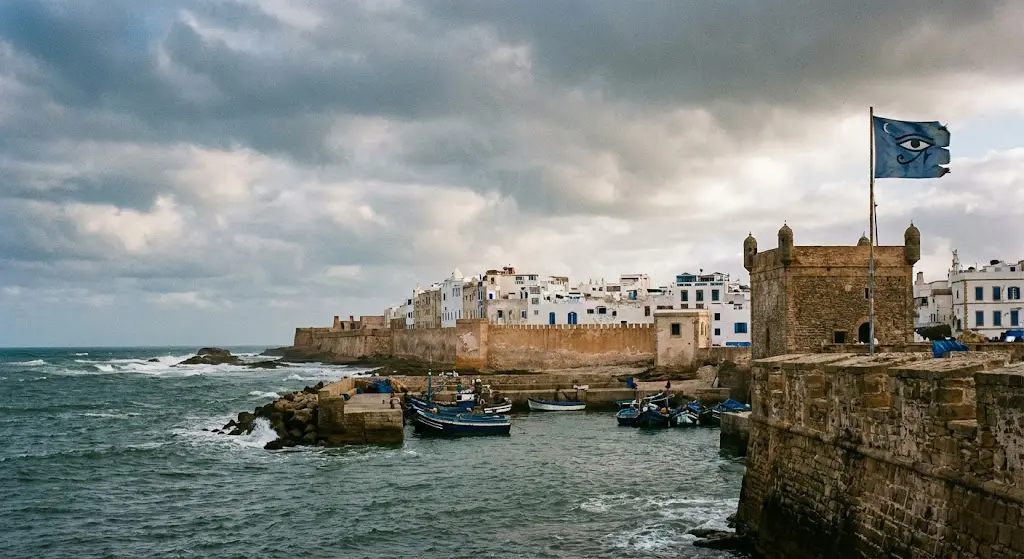
Aicha Qebral’s roots extend deep into the historical soil of Essaouira — a city that was, for centuries, the terminus of trans-Saharan trade routes. Here, gold, salt, spices, and enslaved human beings from Mali, Senegal, and the western Sudan converged. From this brutal demographic crucible, Gnawa culture was born as a mechanism of psychological resistance, memory preservation, and collective healing from the trauma of historical uprooting.
In traditional Gnawa society, the title of Moqaddema is not acquired through academic study. It is earned through a grueling apprenticeship beginning in childhood — based on silent observation, demanding service in zawiyas, and the gradual absorption of spiritual secrets. The apprentice learns when and how to burn different types of incense, how to read the convulsions of disturbed bodies, and when to signal the Maâlem with a subtle glance to change the rhythm or stop it entirely to save someone in a dangerous trance state beyond human endurance.
Aicha’s marriage to Maâlem Boubker Gania was not merely a social alliance. It was a cosmic fusion of Gnawa’s two essential poles: the dominant voice (guembri) and the inner vision (Shawwafa). This union created the vessel for transmitting what anthropologists call Baraka — divine blessing, a concept of how the sacred intervenes in the material world, manifesting as capacity, talent, personal presence, and moral force in chosen individuals.
Aicha Qebral was the pure vessel carrying this Baraka, transmitting it biologically and spiritually to her sons and daughters — establishing the most powerful Gnawa dynasty of the modern era.
The Calling: Chosen by the Spirits
In every great Moqaddema’s life, there exists a moment of fracture before ascent — the phenomenon known anthropologically as “The Calling” or the “spiritual illness.” In Gnawa’s belief system, a person does not choose to become a Moqaddema; they are chosen — forcibly selected by the supernatural entities known as the Mlouk.
Aicha Qebral’s existential transformation, like that of all great Moqaddemas, was linked to a period of unexplained physical and psychological suffering — suffering that defied medical diagnosis and found relief only through complete submission to the lila ritual and embracing the spirit that chose to inhabit her as its medium. This voluntary surrender was not defeat but the signing of an eternal spiritual contract: the woman becomes the guardian of watching entities, an active mediator between spirits and suffering humans.
Once she answered the call, Aicha lost the right to live solely for herself. She became an open spiritual institution — receiving the sick in the corners of her Essaouira home, reading their destinies with penetrating insight, and untangling the knots of their souls entangled with forces of darkness. The hidden calling she answered made her the most renowned Shawwafa (clairvoyant) in Essaouira, where her deep spiritual insight merged with practical worldly wisdom to become the first and last refuge for those whom all other doors had closed upon.
The Unique Signature: Engineering the Sacred
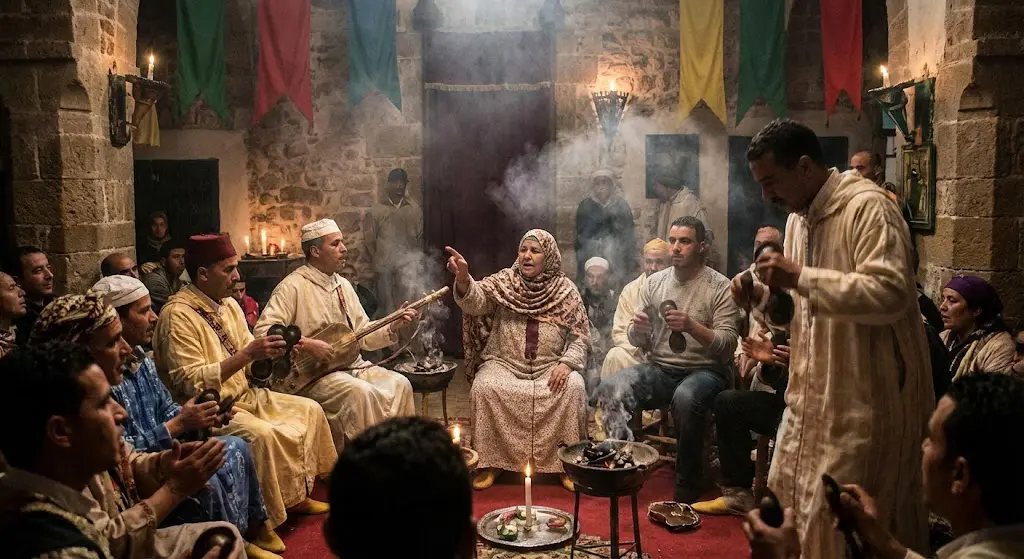
If her son Mahmoud Guinea was known for his unique guembri voice — that deep, relentless bass pulse that strikes the depths of the human soul — then Aicha Qebral’s signature was her mastery of the lila’s invisible architecture. Her ritualistic stamp operated across three precise dimensions:
Diagnosing Spirits Through Inner Senses
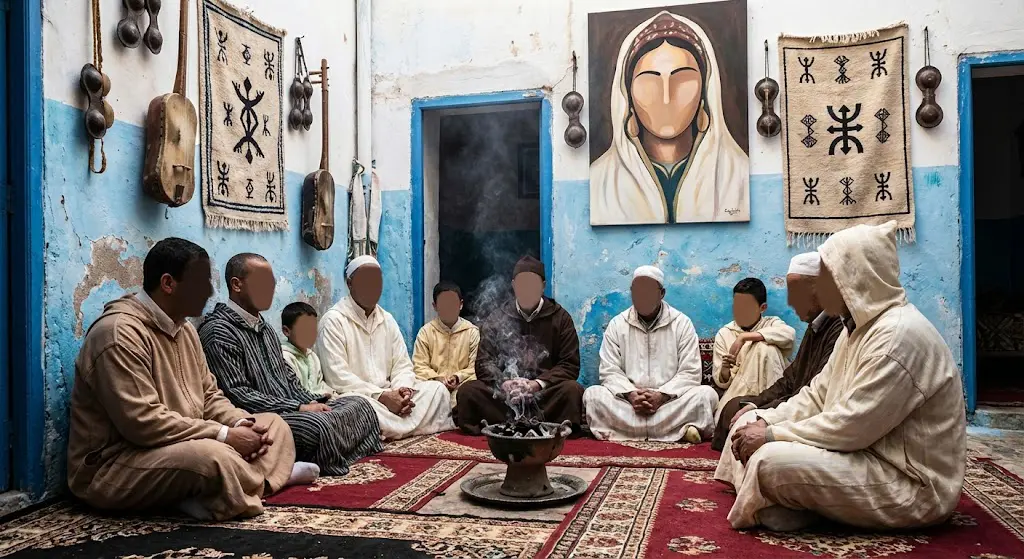
Aicha possessed an extraordinary ability — seemingly supernatural to the outside observer — to “read” the bodies and souls of ceremony participants. Through her developed Shawwafa sight, she instantly recognized which of the seven Mlouk needed urgent summoning to treat a specific patient writhing in the zawiya’s courtyard. She relied not on spoken words but on the language of deep spiritual signals — determining when to place fasookh (negative-repelling incense) in the brazier, when to add jawi makawi to attract pure white spirits, and when to spray cold orange-blossom water to calm raging aquatic spirits like Sidi Moussa.
Silent Command of the Maâlem
In the charged space of the lila, the music must never stop abruptly if someone is at the peak of trance — doing so could cause serious harm. Aicha was the hidden dynamo, the mastermind sending crucial signals — a glance, a slight gesture, a nod — to the Maâlem (whether her husband Boubker or later her sons Mahmoud and Mokhtar) to accelerate the rhythm to climax, lower it gradually, or transition safely from one color-station to the next.
Managing the Human Body and Spiritual Safety Net
The truest signature of a Moqaddema is her physical and psychological care of majdoubeen during the ritual. Jedba is a voluntary or involuntary departure from conscious control that can lead to self-harm without expert supervision. Aicha, accompanied by a trusted network of assistants, formed an impenetrable safety net: covering patients with the precisely appropriate colored cloth, supporting collapsing bodies, and embracing them warmly upon slow awakening to reconnect their scattered consciousness with the physical world.
The Bridge: Protecting the Core in the Age of Fusion
As Gnawa entered its era of globalization — with Mahmoud Guinea collaborating with jazz legends like Pharoah Sanders, Peter Brötzmann, Bill Laswell, and Randy Weston — the danger of losing Gnawa’s original identity loomed large. Critics warned that some fusion experiments risked reducing the sacred art to decorative folklore stripped of its spiritual substance.
Here, Aicha Qebral served as the “Insulating Bridge” — protecting the Gnawa core. She ensured that the Guinea family home and zawiya in Essaouira remained a pure spiritual sanctuary, fortified against ritualistic contamination. When her Maâlem sons returned from their dazzling world tours, they shed their celebrity mantles and submitted to the strict ritual rules imposed by the Moqaddema within closed walls.
Aicha was the heavy anchor that allowed Mahmoud and his brothers to fly high in the skies of world music, with the absolute confidence that they possessed unbreakable roots to return to. Thanks to her spiritual upbringing, Mahmoud Guinea’s music — even in its most complex fusion moments — retained its reverence, its solidity, and its deep trance character, because the heart-rhythm he played was always calibrated to his mother’s spiritual clock.
Legacy: The Feminine Revolution in Gnawa
Aicha Qebral’s legacy extends far beyond her physical life. It lives on through two parallel streams:
The Direct Inheritance
Her daughters carry the torch of taqaddum (ritual leadership). Zaida Guinea is today one of the most celebrated contemporary Moqaddemas and Shawwafas, directing jedba ceremonies with masterful authority. She founded and leads the Haddarate of Essaouira — an all-female Gnawa ensemble that upholds the feminine spiritual presence her mother embodied. The late Jemaa Guinea was another extension of this powerful feminine spiritual authority.
On the male line, her grandsons Houssam Guinea and Hamza Guinea continue the pure tradition she protected — Houssam with his contemplative, deeply meditative guembri style, and Hamza with his fierce devotion to the tbel and qraqeb.
The Gender Revolution
Aicha’s most revolutionary indirect legacy is the historic gender shift now transforming Gnawa music. By establishing absolute respect for feminine spiritual authority, she laid the groundwork for women who later dared to cross the ultimate barrier — picking up the guembri itself. The most prominent is Asmaa Hamzaoui, who founded Bnat Timbouktou in 2012, becoming the first Moroccan woman to publicly play the guembri on stage.
The connection is direct and documented: in Mahmoud Guinea’s final album Colours of the Night (2017), he invited Asmaa and her group to sing backup on the track Sadati — an explicit declaration of legitimacy from the highest authority in Gnawa, and a clear tribute to the feminine role his mother embodied throughout her life.
The Sonic Monument: Album Aicha
The greatest tribute to Aicha Qebral’s legacy came from her own son. Mahmoud Guinea named one of his most important albums simply “Aicha” — a cosmic thank-you note and an explicit acknowledgment of the Moqaddema’s foundational role.
Aicha (Original)
Late 1990s • Cassette • Essaouira Recording
Recorded in the family home with an intimate group — heavy rhythms, hypnotic chanting including the mesmerizing "A bangara bangara" refrain, capturing the atmosphere of a real lila under Aicha's direction.
Aicha (Remastered)
2020 • Hive Mind Records • Vinyl Reissue
Remastered and released on vinyl by Hive Mind Records as their 10th release, with detailed liner notes by researcher Tim Abdellah Fuson (Moroccan Tape Stash). Critics described the music as "crushing and possessive."
This album was not a commercial folk compilation — it was a musical translation of the Moqaddema’s persona. Its heavy rhythms, the relentless hypnotic chanting, and the gradual escalation into trance precisely mirror the controlled states Aicha managed during real lila ceremonies.
"The guembri may speak the language of souls and enchant the ears — but the Moqaddema alone is the one who gives it its living spirit, its true direction, and its safe destination."
— On the legacy of Moqaddema Aicha Qebral
Further Exploration
- 📖 Maâlem Boubker Gania — Her husband — the founding patriarch
- 🌟 Maâlem Mahmoud Guinea — Her son — “The Emperor” who named an album after her
- 🔥 Maâlem Mokhtar Gania — Her son — current patriarch of the Gania lineage
- 🎸 Maâlem Abdellah Gania — Her son — “The Marley of Gnawa”
- 🌱 Maâlem Houssam Guinea — Her grandson — the third generation
- 🥁 Hamza Guinea — Her grandson — guardian of rhythm and tradition
- 🎤 Asmaa Hamzaoui — The woman who broke the guembri barrier, inspired by her legacy
- 🏛️ The Essaouira School — The city and tradition she anchored
- 🎭 The Gnawa Lila Ceremony — The ritual she mastered and commanded
- 🌀 The Seven Mlouk: Colors, Spirits & Meanings — The spiritual cosmology she navigated