Discover the ancient history of Gnawa music, from its West African origins to its evolution as Morocco's most profound spiritual tradition.
In the narrow alleyways of Essaouira, as the Atlantic wind carries the scent of salt and sandalwood, a sound rises that is older than Morocco itself. The deep, pulsing bass of the guembri. The metallic chatter of iron castanets. Voices chanting in languages that few now understand, calling to spirits that crossed the Sahara centuries ago in chains.
This is Gnawa — not merely music, but a living testament to one of history’s greatest tragedies and one of humanity’s most remarkable acts of spiritual survival.
What Does “Gnawa” Mean?
The word carries the weight of history. Gnawa (Arabic: ڭناوة) derives from the Berber term agnaw (singular) or ignawen (plural), meaning simply “black person” — a reference to the sub-Saharan African origins of the tradition’s founders.
But etymology tells only part of the story. The Gnawa are simultaneously an ethnic group (descendants of West African slaves), a spiritual brotherhood (practitioners of healing rituals blending Islam with African traditions), a musical tradition (masters of trance-inducing rhythms), and a living heritage (inscribed by UNESCO in 2019).
To ask “What is Gnawa?” is to ask about slavery and survival, faith and adaptation, the transformation of suffering into sacred art.
Where Did Gnawa Come From?
The origins of Gnawa lie thousands of kilometers south — in the empires of West Africa’s Sahel region. The ancestors of today’s Gnawa were captured from the Bambara of the Niger basin, the Songhai of Timbuktu, the Hausa of Nigeria, and the Fulani pastoralists. These were not primitive peoples but sophisticated civilizations with complex musical traditions and spiritual practices.
The trans-Saharan slave trade intensified in the late 16th century when Sultan Ahmed Al-Mansur conquered parts of the Songhai Empire, bringing back approximately 12,000 enslaved Africans. They were put to work in sugar plantations, construction projects, and military units.
The second wave arrived under Sultan Moulay Ismail (1672-1727), who created the Abid Al-Bukhari — a massive army of over 150,000 enslaved Black soldiers. When his empire fragmented, these communities settled across Moroccan cities, forging a new identity: Gnawa.
Their connection to Sidi Bilal — the Ethiopian slave who became Islam’s first muezzin — gave spiritual legitimacy. By claiming Bilal as their ancestor, the Gnawa assert that their African origins place them at Islam’s heart, not its margins.
Is Gnawa Music or Religion?
The question reveals a Western bias — assuming the spiritual and artistic can be separated. For the Gnawa, they cannot. Music is prayer. Rhythm is ritual. Trance is communion.
Gnawa practice sits at the intersection of Islam (they pray five times daily and fast during Ramadan), Sufism (using music to achieve spiritual states like other Moroccan brotherhoods), and African Animism (belief in spirits that can inhabit humans, rooted in Hausa Bori traditions).
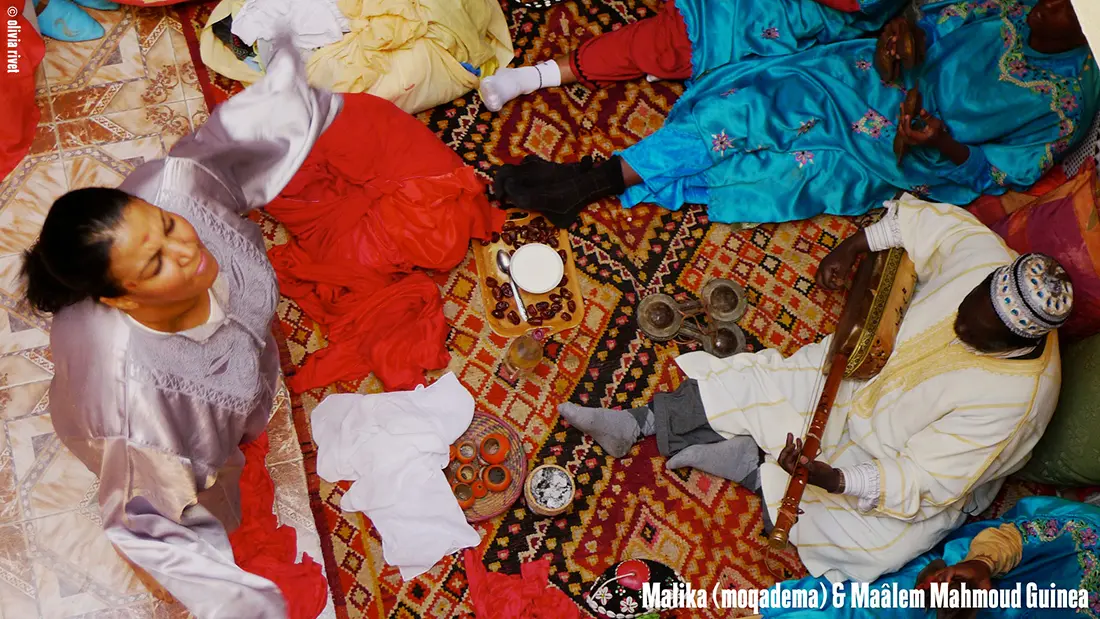
The Seven Colors: Gnawa Cosmology
At the heart of Gnawa spirituality lies the belief in Mlouk — spirits that can inhabit humans and must be appeased through ritual. They are organized into seven families, each with its own color, element, and character.
White
Saints & Light
Air • Purity, blessing
Black
Sidi Mimoun
Earth • Power, mystery
Blue
Sidi Moussa
Water • Moses, the sea
Red
Sidi Hamou
Blood/Fire • Strength, danger
Green
Masculine Spirits
Nature • Healing, fertility
Yellow
Lalla Mira
Feminine • Joy, playfulness
Mixed
Various Spirits
Combined • Specific purposes
During the lila ceremony, each spirit family is invoked through specific songs and incenses. Those “possessed” by a spirit enter trance when that spirit’s music plays.
The Gnawa do not see possession as evil. They view the Mlouk as forces to be harmonized with, not exorcised. The cure for suffering is accommodation — dancing to your spirit’s music, wearing its color, making offerings. The goal is peaceful coexistence.
The Lila: Anatomy of a Ceremony
The Lila (“night”) is the core ritual — an all-night ceremony of music, trance, and healing from sunset to sunrise.
Phase One: The Aada — A street procession where musicians parade through neighborhoods playing drums and qraqeb, announcing the ceremony.
Phase Two: Oulad Bambara — Inside the ceremonial space, the Maâlem plays songs sung partly in Bambara and African languages. These are the oldest songs, preserving words the performers may not understand — speaking of capture, exile, and the journey across the Sahara.
Phase Three: The Mlouk — After midnight, the sacred phase begins. The Moqaddema (female spiritual leader) prepares incense and colored fabrics. Each spirit family is invoked. Those called by a spirit are draped in its color, entering progressively deeper trance until their journey is complete.
The Instruments of Trance
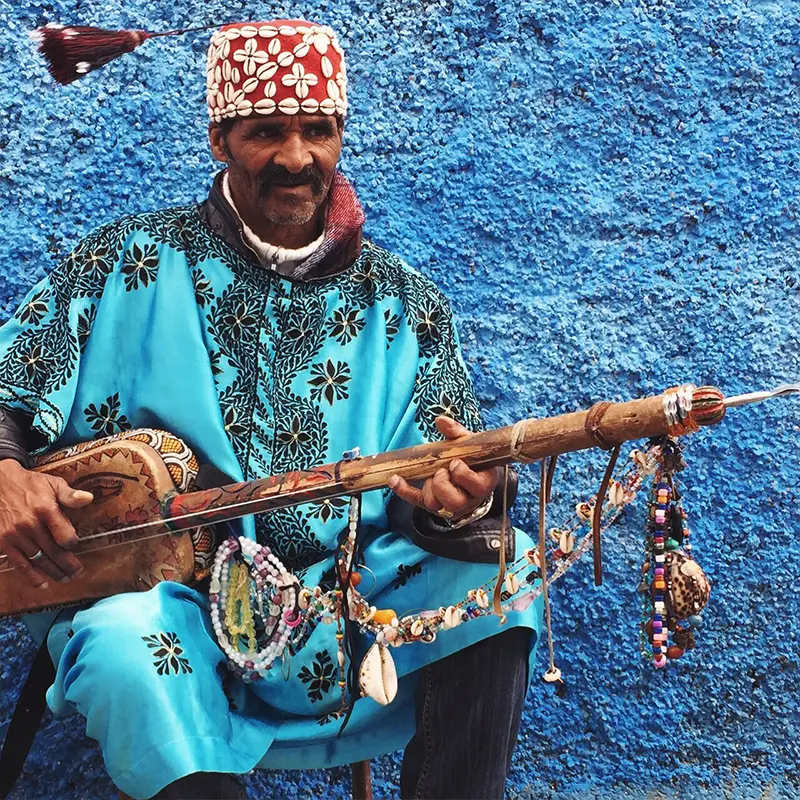
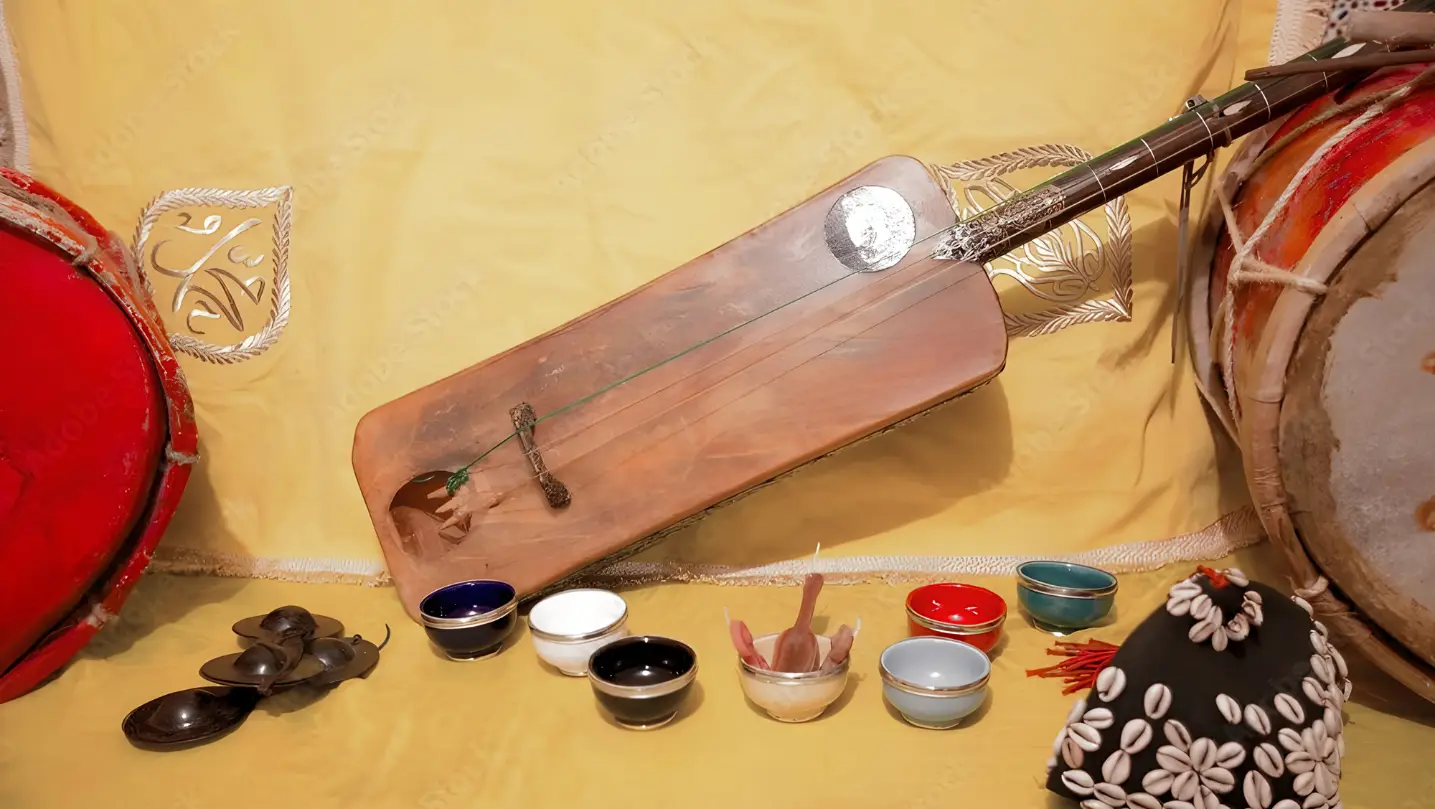
The Guembri (Sintir/Hajhouj) — The soul of Gnawa music. A three-stringed bass lute carved from a single piece of wood and covered with camel skin. Related to the ngoni of Mali — evidence of African origins. Only the Maâlem plays it; mastery requires years of apprenticeship from childhood.
The Qraqeb — Large iron castanets shaped like figure-eights. Played in interlocking patterns, they create the hypnotic metallic rhythm that induces trance.
The Tbel — Large drums used in the outdoor procession, their booming rhythms purifying the ceremonial space.
From Margins to World Stage
For centuries, the Gnawa occupied Morocco’s lowest social rungs — descendants of slaves whose practices were viewed with suspicion as too African, too animist.
Everything changed in the 1970s. Groups like Nass El Ghiwane and Jil Jilala incorporated Gnawa instruments into revolutionary folk-rock. Simultaneously, Randy Weston, the African-American jazz pianist, discovered Gnawa and introduced it to global audiences through collaborations with Maâlem Abdellah El Gourd.
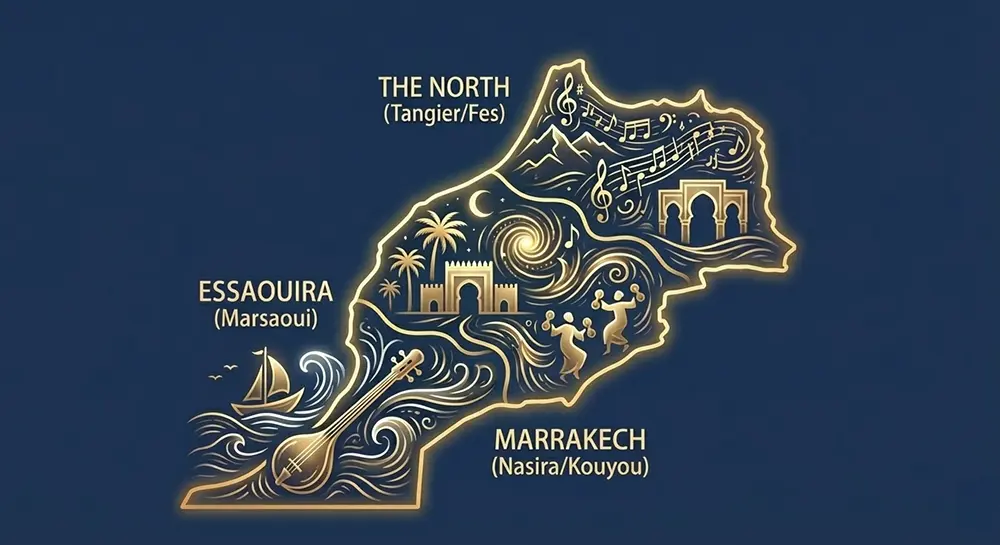
In 1998, the Gnaoua and World Music Festival launched in Essaouira, becoming an annual pilgrimage drawing hundreds of thousands. Traditional Maâlems like Mahmoud Guinea, Hamid El Kasri, and Mustapha Bakbou collaborated with jazz, rock, and electronic artists — proving Gnawa could speak globally without losing its spiritual essence.
UNESCO Recognition
On December 12, 2019, UNESCO inscribed Gnawa on the Representative List of Intangible Cultural Heritage of Humanity, recognizing it as:
“A set of musical productions, performances, fraternal practices, and therapeutic rituals where the secular mingles with the sacred.”
This was Morocco’s eighth UNESCO element. For the Gnawa community, it represented validation after centuries of marginalization — official recognition that the music of enslaved ancestors had become Morocco’s most celebrated cultural export.
The Living Tradition
Today, Gnawa exists in multiple forms: Traditional Lilas continue in homes and zawiyas for healing. Festival Performances bring music to global audiences. Street Performances in Marrakech offer accessible glimpses to tourists. Diaspora communities in France and Belgium maintain the tradition abroad.
The tension between sacred and secular, traditional and innovative, animates contemporary debates. Some worry commercialization strips spiritual power. Others argue evolution has always been central to Gnawa survival.
What remains constant is the music: the deep pulse of the guembri, the iron chatter of the qraqeb, voices calling across centuries to ancestors who survived the unsurvivable and created beauty from bondage.
Why Gnawa Matters
Gnawa is more than music. It is a historical document preserving the memory of trans-Saharan slavery. A spiritual technology offering healing through trance and community. A cultural bridge linking sub-Saharan Africa to the Maghreb. A testament to resilience — proof that the human spirit can transform suffering into transcendence.
When you hear the guembri rising from a Moroccan street, you hear enslaved Africans who refused to let their spirits die. You hear centuries of survival and creative resistance. You hear one of humanity’s great traditions, still alive, still healing, still calling to spirits across the centuries.
The Gnawa did not just survive. They transformed chains into music, exile into prayer, suffering into a gift that now belongs to the world.
"Gnawa is not just music. It is the sound of ancestors speaking through us, healing what history tried to break."
Continue Your Journey
Explore more about the world of Gnawa:
- From Slavery to World Music: The Hidden History of Gnawa — Dive deeper into how the music of enslaved Africans became Morocco’s most celebrated cultural export.
- The Gnawa Lila Ceremony: Full Ritual Explained — Step inside the sacred all-night healing ritual that is at the center of Gnawa spirituality.
- The Seven Mlouk: Colors, Spirits & Their Sacred Meanings — Understand the cosmic forces and spirit families at the heart of Gnawa cosmology.
Sacred Instruments
- The Guembri — Learn about the three-stringed bass lute that leads every ceremony.
- The Qraqeb — Discover the iron castanets that drive Gnawa’s hypnotic rhythms.
Legendary Artists
- Mahmoud Guinea — The King of Gnawa, whose guembri defined the Marsaoui style.
- Hamid El Kasri — The 21st-century superstar blending northern and southern traditions.