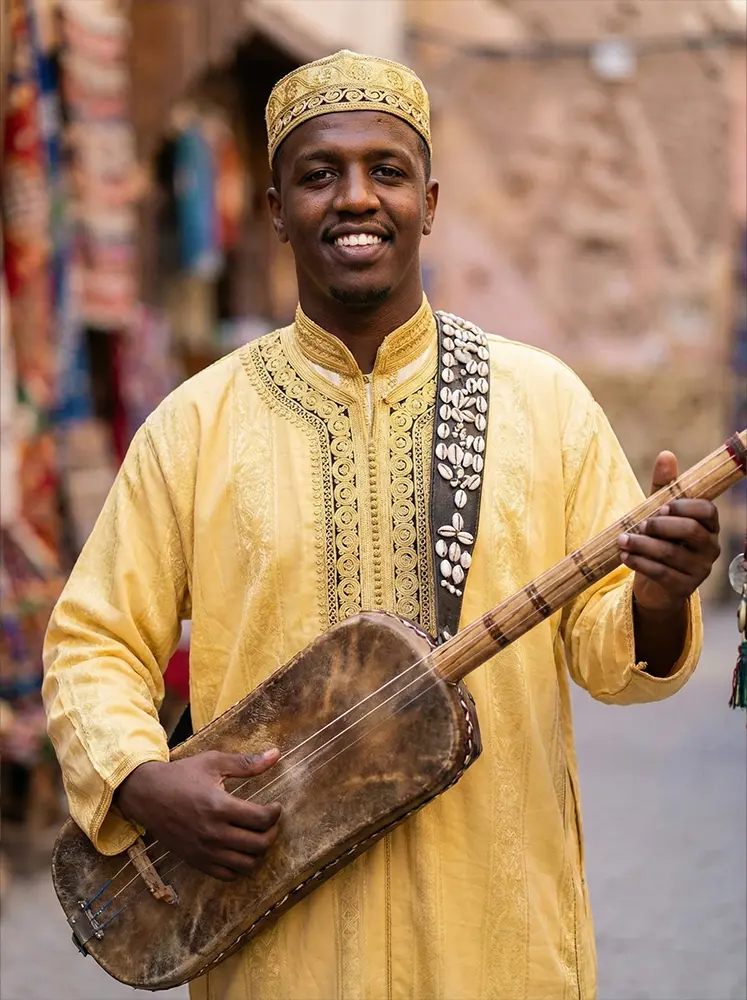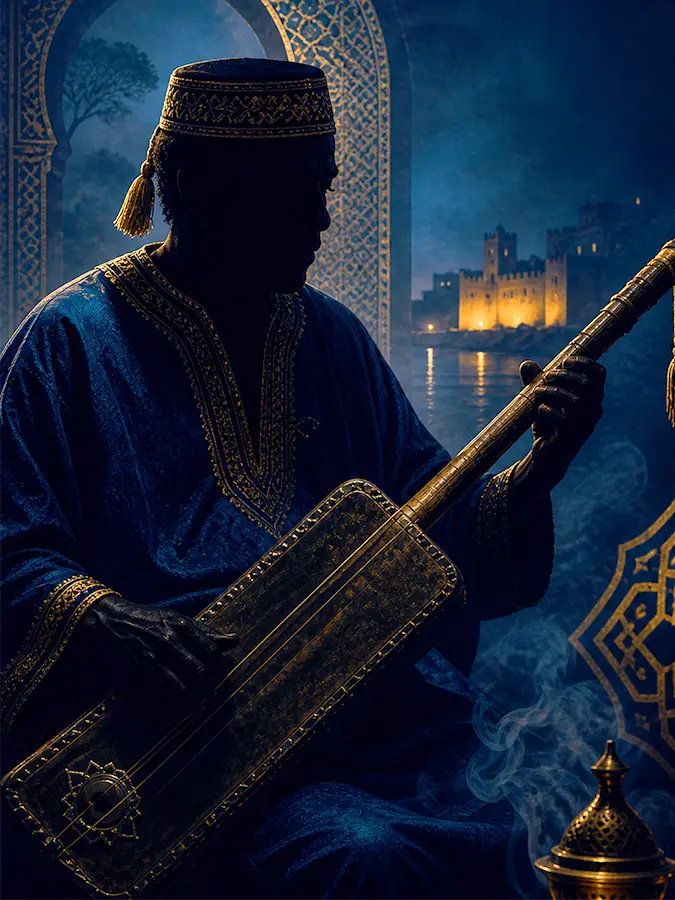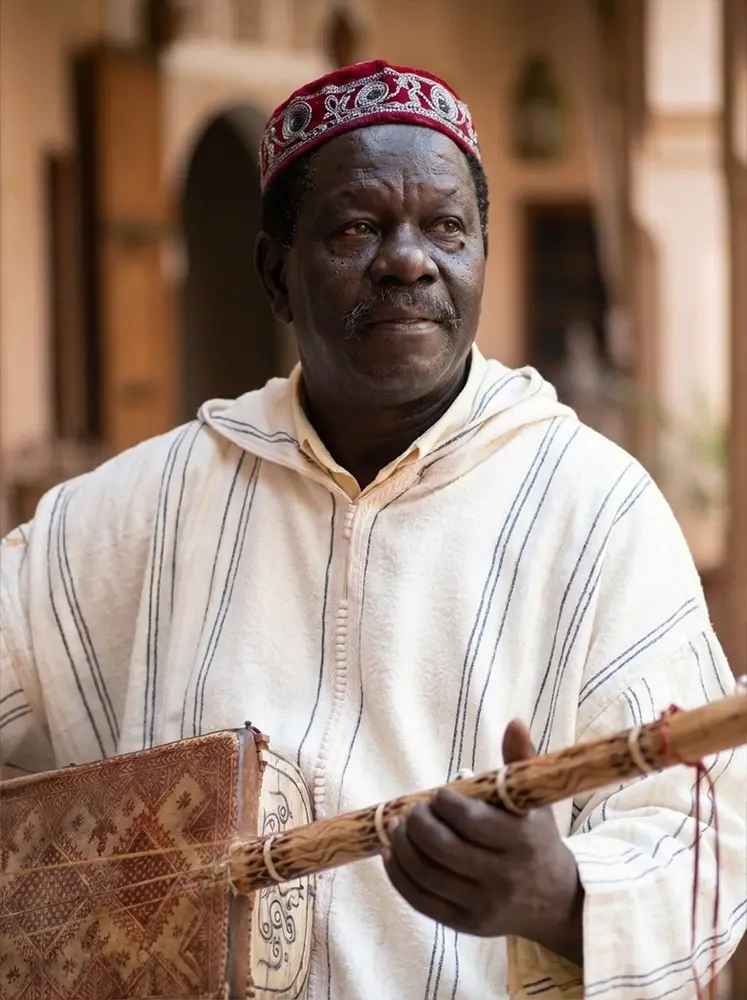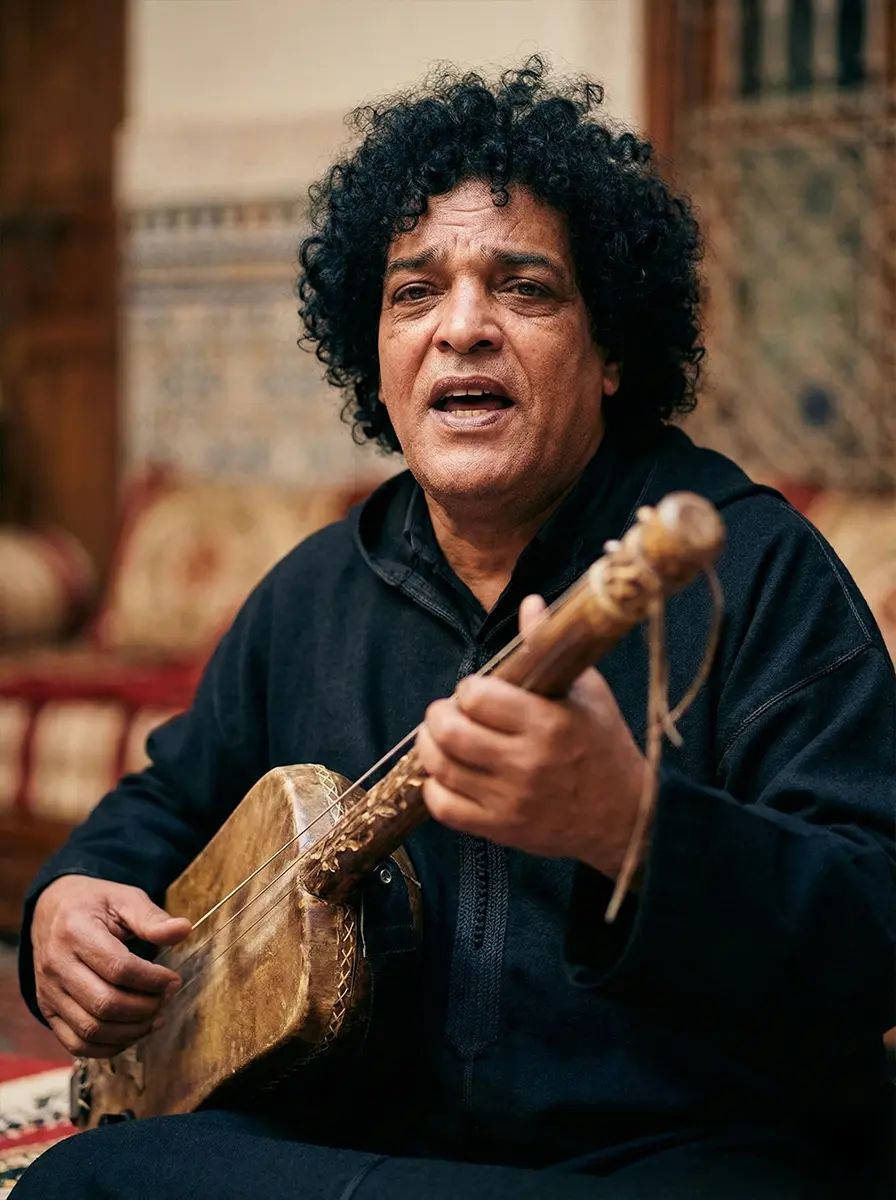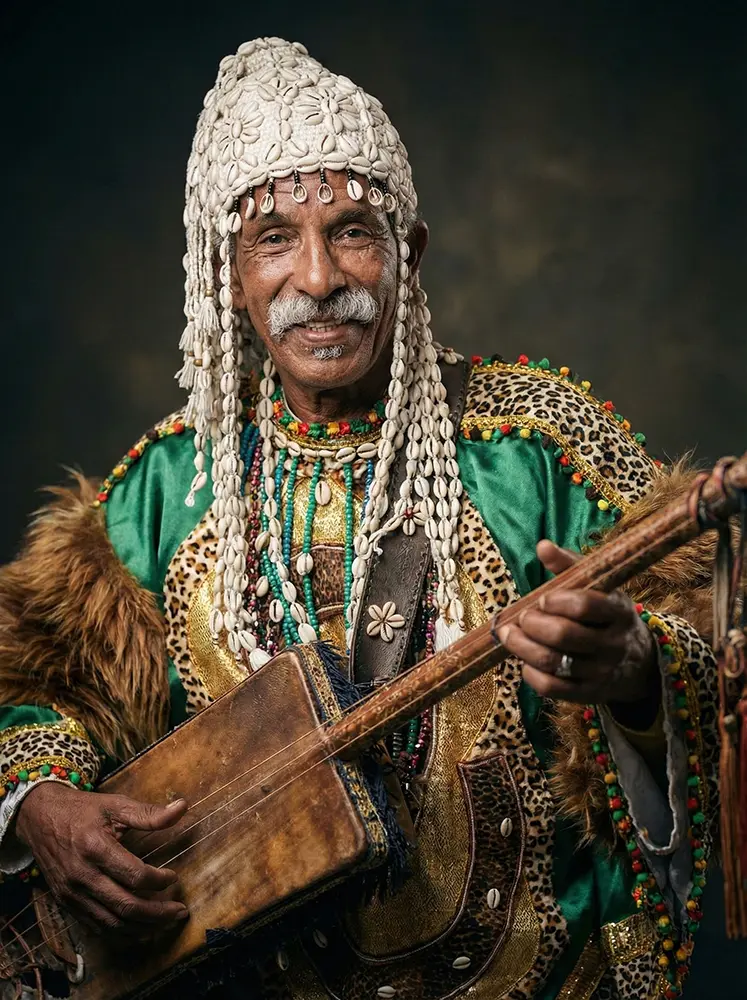
They call him “The Bob Marley of Gnawa.”
It’s not just the dreadlocks or the reggae inflections that have earned Maâlem Omar Hayat this nickname. It’s the way he transforms every performance into a celebration, the way he bridges the sacred and the joyful, the way he makes ancient African rhythms feel as fresh and liberating as a Kingston sound system.
Trained by the legendary Mahmoud Gania, rooted in the deepest traditions of Essaouira’s Gnawa heritage, Omar Hayat has carved out a unique space: a Maâlem who honors the ancestors while dancing with the modern world. He is the guardian who learned to groove.
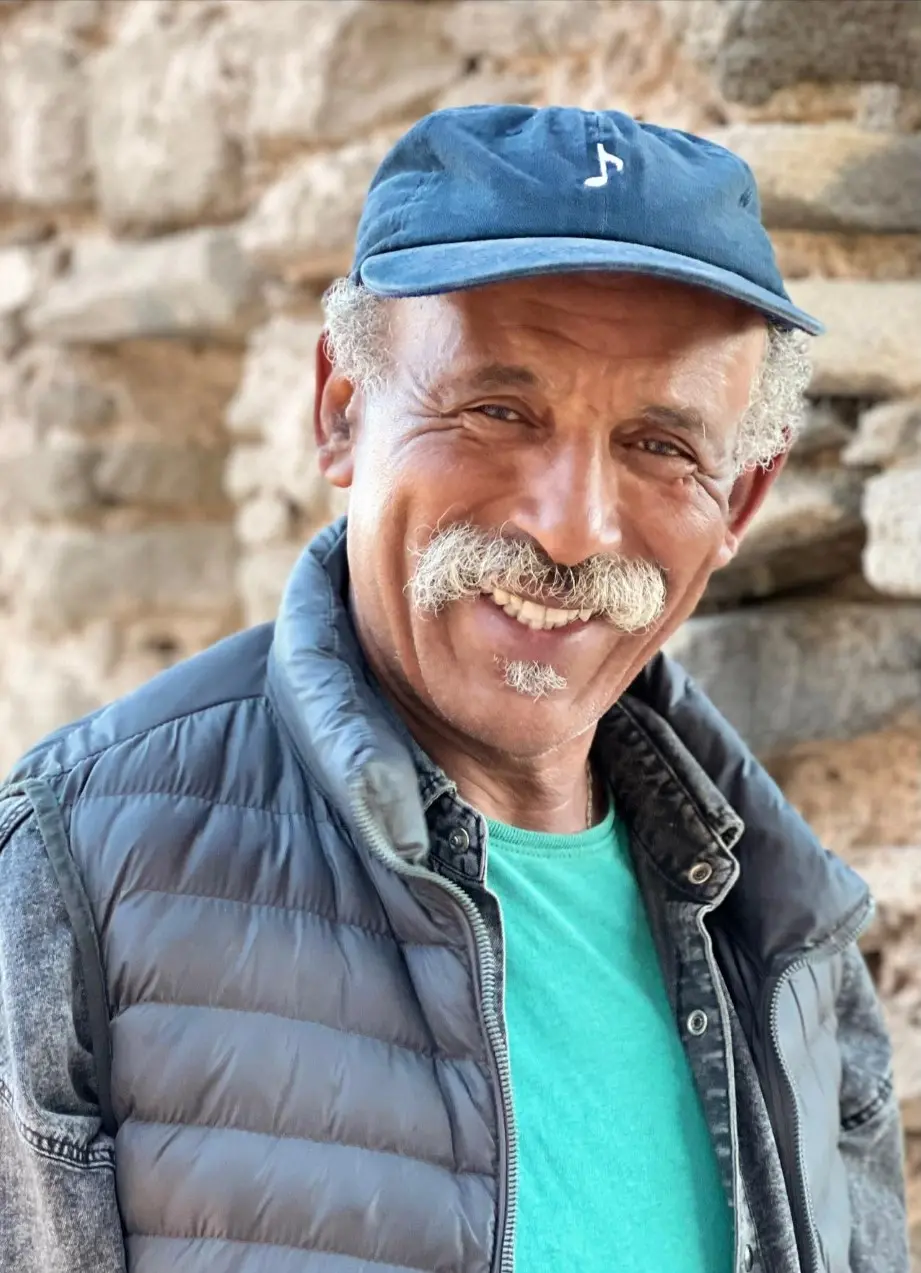
Born in the Wind City
Essaouira — the city where Atlantic winds carry the echoes of Africa, where Gnawa was born from the songs of the enslaved, where the annual festival draws hundreds of thousands to witness the sacred made spectacular. This is where Omar Hayat opened his eyes and first heard the guembri’s pulse.
Growing up in the narrow streets of the medina, young Omar was surrounded by Gnawa before he understood what it meant. The rhythms seeped through walls, the qraqeb chattered in nearby zawiyas, the masters walked the same alleys he played in. It was not music to him — it was atmosphere, as natural as the salt breeze from the sea.
But something in those rhythms called to him differently than to other boys. He didn’t just hear the music. He felt it pulling at something deep inside.
Learning from the Master
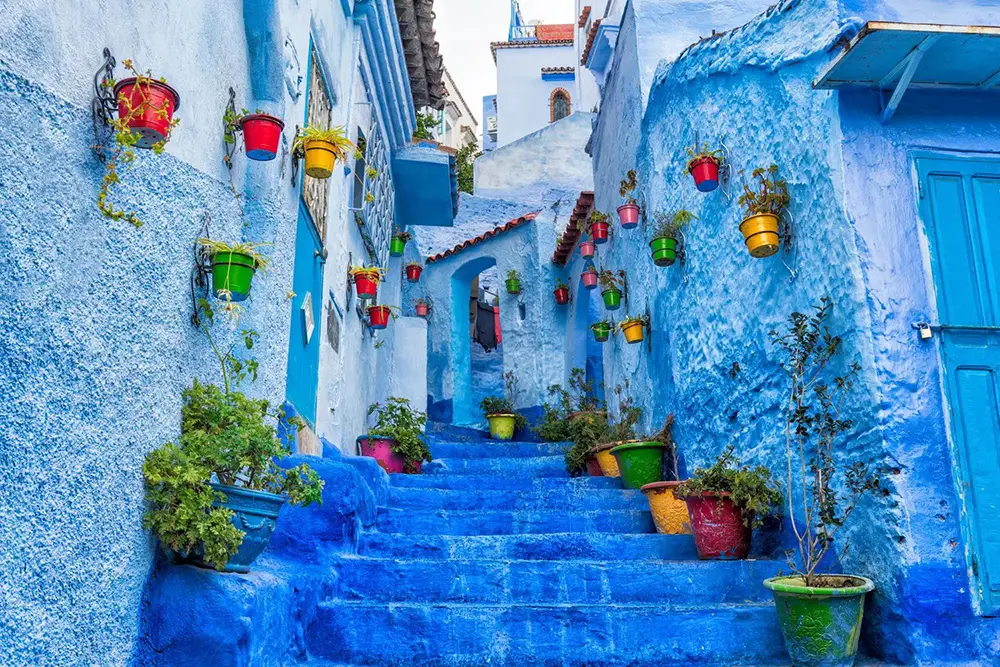
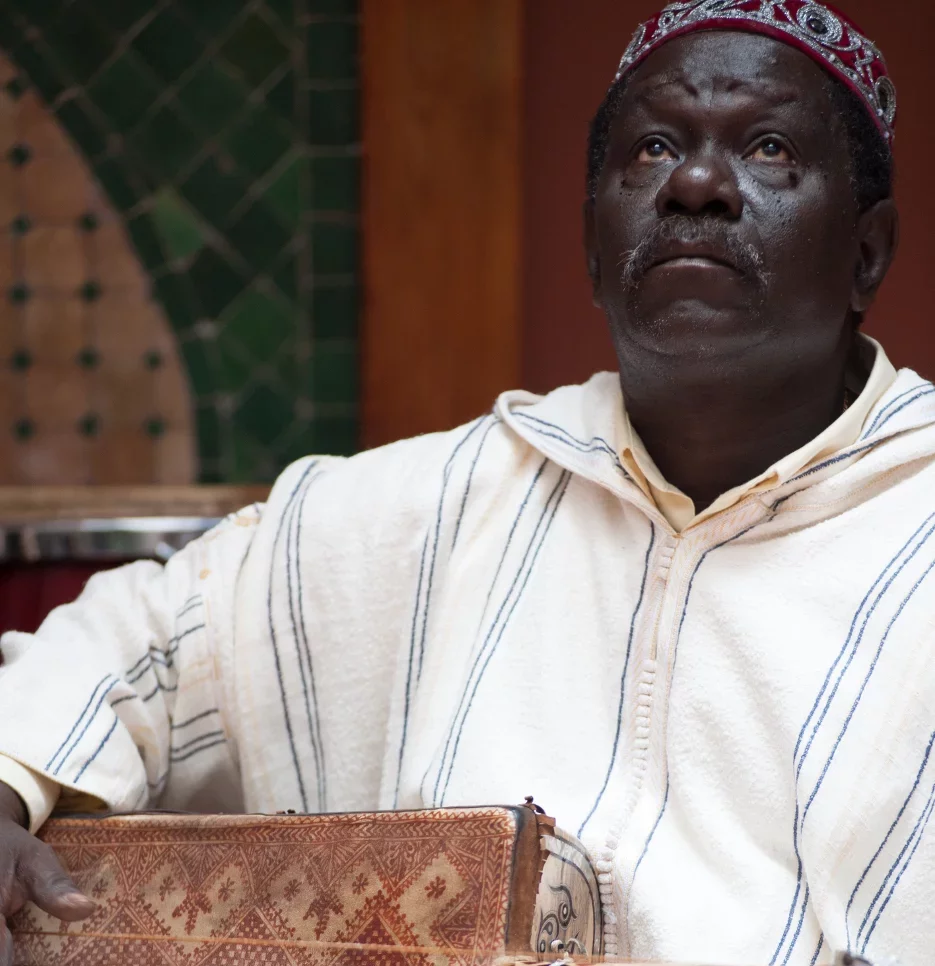
When Omar Hayat sought to learn the guembri, he went to the source: Maâlem Mahmoud Gania, the greatest Gnawa master of his generation, the “Smiling Saint of Essaouira.”
Under Mahmoud’s guidance, Omar learned more than technique. He learned that Gnawa is not performance — it is healing. He learned that the guembri is not an instrument — it is a voice that speaks to spirits. He learned that the lila ceremony is not entertainment — it is medicine for souls that modern life cannot cure.
But Omar also brought something of his own to these lessons. Where Mahmoud was serene and spiritual, Omar was electric and theatrical. Where Mahmoud smiled gently, Omar grinned wildly. The master recognized this energy not as rebellion but as a gift — a way to carry the tradition to audiences who might never sit through a midnight ceremony.
The Wolf in Ceremony Robes
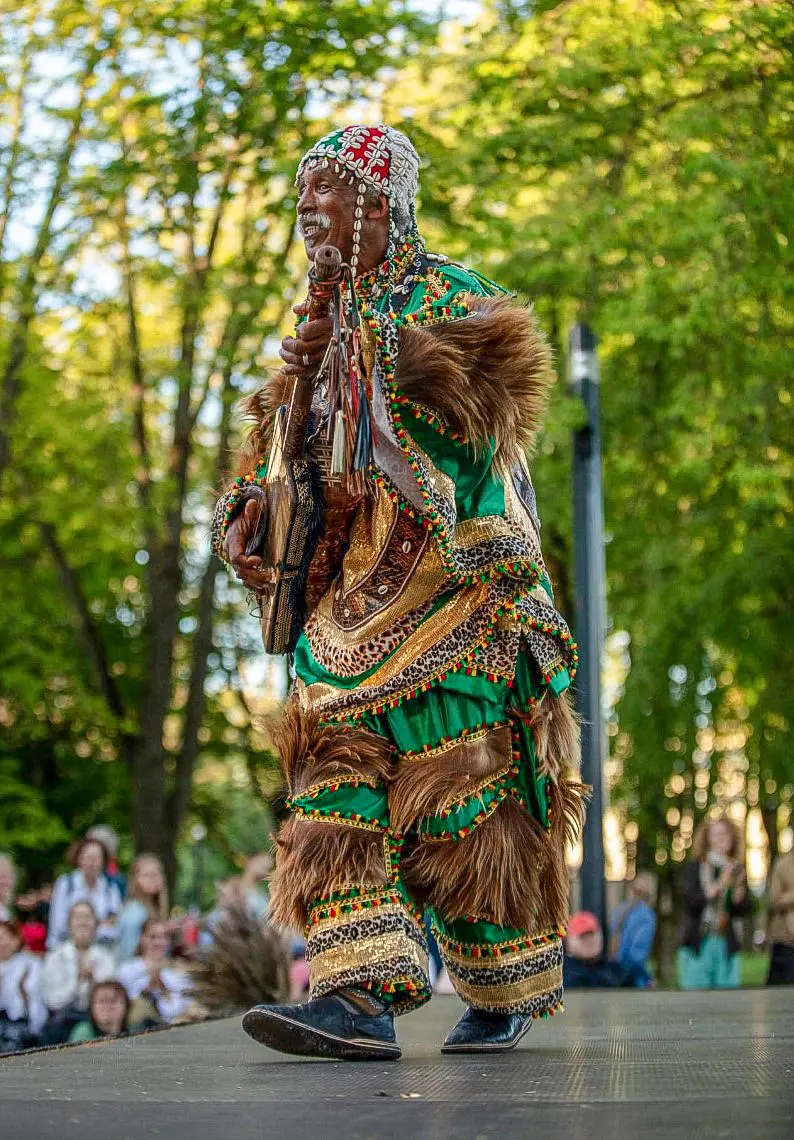
In 2015, at the Gnaoua Festival, Omar Hayat took the stage wrapped in a wolf-skin cloak — his signature theatrical touch. The crowd, still processing their shock at seeing the ailing Mahmoud Gania earlier that night, found themselves swept into a different energy entirely.
Omar played with fierce joy, combining the authenticity of traditional Gnawa with the showmanship of a rock star. He was the bridge between Mahmoud’s spiritual depth and the festival audience’s hunger for spectacle. He proved that honoring tradition and electrifying a crowd were not opposites.
“Omar Hayat is a product of the Mahmoud Gania school,” one critic wrote, “but he occupies the space between Gania and Hamid El Kasri — traditional enough to satisfy purists, theatrical enough to thrill newcomers.”
The Omar Hayat Sound
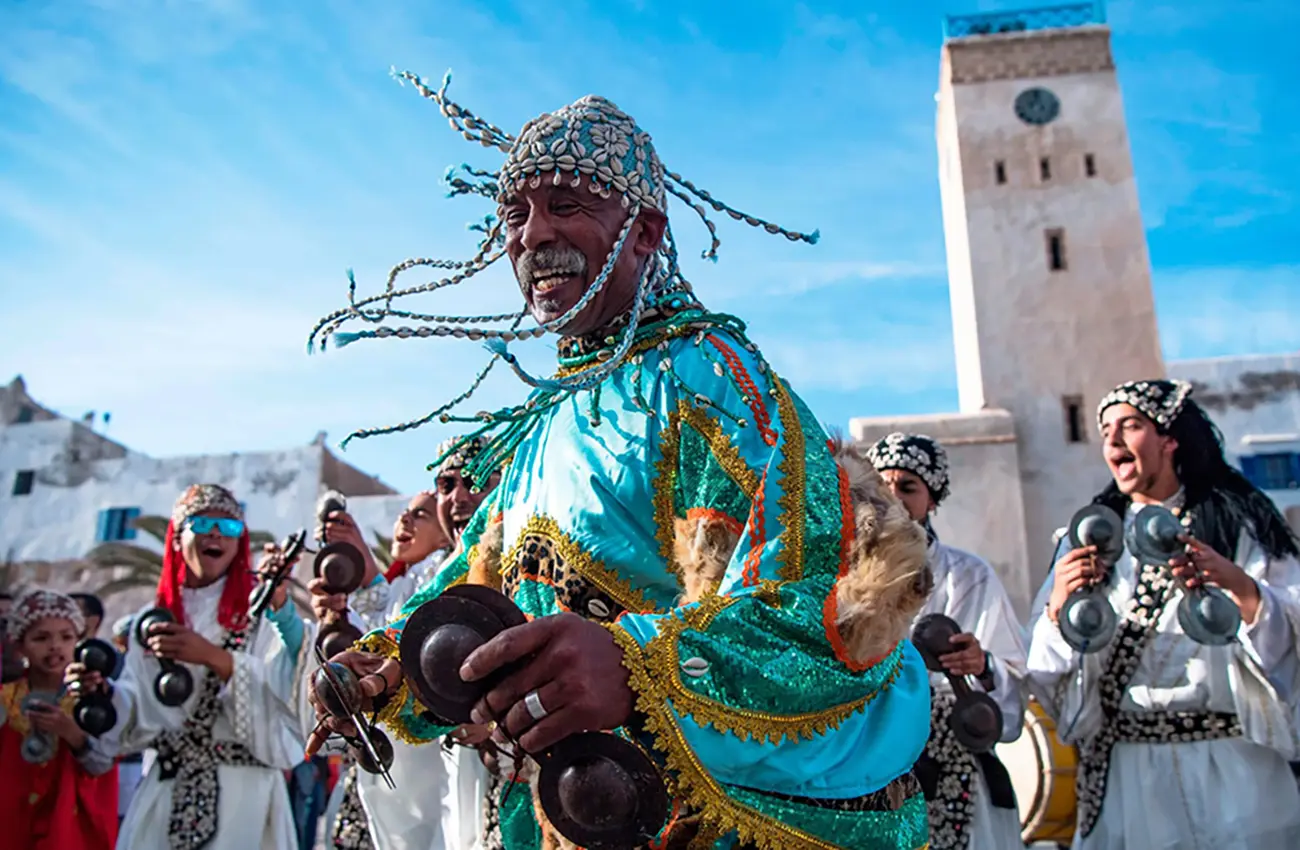
What makes Omar Hayat instantly recognizable is his fusion of Gnawa’s heavy, circular rhythms with reggae’s offbeat pulse. It’s a combination that sounds impossible on paper but feels natural in practice — after all, both traditions trace their roots to Africa, both emerged from the suffering of displaced peoples, both use repetition to induce altered states.
The Reggae Pulse
Offbeat accents and laid-back grooves woven into traditional Gnawa patterns — the Bob Marley connection made audible.
The Stage Energy
Theatrical presence that transforms ceremony into celebration — captivating tourists and locals alike.
The Handmade Sound
Builds his own guembris, ensuring each instrument carries his personal sonic signature.
His influences are clear: Jimi Hendrix, whose psychedelic explorations echo Gnawa’s trance states; Nass El Ghiwane, who proved Moroccan tradition could rock; and of course Bob Marley, whose spiritual reggae shares Gnawa’s healing mission.
Building Bridges
Since founding his own group in 1991, Omar Hayat has become one of Gnawa’s most adventurous collaborators, always seeking new conversations between traditions:
Ibrahim Maalouf (2008) — The Lebanese-French trumpet virtuoso joined Omar at the Gnaoua Festival, creating a fusion of Middle Eastern jazz and West African trance that electrified the crowd.
Médéric Collignon (2009) — The French pocket trumpet player and vocal experimenter found unexpected common ground with Omar’s theatrical approach.
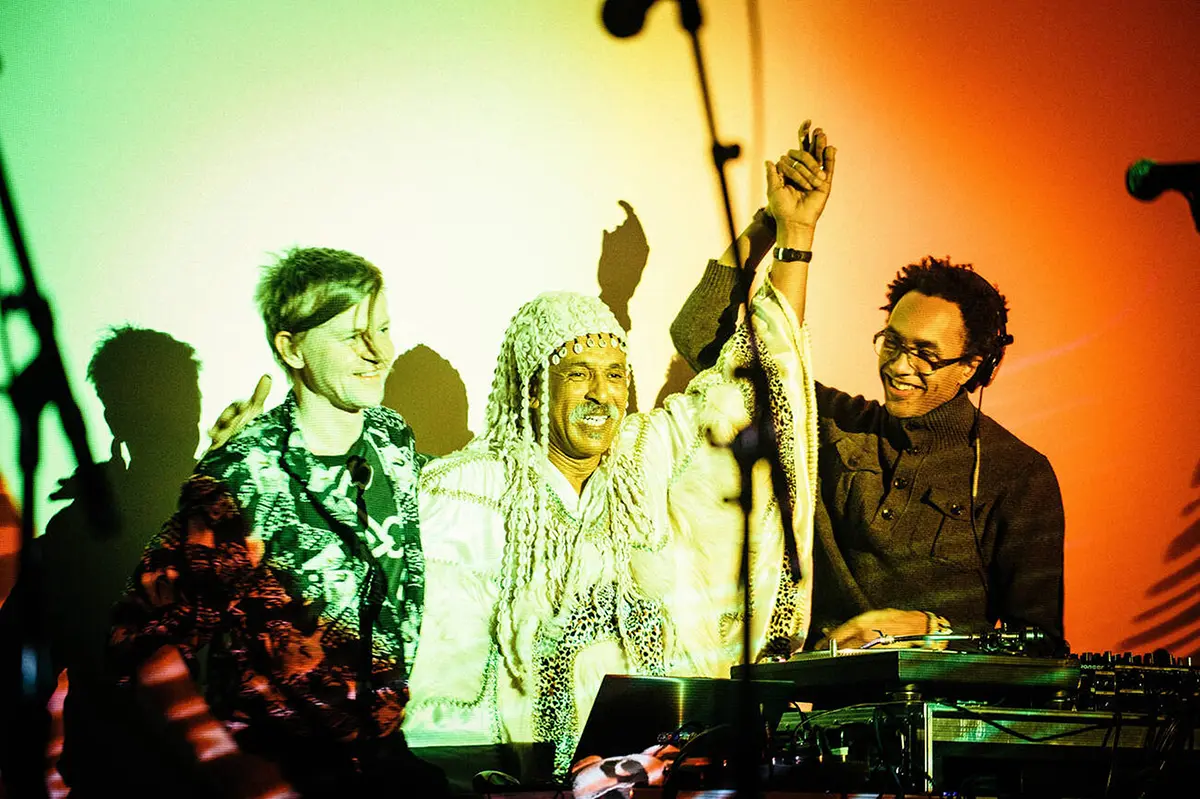
DJ Rupture (2016) — At Copenhagen’s prestigious Frost Festival, Omar proved Gnawa could dialogue with electronic music, trading ancient rhythms with cutting-edge beats.
Lahala Kingz (2011) — A collaboration with Essaouira’s hip-hop crew that brought Gnawa to younger Moroccan audiences.
The Festival Fixture
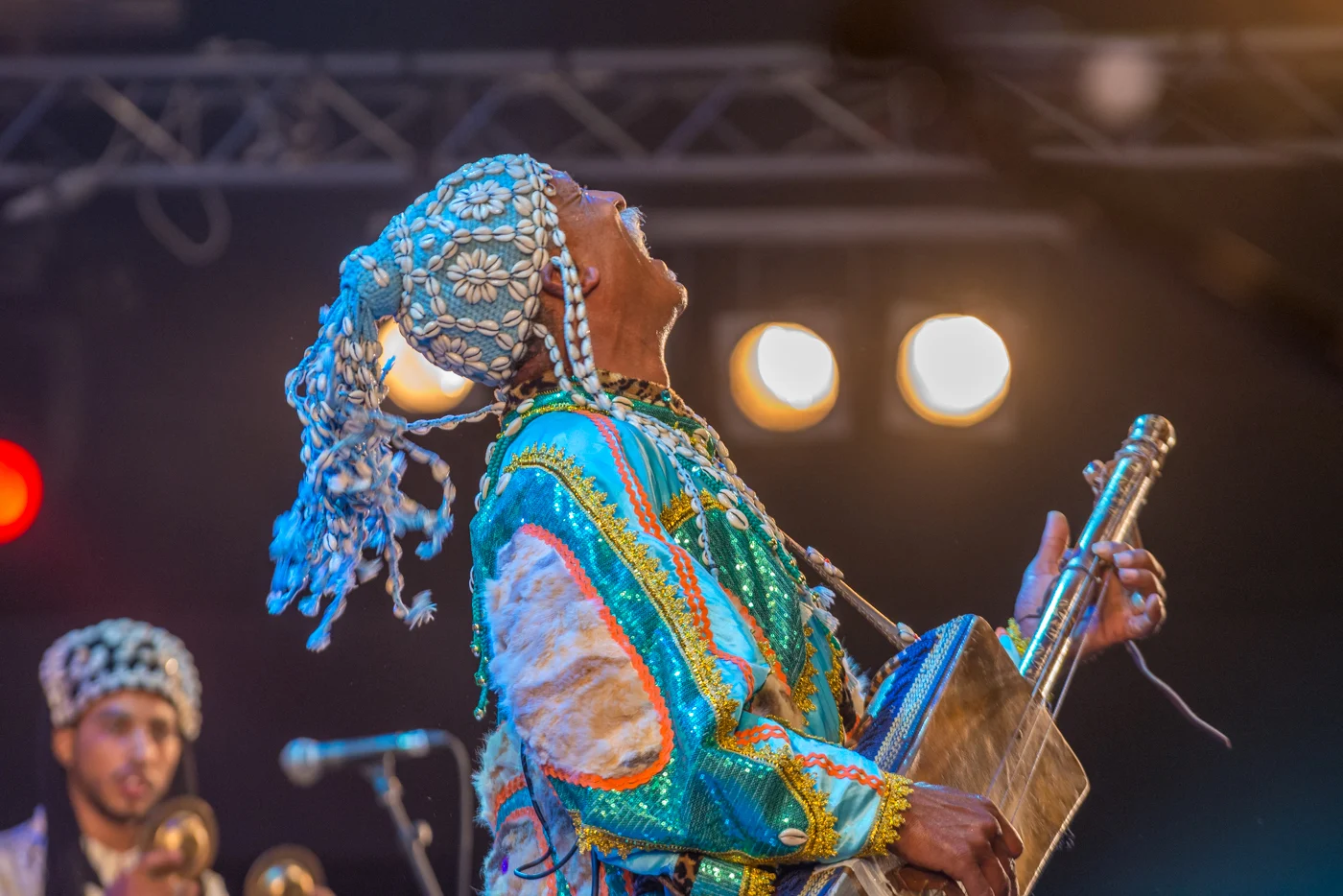
Omar Hayat has become a beloved regular at the Gnaoua and World Music Festival in Essaouira — the annual gathering that serves as Gnawa’s global showcase. Year after year, he delivers performances that balance tradition and innovation, satisfying purists while thrilling newcomers.
His appearances have become anticipated events: which guest will he bring? What theatrical surprise will he unveil? How will he transform the ancient into the immediate?
But beneath the spectacle, the spiritual core remains intact. Omar never forgets that he is a healer first, an entertainer second. The reggae grooves and wolf cloaks are doorways, not destinations — ways to invite new audiences into the deeper experience of tagnawit.
Passing the Rhythm
Now an established master, Omar Hayat faces the responsibility all Maâlems eventually confront: ensuring the tradition survives. He teaches in Essaouira, passing on not just technique but philosophy — the understanding that Gnawa is medicine, that the guembri speaks to spirits, that innovation must serve tradition rather than replace it.
His fear is the same fear that haunts all true Maâlems: that the sacred will be lost to spectacle, that the healing power will be sacrificed for applause. His mission is to prove this need not happen — that you can dance with the modern world without losing your soul.
Essential Listening
Loughmami
Traditional Ritual
Pure spiritual healing — Omar at his most traditional, channeling the ancestors.
With Ibrahim Maalouf
2008 • Festival Fusion
The legendary trumpet collaboration — Gnawa meets Middle Eastern jazz.
Essaouira Lighthouse
Live Performance
The spirit of Essaouira alive — theatrical energy and deep tradition in one unforgettable set.
"Gnawa is not music. It is a spiritual journey that connects generations."
— Maâlem Omar Hayat
The Guardian Who Dances
When Omar Hayat takes the stage — wrapped in his wolf cloak, dreadlocks flying, guembri thundering its ancient bass — he embodies a beautiful contradiction. He is deeply traditional and wildly modern. He is a spiritual healer and a showman. He is a guardian of sacred secrets and an ambassador to the uninitiated.
This is not contradiction. This is evolution.
The Gnawa masters of old sang the songs of enslaved Africans, transforming suffering into healing, exile into belonging. Omar Hayat continues this transformation, taking a tradition born in darkness and bringing it into the light of global stages, festival crowds, and new generations who discover in his reggae-inflected grooves a doorway to something ancient and profound.
The Bob Marley of Gnawa? Perhaps. But more accurately: a Maâlem for the 21st century, proving that tradition lives not by staying still but by dancing forward.