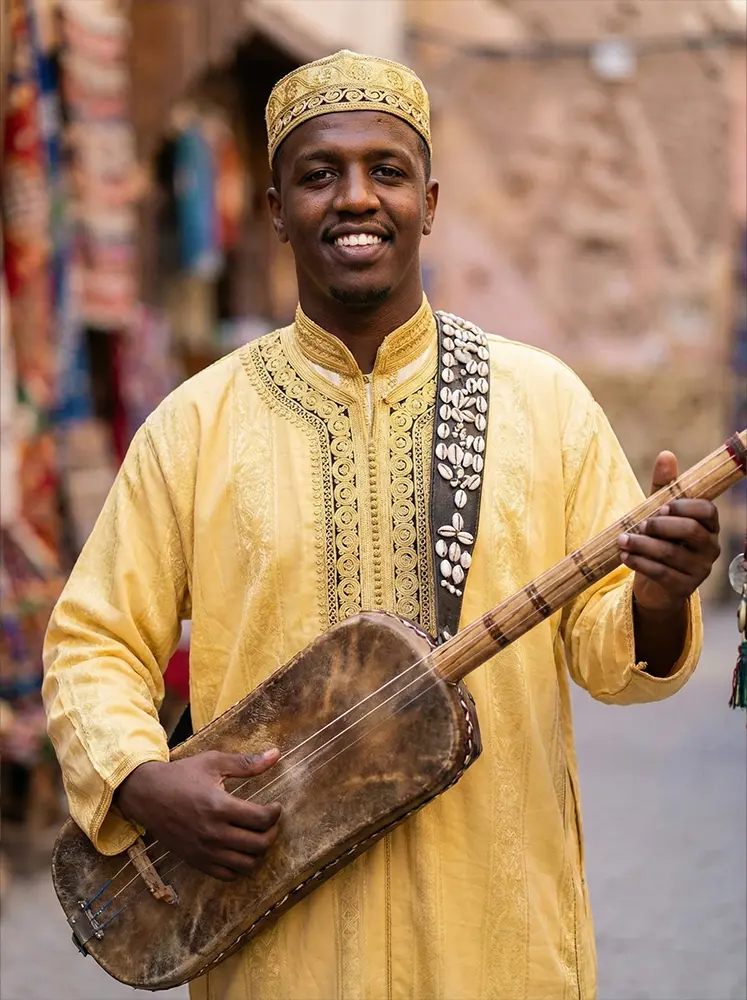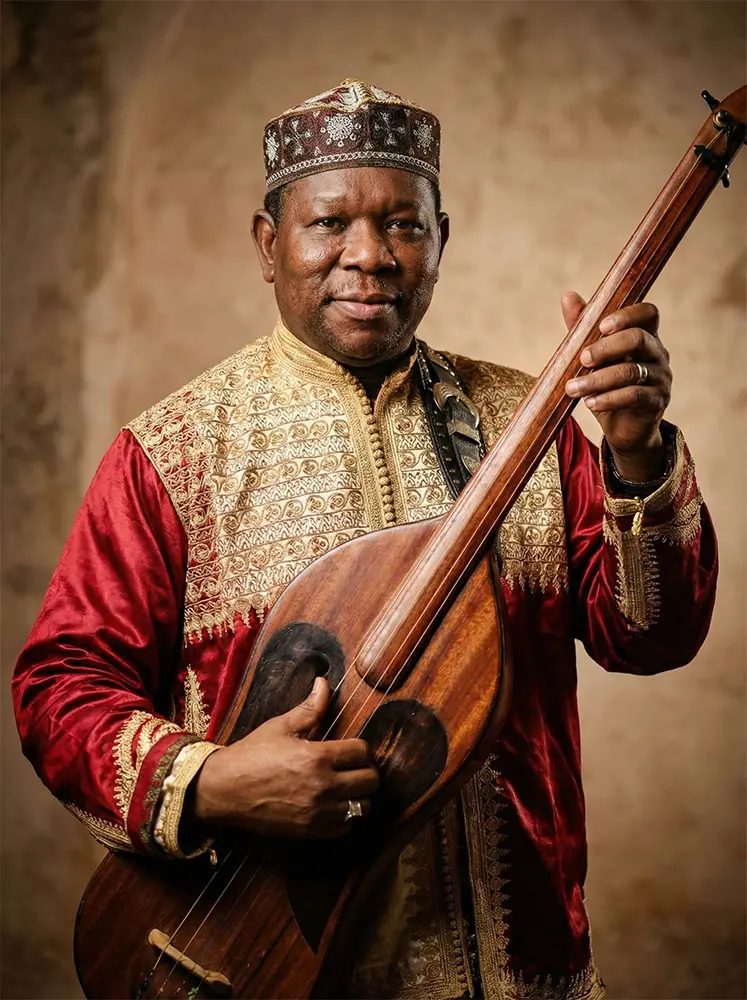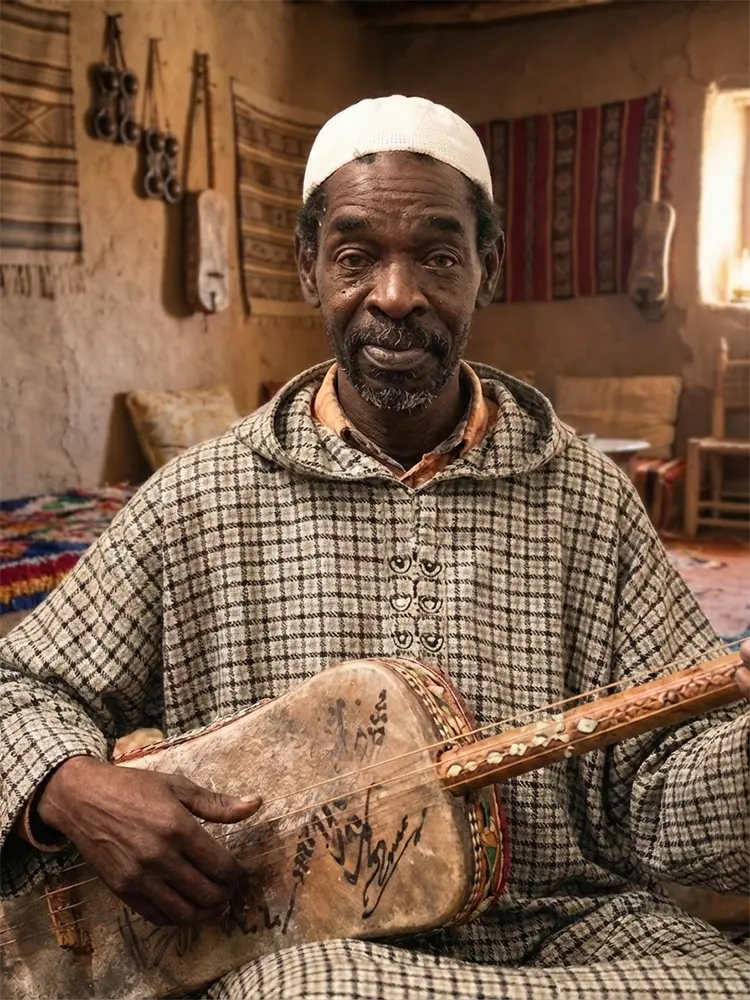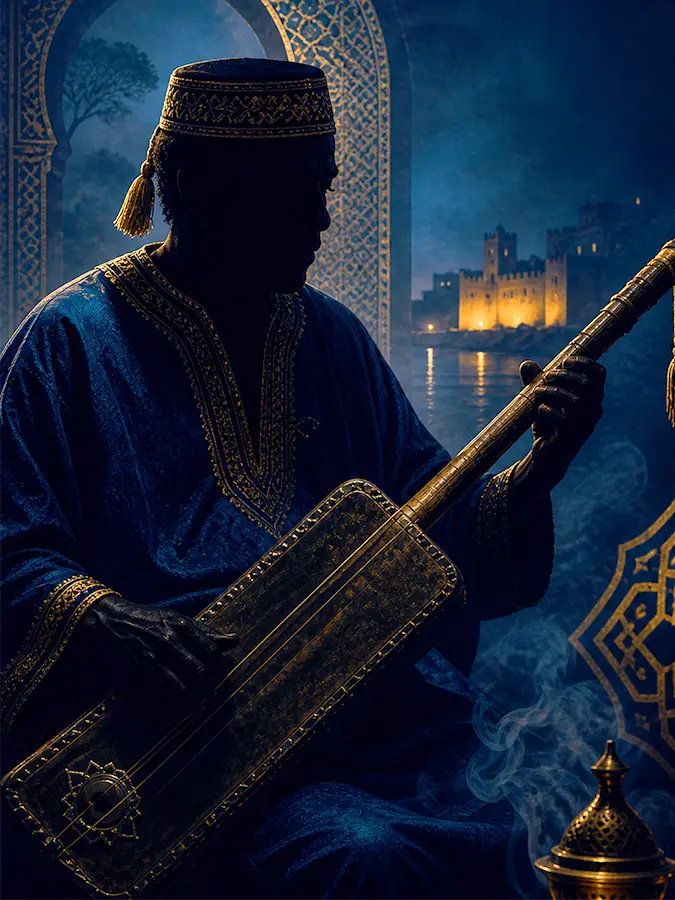
Why is the name of Maalem Mahjoub El Goubani always invoked when speaking of the deep roots of Gnawa? The answer transcends his musical brilliance to touch the very soul of this culture’s spiritual formation. He was the spiritual father and Moqadem of Zawiya Sidi Bilal in Essaouira — the primary guardian and custodian of the sacred ritual’s secrets. What sets him apart from his generation is that he represents a rare and living historical continuity: a family that preserved its tradition across 400 years of unbroken transmission from father to son. El Goubani was the most important traditional reference who established the pillars of Tagnaouite with an uncompromising rigidity — and yet, despite this ritual orthodoxy, he was a magnetic force that drew innovators and Western musical legends like Jimi Hendrix and Carlos Santana to explore the cosmic rhythm at his hands. He never sought renewal for the sake of spectacle. He was the original from which all inspiration for renewal sprang.
“My father was called M’Barek, and he was born in Chnafou in Sudan, from where he was kidnapped and sold in the desert, while my mother was originally from Bamako in Mali… As for me, I was born in Essaouira in 1923… and since 1985, I have been Moqadem of the Gnawa zawiya.”
— Maalem Mahjoub El Goubani speaking of his roots and the weight of his responsibilities (Namir Documentation, 1998)
Roots: The Trans-Saharan Thread
To understand the immense anthropological weight of Maalem Mahjoub El Goubani, one must dive into a history written not in manuscripts but in the living memory of Gnawa music. The history of the Gnawa community is oral — a “living” history re-enacted every time guembri strings vibrate and iron qraqeb clash.
El Goubani was born in Essaouira (ancient Mogador) in 1923. But his real roots pierced deep into the African continent, beyond the Atlas Mountains and the sands of the Sahara. His father, named M’Barek, came from a village called Chnafou in Sudan. His family’s arrival in Morocco was not a voluntary migration — it was the direct product of kidnapping and enslavement. His grandfather and father were seized from their village by force of arms and sold as slaves, enduring the brutal hardships of the trans-Saharan caravan route. His mother’s fate was no less tragic: she was captured from the region of Bamako in Mali and driven along the long and desolate road of slavery northward.
The Exceptional Family
The Soudani family represents a historically and anthropologically exceptional case within the Gnawa social fabric. While many who belong to this community today find it difficult to pinpoint the precise geographic or ethnic origin of their ancestors — due to the violent rupture caused by the slave trade that peaked between the sixteenth and seventeenth centuries — the Soudani family managed to preserve this direct lineage, becoming a living and tangible testament to cultural continuity across the Sahara.
To understand how this family ended up in Essaouira, one must return to the roots of the Gnawa presence in the region. Enslaved people were initially brought from Sudan and Mali to work in sugar factories in the Haha region south of Essaouira. With the establishment of Essaouira’s great port in 1760 by Sultan Sidi Mohammed Ben Abdellah, more enslaved people arrived from Senegal, Sudan, and Ghana.
The Sacred Sound of Survival
In this socio-historical climate saturated with pain, music was not a form of artistic entertainment for El Goubani’s ancestors — it was a vital tactic for survival and a spiritual tool for healing the wounds of captivity and exile. The Gnawa songs constitute an oral historical record narrating the death marches across the barren Sahara, documenting the suffering of slavery and the trauma of uprooting. The guembri that El Goubani would one day master is described by its makers with deep poetic and spiritual feeling as “the drop of blood that was shed” — from this bleeding wound, the instrument draws its haunting spiritual dimension.
El Goubani grew up within the walls of Zawiya Sidi Bilal in Essaouira, the spiritual refuge and seat of the Gnawa brotherhood. His childhood was not ordinary. The zawiya was not merely a music school — it was a hospital for souls, a temple gathering the African diaspora. In the first Lilas he attended as a child, he was not watching a “performance” but witnessing complex healing rituals of the derdeba. There, his senses absorbed the ascending rhythm of the guembri intertwined with the piercing fragrances of incense — jawi, frankincense, and sheba — and he watched how the seven colors of the Mlouk (spirits) controlled the bodies of participants, transporting them into the state of jedba (trance).
He understood from his earliest formative years that these chants were not secular music, and that the guembri was not merely a piece of argan wood strung with goat-gut strings. This instrument holds the history of an entire people.
The Calling: The Moqadem’s Mantle
Maalem Mahjoub El Goubani did not wake up one day to simply decide to become a “Maalem” or “Moqadem.” In the Gnawa world, the title is not seized — it is granted based on spiritual merit, accumulated knowledge, and the ability to navigate hidden worlds.
Over decades of practice and total submission to the laws of the zawiya and the guidance of the sheikhs who preceded him, El Goubani advanced through the paths of Tagnaouite. The pivotal moment and crowning achievement of his journey came relatively late in his life — testament to the weight of the position and the greatness of the responsibility.
In 1985, he received the greatest calling: he was officially appointed Moqadem of the Gnawa zawiya (Zawiya Sidi Bilal) in Essaouira. Only two years later, in 1987, his standing was further cemented when he was installed as Moqadem of the Gnawa brotherhood for the entire city — the supreme, unrivaled reference.
The Moqadem’s Distinction
The title of Moqadem differs fundamentally from that of Maalem. A Maalem may be a skilled performer; the Moqadem is the supreme spiritual, administrative, and ritual authority within the brotherhood. He is the supreme leader who organizes the course of the healing “Lila” from sunset prayer to dawn. He alone is presumed to possess complete and comprehensive understanding of the secret sequence of the ritual phases (mahallat), the seven colors associated with each spiritual entity, and the precise types of incense required by each case to calm the “Jnoun” (spirits).
El Goubani was not merely a musician leading a band — he was the metaphysical shield protecting his followers. He was the anchor ensuring that souls returned safely to their bodies after soaring through realms of transcendence.
The Moqadem's Role
Director of the complete Lila from sunset to dawn. Controls the sequence of the seven colors, the incense, and the transition between each spiritual phase.
400-Year Lineage
Custodian of a tradition transmitted father to son from Sudan to Morocco across four centuries. A living testament to trans-Saharan cultural continuity.
Guardian Against Dilution
Among fewer than 10 masters in Essaouira capable of conducting a true healing Lila. He stood as the last line of defense for the sacred core of Tagnaouite.
The Unique Style: The Essaouira School
To understand the artistic fingerprint of Maalem El Goubani, we must engage in musical and rhythmic anatomy that goes beyond encyclopedic description.
The Essaouira school he inherited and developed — specifically the Soudani family’s approach — is distinguished by a vitality and rhythm that leans toward what modern music theory calls Funk: a nuanced rhythmic attack and a dark “blue sense of pitch” in extracting tones.
The Technique: Drop-Thumb Frailing
The secret lies in the method of taming the guembri. The authentic playing relies on a technique of extreme complexity known in ethnomusicology as “brushless drop-thumb frailing.” This ancient technique — documented in nineteenth-century banjo teaching manuals in America as an African inheritance — avoids sweeping multiple strings at once to produce chords. Instead, the thumb falls repeatedly and rhythmically on the free-vibrating bass string, creating a pulsating drone resembling circular heartbeats. Simultaneously, the index and middle fingers pluck sharp rhythmic patterns in a style resembling Morse code percussion.
This brilliant combination creates two sonic layers from a single instrument: a hypnotic, circular layer below; a vital, urgent layer above. The distinctive sound resonates through strings made from twisted, dried goat gut, stretched over a resonance box covered with camel skin.
| Element | The Goubani School Signature |
|---|---|
| Rhythmic Dynamic | Gradual transition from deep heavy rhythm to accelerating circular spirals -- facilitating spiritual ascent |
| Guembri Technique | Drop-thumb frailing: continuous low drone (bass pulse) combined with rapid African-style upper percussive strikes |
| Qraqeb Role | Syncopated rhythmic engine driving the cycle toward its peak -- not accompaniment, but a second lead voice |
| Philosophy | Strict literal adherence to ritual texts and mahallat sequence, with a distinctive "funky" rhythmic attack that gives the school its vital character |
Sacred or Stage?
For Maalem El Goubani, music was first and foremost a sacred ritual (Sacred). Even as the music began to acquire a secular, performative character — played before audiences in open squares — he remained firmly attached to its therapeutic and spiritual function. He was acutely aware of the danger of Gnawa culture becoming consumable folklore. Surrendering the sanctity of the ritual meant emptying the music of its historical charge as the voice of the enslaved people’s suffering. He never mixed healing performance in the zawiya with passing tourist spectacle.
Career and Recognition
Maalem El Goubani’s professional path did not follow the mechanisms of modern star-making. He had no management, no ambition for world tours. His path was firm and rooted in place — like an ancient argan tree driving its roots deep into Essaouira’s soil. And because the mountain does not move, the world chose to make pilgrimage to it.
When the West Made Pilgrimage
In the late 1960s, in the context of a global search for roots, giants of the world guitar like Jimi Hendrix and Carlos Santana traveled to Morocco, heading specifically to Essaouira to meet and play with Maalem El Goubani.
Hendrix was haunted by an obsession with hidden spiritual worlds — his music was filled with veiled references to supernatural phenomena and attempts to break the boundaries of consciousness. When he visited Morocco, he was searching for the “original blues” — the unwritten music that liberates the soul. He found in El Goubani’s performance a reflection of his own music: infinite improvisation over a fixed, strict rhythmic foundation.
Santana, who stated repeatedly that Hendrix was a great spiritual and musical inspiration for him, believed that true music works by “setting the mind aside because it is limited, and allowing the soul and heart to be freed.” This Santana philosophy aligns astonishingly with the principle of the Gnawa jedba that El Goubani led.
For El Goubani, fusion was not a rejection when understood as hosting guests in his spiritual home. He welcomed foreign musicians to sit and play with him, on the condition that the guembri rhythm and qraqeb pattern remained unchanged. He saw Fusion as a dialogue between instruments, not a dissolution of identity.
The Posthumous Honor
The greatest irony and tribute in his journey came after his death — in a way laden with poignancy that confirms his towering presence. Maalem El Goubani departed this world in 1997. The following year, in June 1998, the inaugural edition of the Essaouira Gnaoua and World Music Festival was launched. It began not as the massive public gathering we know today, but as an intimate and intense event — as if held expressly as a spiritual tribute and great honor to the generation of pioneering masters who were departing the scene, with El Goubani at their forefront. In that first edition, within the institution of “Dar Essouiri,” an authentic Lila was held that recalled the ritual vigil he had established, with his sons present to carry his legacy to the new stage.
Fusion and Musical Bridges
Gnawa music is in its very essence historical fusion — it melted African memory (Western Sudan, Senegal, Mali) with Amazigh and Arab spiritualities in a Moroccan Sufi crucible. So the idea of cultural blending was not foreign to this brotherhood.
The most prominent example: El Goubani’s son, Maalem Najib Soudani, founded The Sudani Project to merge jazz with Gnawa in collaboration with saxophonist Patrick Brennan. Brennan noted with sharp intelligence that the role of the metal qraqeb and the guembri’s thick strings precisely parallels the roles of the cymbal and bass in a jazz ensemble — making dialogue between them natural and astonishing.
This lineage of fusion, born from El Goubani’s open-yet-rooted philosophy, established the model for authentic Gnawa collaboration with world music: dialogue without dissolution, openness without betrayal of the ritual core.
Legacy and Transmission
El Goubani bequeathed a tradition spanning 400 years of father-to-son transmission. He fathered six sons who formed the Soudani Brothers group. Among them, two names carried the Essaouira Tagnaouite to the world:
Maalem Najib Soudani — Raised inside Zawiya Sidi Bilal under his father’s direct supervision. Najib does not merely perform; he maintains a modest workshop near “Derb Oujda” in Essaouira for building guembri instruments by hand and forging qraqeb — a maker of sound and guardian of heritage.
Maalem Allal Soudani — Known as “the Dreamer.” He embodies the organic phenomenological dimension of Gnawa ritual, describing the state of playing and jedba in an expression passed down from his father: “When I play, I no longer feel my body. I empty myself completely. And when I reach the state of ecstasy (Trance), I become nothing but a leaf on a tree swaying at the mercy of the wind.”
What He Feared Would Be Lost
The greatest fear was summarized in the paradox of popularity. For Gnawa culture to survive in the modern age, it had to become popular and known — yet this dense popularity (Profane) threatens to slowly kill its sacred core (Sacred). Today, Essaouira teems with private concerts and hundreds of musicians performing tourist spectacles, while fewer than ten masters possess the actual spiritual ability to conduct a complete sacred healing Lila. El Goubani wanted to leave behind a generation that understood that this music was born from the womb of slavery’s suffering, and that its primary function is healing and binding the spiritual wounds of “the drop of blood that was shed.”
Essential Listening
Sudan Mahallat
Ritual / Memory
Songs played to summon the ancestors, repeating phrases of exile and loss: "They brought us from Sudan... the masters of this land brought us to serve them." This is not mere singing -- it is a historical record of the trauma of enslavement. The listener feels the weight of footsteps in the desert, the guembri weeping softly to reflect buried sorrows.
Mlouk Mahallat
Therapeutic / Jedba
Recordings showcasing the Essaouira school's funky style. Beginning quietly with the drop-thumb frailing technique, before qraqeb rhythms ascend in spiral form. This track demonstrates the school's capacity to empty consciousness of its material constraints and allow the body free expression under the influence of trance.
The Sudani Project
The Son's Heritage / Jazz Fusion
The collaborative album (Sudani CD) bringing together Maalem Najib Soudani, Patrick Brennan, and Nirinkar Khalsa. This work demonstrates how the authentic Tagnaouite established by El Goubani can interweave with jazz -- achieving civilizational dialogue without surrendering its spiritual momentum. A living extension of the father's legacy.
"My father was called M'Barek, and he was born in Chnafou in Sudan, from where he was kidnapped and sold in the desert, while my mother was originally from Bamako in Mali... As for me, I was born in Essaouira in 1923... and since 1985, I have been Moqadem of the Gnawa zawiya."
Maalem Mahjoub El Goubani (Namir Documentation, 1998)
Continue Your Journey
- The Essaouira School — The regional tradition El Goubani guarded and shaped
- Gnawa Slavery and World Music History — The trans-Saharan roots that define his family’s story
- The Gnawa Lila Ceremony Explained — The healing night El Goubani presided over as Moqadem
- The Seven Mlouk: Colors, Spirits, Meanings — The spiritual map he navigated with absolute mastery
- Maalem and Moqaddema: The Sacred Roles — Understanding the distinction between Maalem and Moqadem
- Gnawa Festival Essaouira Guide — The festival born the year after his passing
- Mahmoud Guinea — His contemporary, the other pillar of the Essaouira school
- Boubker Guinea — The patriarch of Essaouira’s most famous Gnawa dynasty