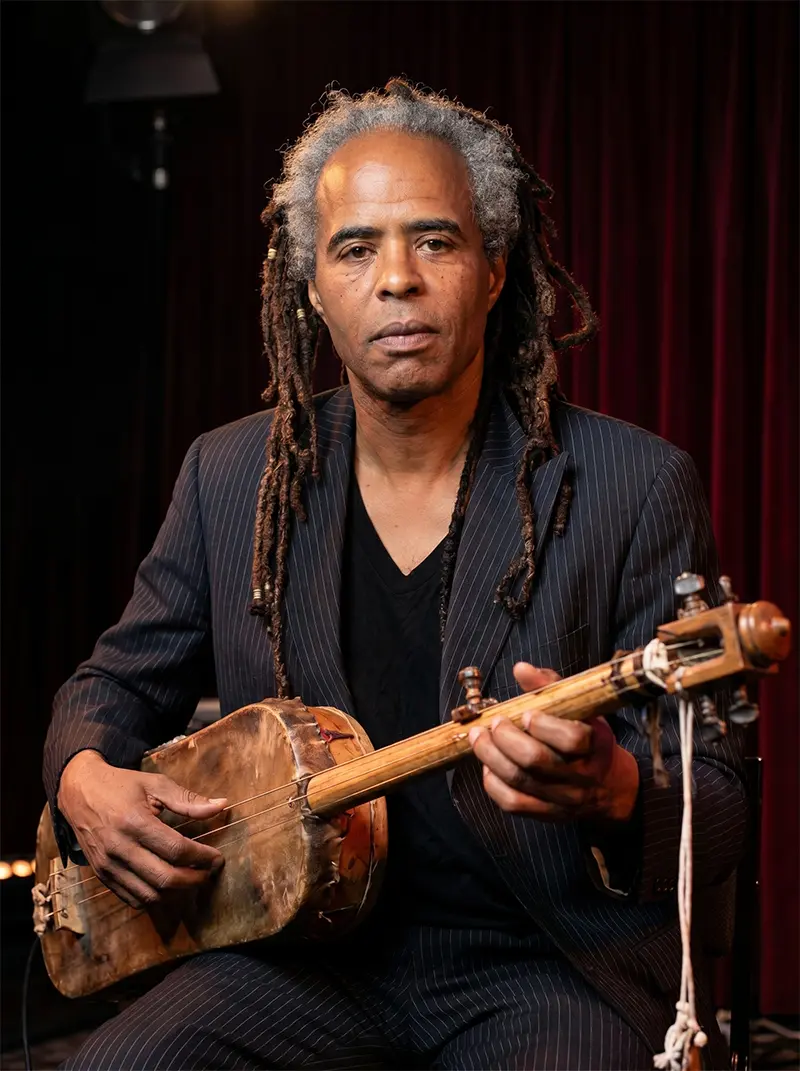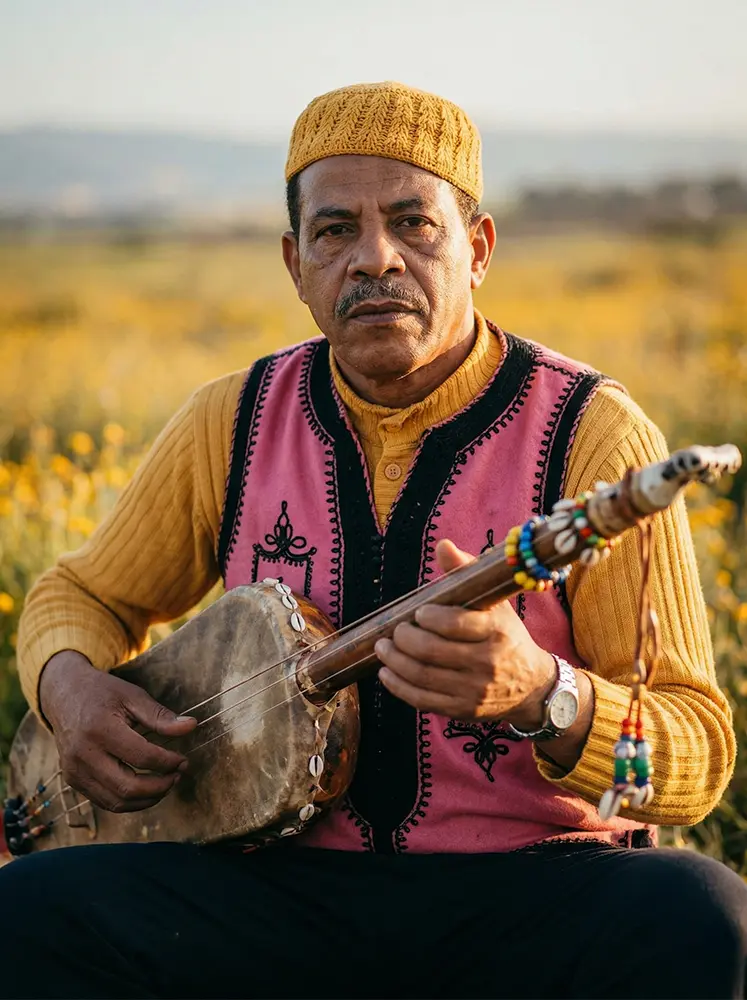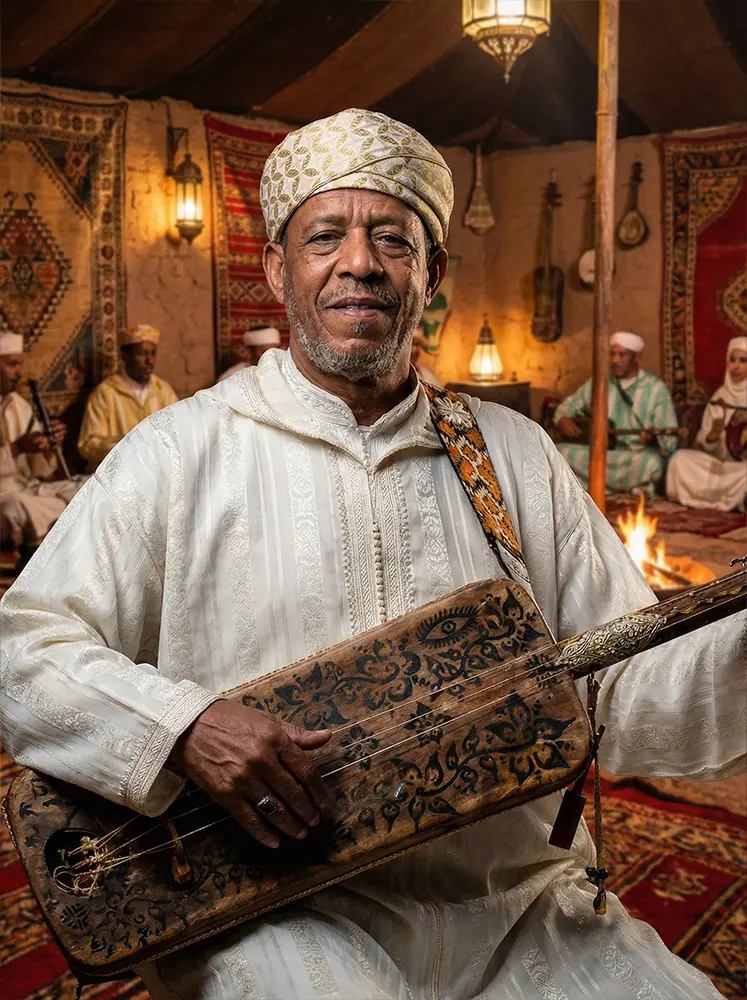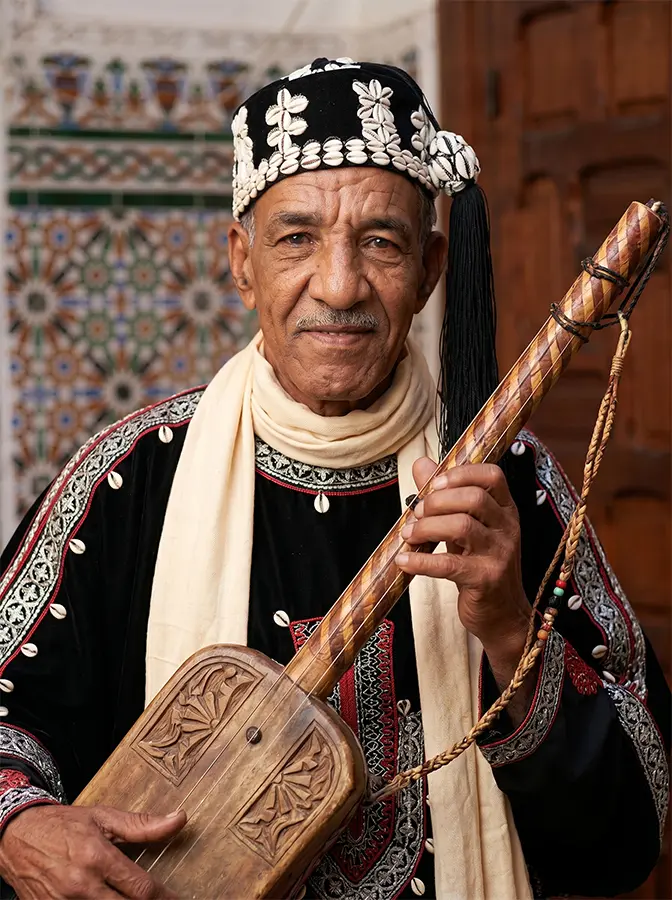
There are names in the world of Gnawa that play music, and there are names that are the tradition itself. Maalem Abdellatif El Makhzoumi, known by his legendary nickname Chabada, belongs to the second kind. He is a rare case in the Gnawa world: a master who unites two forms of mastery — the mastery of performance (voice and guembri) and the mastery of craft (building the instruments themselves: the qraqeb and the guembri). What separates him from his contemporaries is his absolute commitment to the spiritual weight of the Marrakech school and his refusal to drain the ritual of its healing content.
“The Lila is not a performance or a show. It is a great spiritual hospital; for every illness there is a ward, and for every soul there is a cure.”
Roots: Born Inside the Ritual
To understand the sonic and spiritual architecture that defines Maalem Abdellatif El Makhzoumi, one must go deep into the anthropological roots of Marrakech. For Makhzoumi, belonging to the Tagnawit culture was not a career choice made later in life — it was an existential destiny written from his first breath. This connection reaches back through centuries of cultural and spiritual exchange that began with the trans-Saharan caravans, specifically from the Saadian dynasty era in the late sixteenth century, when Sultan Ahmad Al-Mansur brought thousands from the Songhai Empire to Morocco. Those ancestors who carried the pain of exile and slavery transformed their suffering into a healing system built on rhythm, trance, and the consecration of spirits (the Mlouk).
Born at the Heart of the Sound
In the heart of this African-Moroccan legacy, music was not something practiced outside the home on special occasions for Makhzoumi — it was the very environment in which he drew his first breaths. His birth story is one of the deepest narratives in Marrakech’s Gnawa circles: his birth coincided with a ritual Lila being held inside a zawiya. On that decisive day, despite his mother being in labor, his father asked her to stay home and not go to the zawiya. But his grandmother intervened firmly, declaring: “A daughter of Gnawa cannot be turned away from Gnawa.” And so Abdellatif was born — spiritually and physically — in the embrace of heavy rhythm, becoming “a son of Gnawa” in both the literal and metaphorical sense, absorbing melodies and incense smoke before he learned to speak.
Apprenticeship Under Sidi Amara
Belonging to a Gnawa zawiya is an essential condition for ensuring the purity of knowledge transmission. Makhzoumi was closely tied to the Marrakech school that uses the ancient zawiyas as centers of worship and healing. He apprenticed spiritually and musically under great masters, foremost among them Maalem Sidi Amara, considered one of the pillars of the Gnawa school. Makhzoumi describes his teacher Sidi Amara as “a master and a half,” insisting that he possessed a performance school (Tagnawit) entirely his own, unlike any of his contemporaries. This early formation inside the zawiya taught him that Gnawa is not merely vocal performance — it is the summoning of ancestral spirits, and that the discipline of silence and listening to the beats of the guembri is the first step toward healing.
The Traditional Workshop: The Birth of “Chabada”
Alongside his spiritual apprenticeship and playing, Makhzoumi discovered early that a true Maalem must be the master of his tools — that you cannot extract the correct tone from an instrument you do not know how to build. Here emerged his parallel apprenticeship in the workshop (Dier) of Maalem Abdellah Karkoubi, one of the great masters of traditional Gnawa instrument-making in Marrakech. Under Karkoubi’s supervision, Makhzoumi learned the secrets of hammering iron and transforming it into qraqeb with a distinctive ring that blends the echo of historical chains with the organized rhythm of the spirit.
In this workshop, the identity of “Chabada” as a master craftsman crystallized. He understood that Marrakchi qraqeb require extremely precise specifications to match the heavy rhythm: they must be large and heavy, which gives the “Ghiwan” and “Koyo” rhythms an unmatched depth and prevents them from sliding toward consumable speed. This unique duality (player and maker) made Makhzoumi view music as a complete architectural structure, beginning with smelting iron and ending with the devotee entering the state of jedba (trance).
The Calling: The Lila as a Spiritual Hospital
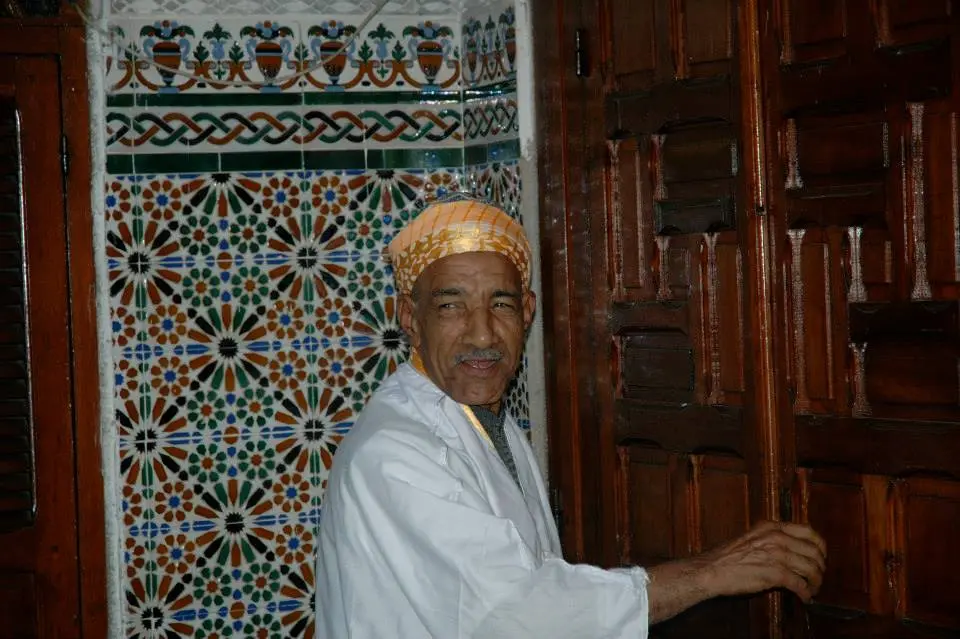
The transition from “Koyo” (assistant player and responder) to “Maalem” (master who carries the guembri and leads the Lila) does not happen suddenly. It is a spiritual crossing that requires psychological maturity, absolute courage, and acceptance of the cosmic responsibility that comes with caring for souls. For Makhzoumi, the moment of transformation was not driven by a desire for theatrical appearance — it was born from a deep philosophical realization about the nature of the Gnawa ritual and its healing function.
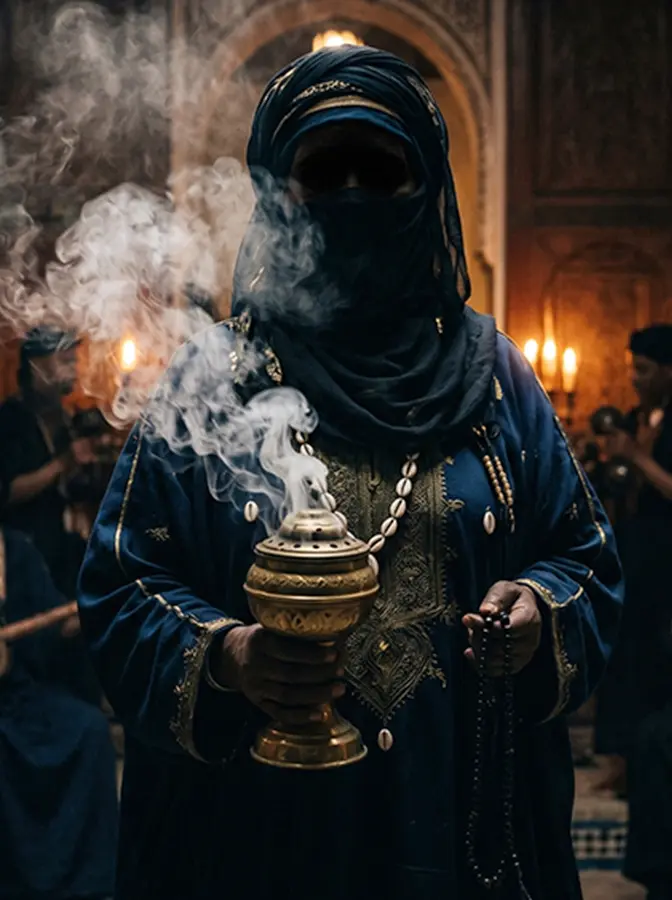
Gnawa music is often viewed outside Morocco as a type of folklore or rhythmic dance music. But Makhzoumi holds an entirely different vision. His deep understanding came when he realized that the Lila (which extends from evening until the early morning hours, and may last seven days in major cases) is not a concert — it is a complex healing institution. In one of his philosophical revelations, Makhzoumi describes the Gnawa Lila as exactly resembling an ancient “hospital,” containing specialized wards for treating internal and psychological illnesses. He explains: “In the Lila there is a ward for the heart, a ward for the head, a ward for the bones” — and every note struck on the guembri strings is directed to penetrate a specific organ and extract what ails it.
This elevated understanding of the clinical function of music changed his view of himself: he no longer saw himself as an artist, but as a “doctor of souls” entrusted with the health of devotees who come to the Lila carrying burdens — physical and psychological afflictions that medicine cannot explain.
Purity and the Refusal of Desecration
Accompanying this transformation was a decisive commitment to reject compromise. Makhzoumi insists that the guembri (Hajhouj) possesses a sanctity no less than that of sacred places. He categorically refuses to bring the guembri into unworthy spaces and affirms that the player must be in a state of complete ritual purity (wudu) before touching the strings. He believes the instrument possesses its own will: it gives the tone and resonant sound only to those who respect it and grant it its dignity. This absolute commitment sometimes put him at odds with the demands of the fast market, but he chose to be a guardian of the temple rather than a vendor in its courtyard.
The Marrakchi Sound: Architecture of Weight
The Heavy Tempo
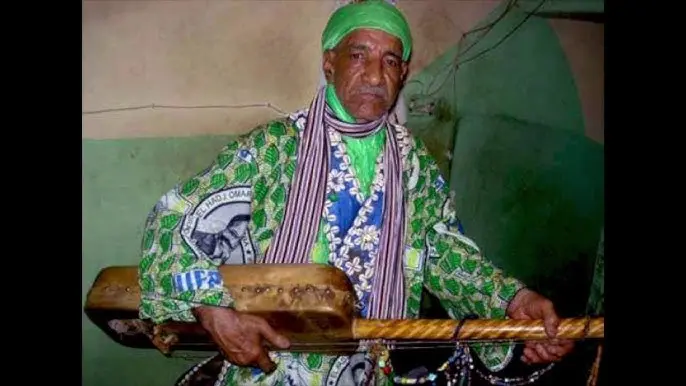
While the Marsaoui school accelerates the tempo from the start to create rapid crowd excitement, Makhzoumi walks the rhythm slowly and deliberately -- "degree by degree" -- building spiritual tension in dense circular layers. This slowness saturated with density is essential for establishing the foundation (Fersha) upon which the ritual wings of the Lila are built.
The Ghzil and Qriss
Makhzoumi treats the instrument not as a player but as a weaver binding invisible threads. His "Ghzil" technique involves complex rhythmic weaving where fingers move in rapid circles on the thick strings creating continuous streams of interlocking polyrhythms. "Qriss" is an advanced double-tap on the skin and wood simultaneously, producing a muted drum-like percussion that supports the main bass line.
The Heavy Qraqeb
Marrakchi qraqeb are large and heavy, forged from thick iron. They create deep overtones that mimic the resonance of historical chains, supporting the somber and slow rhythm. The weight prevents the rhythm from sliding toward consumable speed -- a fundamental distinction from lighter coastal instruments.
The Alchemy of Marrakchi Guembri-Making
Makhzoumi’s artistic signature does not begin on stage — it begins in his workshop. As a professional craftsman, he engineers the sound before he plays it. He refuses commercial ready-made instruments (made quickly for tourists and decoration) and insists on building his tools through a traditional chemistry of extreme complexity that takes at least a full month to produce a true musical masterpiece.
| Stage | Technical Process | Sonic and Ritual Purpose |
|---|---|---|
| Carving and Hollowing | Using a solid wood piece (Qarta) and carving it with an adze at measured centimeter distances | Creating a precise cavity that ensures sound amplification (Acoustic Resonance) at the required low frequencies |
| Skin Treatment | Using camel neck or local goat skin, soaked in milk instead of water and chemicals | Milk gives the skin exceptional moisture and softness that prevents tearing under heavy striking, producing a warmer and more flexible sound |
| Assembly and Stretching | Stretching skin over wood with extreme care, avoiding excessive nail holes | Maintaining even tension across the entire skin surface for precise response to the Qriss technique and producing a pure tone |
Career and Recognition
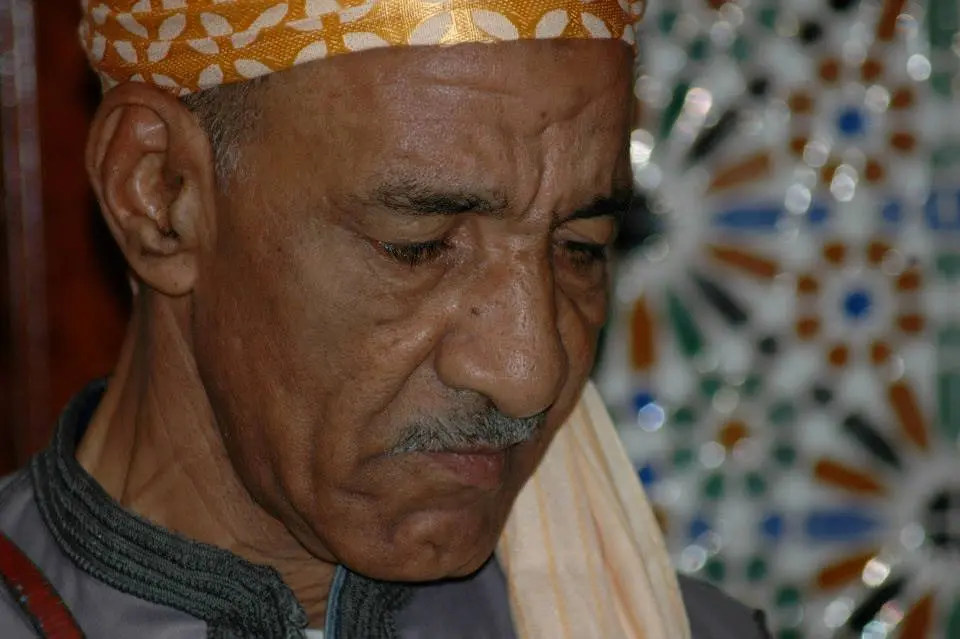
Makhzoumi’s journey from the ancient alleys of Marrakech to the spotlights of world stages was not built on commercial planning — it was the inevitable product of the gravitational pull of authenticity. In his early career through the late twentieth century, the Gnawa Maalem was not considered a professional musician in the modern sense; ritual practice often took place in exchange for meals for the troupe (Koyo) or a few dirhams collected as ftuh (donations) during Lilas that could last seven grueling days.
The International Breakthrough
The pivotal moment of international recognition came when Cuban world-jazz pianist Omar Sosa noticed Makhzoumi’s heavy, history-saturated style. Sosa was searching for the deep African roots of jazz and blues. Impressed by what he found, he invited Makhzoumi to Paris in 2003 for a joint concert. This first international trip served as a global birth certificate for Makhzoumi, as Sosa introduced him in European artistic circles as one of “the titans of Gnawa culture and its last true guardians.”
For audiences outside Morocco, Makhzoumi was never seen as a mere folkloric performer — he was considered a spiritual “maestro,” capable of creating states of magnetic rhythmic hypnosis (trance) using a primitively crafted stringed instrument and rhythmic techniques that surpass the complexities of modern orchestral ensembles.
Did Fame Change His Relationship with the Ritual?
Despite participating in major festivals (such as Jazz au Chellah in 2009 and the Essaouira Gnaoua Festival), the relationship between Makhzoumi and the authentic ritual remained fortified against commercial vanity. He affirms clearly that festivals are spaces for cultural communication and artistic celebration, but the true “Rehba” (sacred ground) remains the ritual Lila held in the homes of devotees or zawiyas for the purpose of healing.
Fusion and Musical Bridges
Gnawa music is by its very nature a form of historical fusion — it melted African memory (Western Sudan, Senegal, Mali) with Amazigh and Arab spiritualities in a Moroccan Sufi crucible. From this standpoint, Makhzoumi does not view Gnawa’s interaction with world music (such as jazz and blues) as a sudden innovation, but as a continuation of an ancient cultural dialogue. Nevertheless, he holds an extremely strict philosophy toward what is now called “Fusion.”
The Dialogue with Jazz: Chabada and Omar Sosa
The most prominent example embodying this philosophy was his epic collaboration with Cuban master Omar Sosa. At the closing concert of Jazz au Chellah festival in 2009, Makhzoumi did not change his heavy Marrakchi rhythms to suit the speed of contemporary piano — rather, the piano withdrew humbly to harmonize with the deep strikes of Makhzoumi’s guembri. This encounter was not merely an assembly of different sounds — it was a dive into the concept of the “Chabada” rhythm in jazz, a bouncing and pulsating rhythm that intersects astonishingly with the low-register rebounds of the qraqeb and guembri.
In collaborations like these, Makhzoumi proves to modern generations that openness to the world does not require severing oneself from roots, and that the Marrakchi guembri possesses enough harmonic richness to tame the most complex instruments of Western music — provided it is played by a master who knows when to strike the string and when to remain silent.

Legacy and Transmission
In his seventh decade, Maalem Abdellatif El Makhzoumi stands in a sensitive zone between two eras. The question of legacy and knowledge transmission (Transmission) represents his greatest concern, especially as he witnesses the radical transformations in methods of learning in the digital age.
He insists that a true apprenticeship is “spiritual and moral before it is mechanical.” The learner must spend long years (typically 7 to 18 years in Gnawa tradition) serving the zawiya, sitting in the “Rehba” (playing circle), learning the types of incense, and understanding the hierarchical sequence of colors and Mlouk.
What Makhzoumi fears most is that the “awe” and healing function will disappear from Gnawa. He expresses deep sadness at the shrinking number of true devotees who once came to the Lila with sincere intention and streaming tears searching for spiritual healing, now replaced by audiences seeking spectacle stripped of meaning. He also fears the extinction of the heavy hand-craft tradition of qraqeb and guembri making — noting the spread of cheap colored instruments (made for decoration or tourists) manufactured in a few days, lacking the soul and resonance required for healing.
What he wants to leave behind is a generation of Maalems who are not ashamed of the “heavy” Marrakchi school. His true legacy lives in the instruments he built with his own hands that will continue to play for years after him, and in the apprentices who absorbed the philosophy of “wudu before playing.”
Essential Listening
Zid Lmal
Ritual / Foundation (Ouled Bambara)
From the foundational phase of the Lila where deep African origins are summoned. Makhzoumi's playing here showcases classic Marrakchi weight. The tempo moves with extreme slowness, giving listeners the chance to contemplate the deep resonance of the guembri and its perfect harmony with the vocal responses of the Koyo chorus.
Sidi Moussa
Stage / Kinetic (Blue Marine Spirits)
This track belongs to the blue color suite dedicated to the spirits of the sea and water. Makhzoumi's performance brims with immense energy suited for the stage. The qraqeb here create a sound that mimics crashing waves, while Makhzoumi applies his "Nzoul" (descent) technique with mastery.
Hammouda / Youbadi
Personal / Technical Showcase
Here the individual identity of "Chabada" shines through. The "Ghzil" technique (rapid finger weaving on the strings) reaches its peak. The complex interaction between the continuous percussion line and the precise guembri improvisations reflects his extraordinary ability to tame the instrument and lead the Lila with mastery.
"The Lila is like a hospital; whoever is sick comes. There is a ward for the heart, a ward for the head, a ward for the bones... Enter the Lila with intention and listen to the tone -- live with it and it will heal you."
Maalem Abdellatif El Makhzoumi (Chabada)