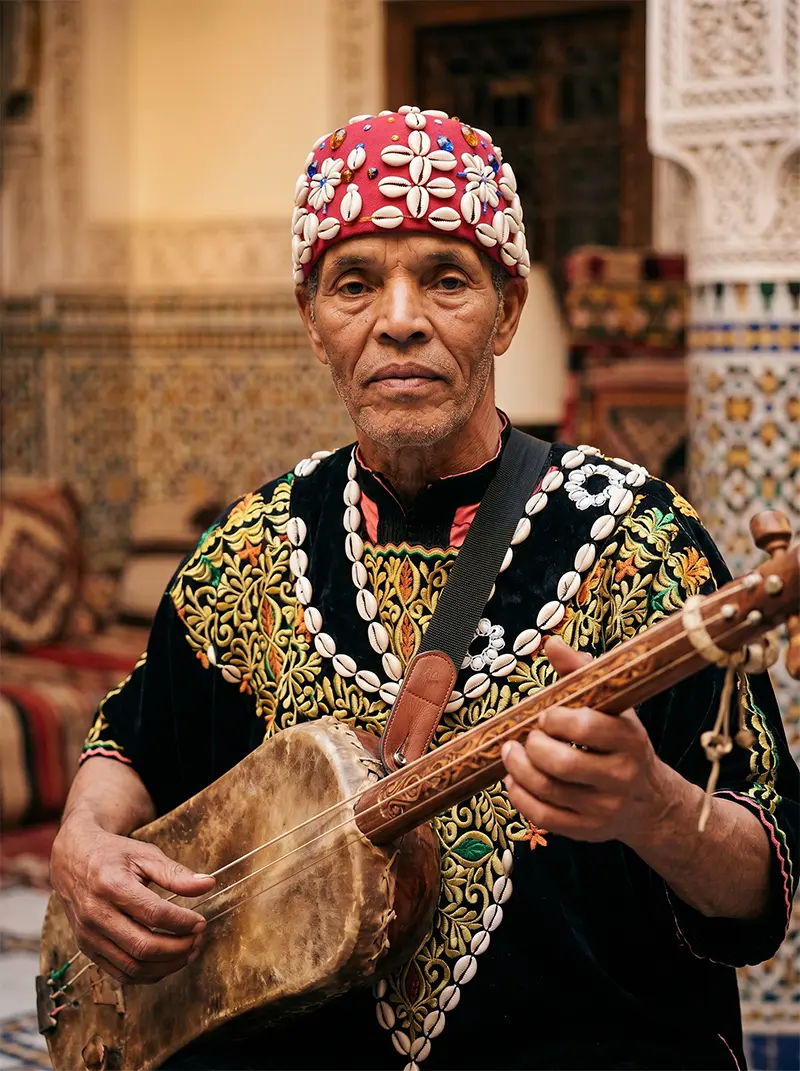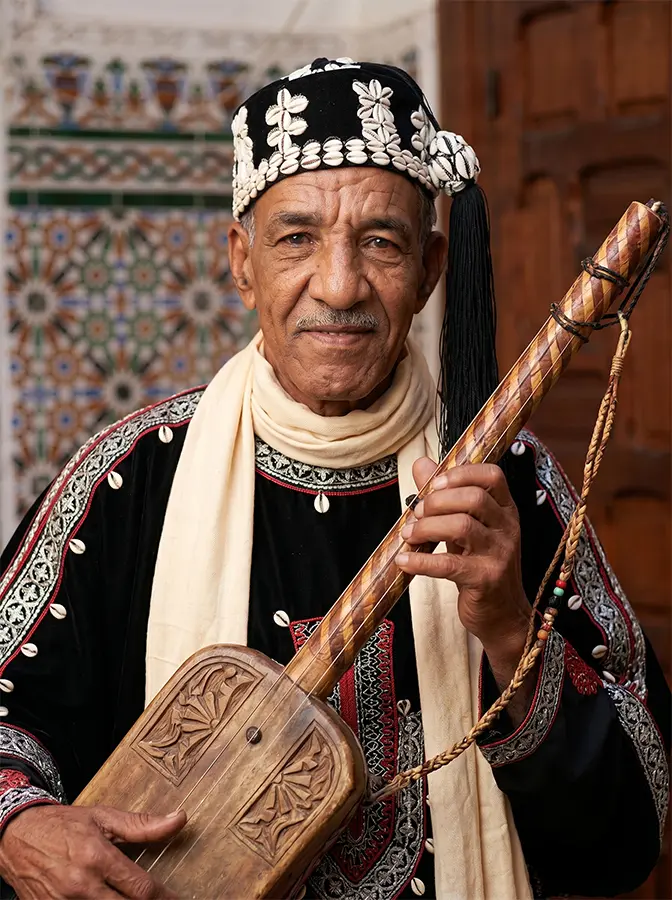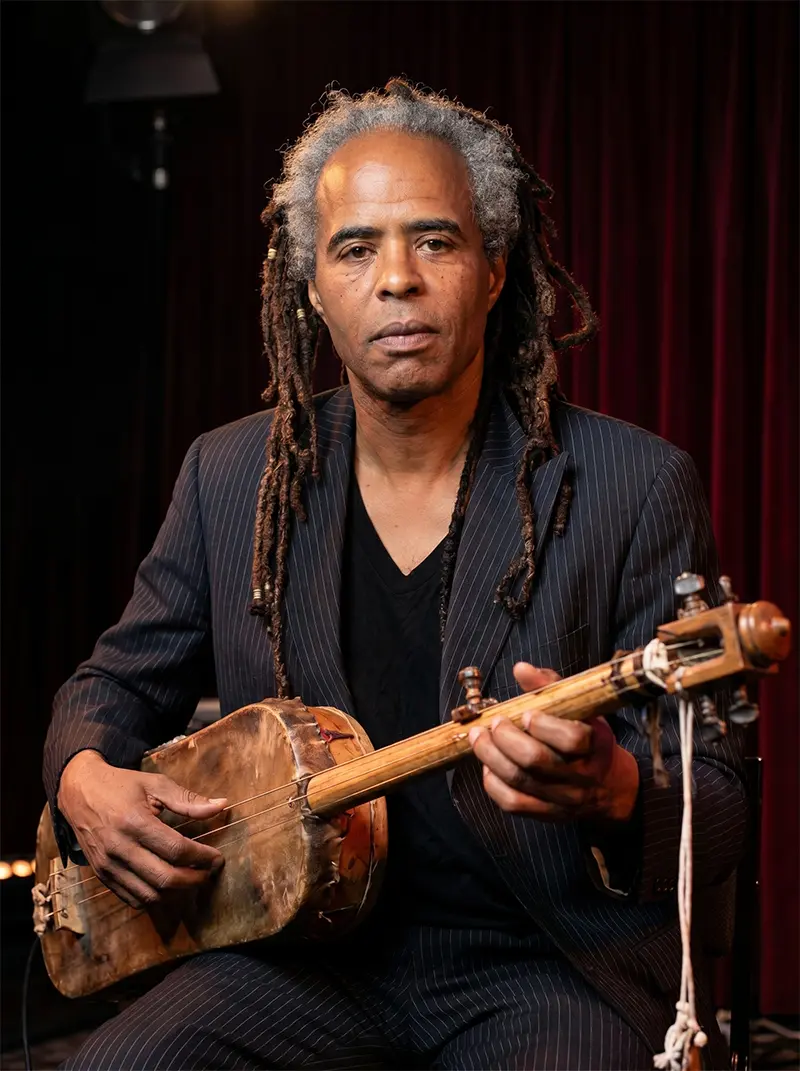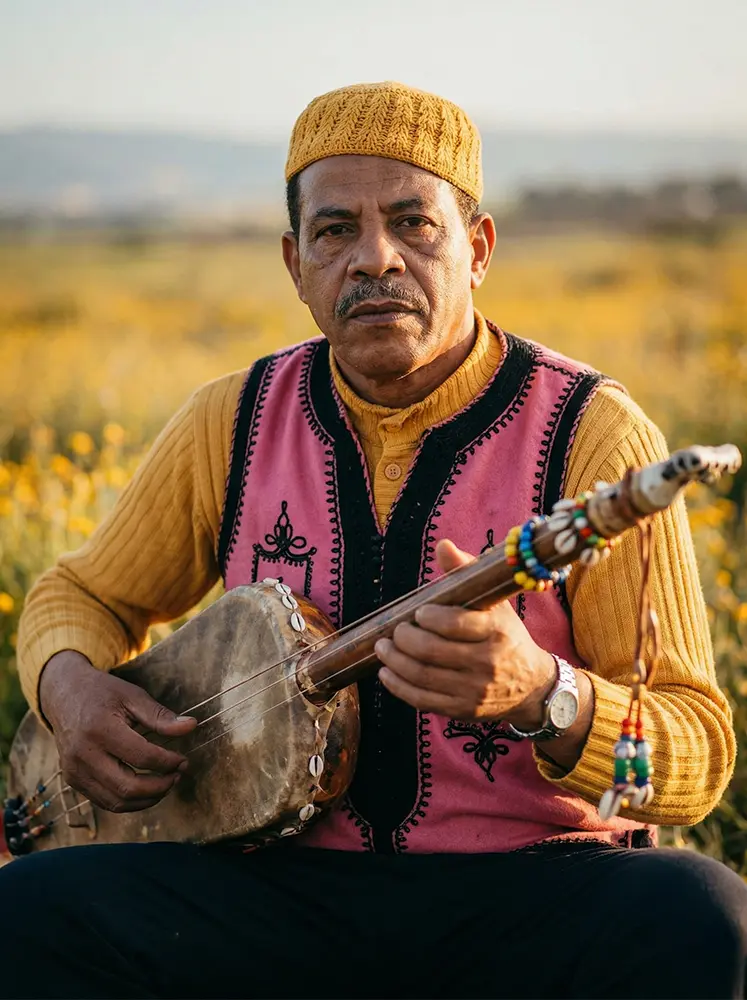
Maâlem El-Ayachi Bakbou is the beating heart and the deepest root of tagnaouite in the red city of Marrakech. His name surfaces whenever Gnawa is discussed because he represents the spiritual authority and original wellspring from which one of the most important Gnawa dynasties of the modern era branched out — the dynasty that carried this art to the world stage. What sets him apart from his peers among the founding generation is his extraordinary ability to preserve the sanctity of the Gnawa ritual inside the zawiya, while simultaneously possessing an open-minded vision that allowed his students and sons to carry this heritage from enclosed healing spaces to open stages. He is a traditional reference par excellence, a guardian of al-tabout (the spiritual core of Gnawa), yet at the same time the first to pave the road for the renewal movement that transformed the face of contemporary Moroccan music.
The Scent of the Sahara and the Memory of Diaspora
Understanding the deep roots of Maâlem El-Ayachi Bakbou requires returning to the earliest pages of the African diaspora’s history in Morocco. The origins of Gnawa music trace back to West African and Sahelian ethnic groups — specifically from the Hausa, Bambara, Fulani, and Soninke empires. These ancestors, brought to Morocco through trans-Saharan trade caravans from the eleventh century onward and reaching the era of Sultan Moulay Ismail in the seventeenth century who conscripted them into the Abid al-Bukhari army, carried with them their animist beliefs and rhythms that were eventually reshaped within an Islamic Sufi framework.
In a rare anthropological documentary by French filmmaker Jacques Willemont titled “Gnawa: Beyond the Music,” Maâlem El-Ayachi Bakbou appears speaking proudly about his roots, declaring unequivocally: “The origin of our family is the Sahara.” This statement is not merely a geographical marker — it is a declaration of ontological belonging to a culture of nomadism, patience, and the preservation of identity across generations. The Bakbou family settled in Marrakech, a city that formed a cultural melting pot where trade routes intersected and Amazigh, Arab, and African traditions intermingled. In this climate, the Bakbou school took shape inside the Zawiya Gnawiya — a space combining the functions of a house of worship, a psycho-spiritual healing clinic, and a secret musical institute.
The Zawiya: Spiritual and Musical Incubator
El-Ayachi Bakbou belongs to a spiritual lineage that takes the Gnawa zawiya as its center of operations. Music in this context was never an art played for entertainment or spectacle — it was a liturgical tool inseparably bound to the daily rituals of life inside the household. El-Ayachi considered the guembri (hajhouj) a living being that needed spiritual nourishment through incense and ritual care before any material maintenance.
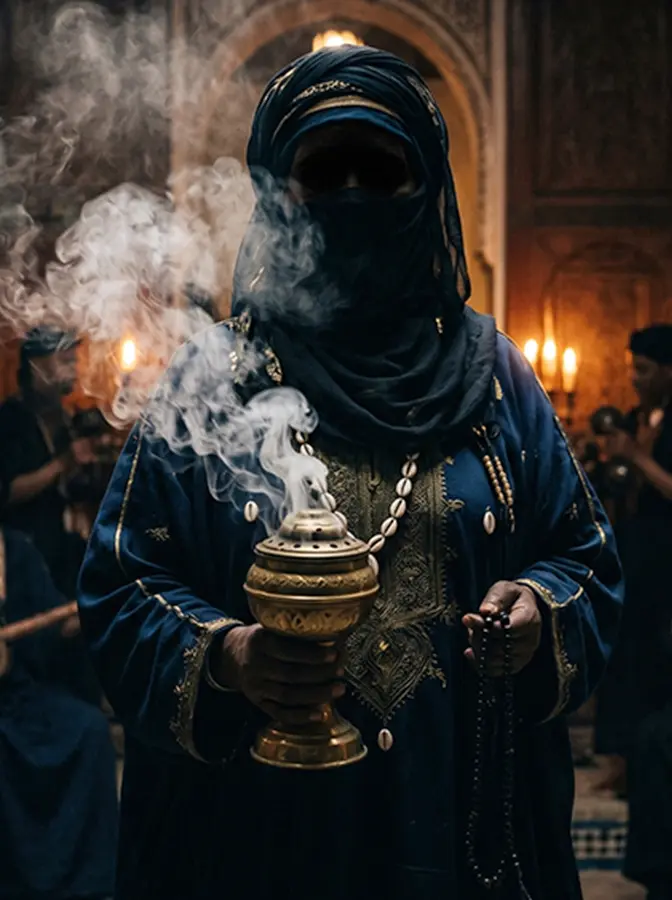
Music was intricately woven into the precise rituals of the Marrakchi household. The children of the Bakbou family did not learn music through theoretical lessons but through what can only be described as osmotic absorption. Imagine the first lila attended by one of El-Ayachi’s young sons — little Mustapha or Ahmed — sitting in the corner of a dimly lit room. The scent of benzoin and frankincense fills the air, bodies sway in pendular rhythmic motion. The father, El-Ayachi, strikes the thick strings of the guembri, and the clay walls of the zawiya tremble. In that moment, the child feels the sound vibrations travel through the earth to the soles of his feet, then rise into his chest. It is the precise instant when the child realizes — without anyone telling him — that Gnawa is “not just music,” but a language of communication with invisible entities (the mlouk), and that his father is not merely a musician, but a “doctor of souls” and a master steering a ship of the afflicted toward shores of serenity and healing.
From Apprenticeship to Mastery
Apprenticeship in the world of Gnawa is harsh and long. At the beginning, the trainee is given the qraqeb (double iron castanets) that symbolize the ancient shackles. Senior masters recount how holding the qraqeb for hours on end bloodies the fingers and exhausts the muscles — a test of the disciple’s ability to endure pain and rhythmic discipline. El-Ayachi Bakbou himself walked this rigorous path, forbidden from touching the guembri until he proved his spiritual and physical worthiness. He understood from childhood that the instrument chooses its master, and that the transition from striking iron (qraqeb) to caressing the gut strings (guembri) is a passage from the state of murid (seeker) to the rank of sayyid (master).
| Stage | Instrument | Spiritual Dimension | Role in the Lila |
|---|---|---|---|
| Absorption (Observation) | None (listening only) | Absorbing the rhythms of the spirits, learning the colors and incenses | Memorizing the poetic and rhythmic corpus without practice |
| Discipline (First Practice) | Qraqeb (Castanets) | Taming the body, enduring pain, merging into collective rhythm | Maintaining the structural polyrhythm |
| Command (Leading Rhythm) | Tbel (Drum) | Announcing arrival, controlling the external space, calling the spirits | Leading the Aada (opening street procession) |
| Mastery (The Maâlem) | Guembri / Hajhouj | Direct communication with the spirits (mlouk), guiding the trance | Leading the Derdeba (the enclosed inner ritual) |
The Calling: When the Spirits Chose Their Master
The Calling is the deepest station in the life of any Gnawa master, yet it is often ignored in superficial biographies written about this music. When does a skilled player decide to ascend to the rank of Maâlem? In Gnawa tradition, this decision is never made individually or based purely on technical skill. The rank of Maâlem means, in its literal translation, “He who knows.”
For El-Ayachi Bakbou, the moment of transformation was not a career promotion — it was a destined commitment. Oral traditions linked to the Marrakech schools indicate that the “decisive night” in a future master’s life often involves an intense spiritual experience. When a player takes charge of the Derdeba (the complete healing ritual) for the first time, he bears responsibility for the bodies that will enter the state of jedba (trance). El-Ayachi Bakbou knew well that making a mistake in summoning the wrong molk (spirit), or playing a rhythm that does not match the designated color and incense, could cause psychological and physical harm to the person in trance.
Confronting Fear and the Test of Refusal
Did El-Ayachi face rejection or fear? The answer lies in the nature of the instrument itself. In Gnawa heritage, it is believed that the guembri is inhabited by spirits, and playing it at night opens gateways between worlds. The fear here is not of the audience, but of the “invisible forces” being summoned. El-Ayachi had to prove to the senior sheikhs of the zawiya and to the Moqaddema (the clairvoyant who manages the spiritual side of the lila) that he possessed the baraka (grace and spiritual power) to control these forces.
El-Ayachi overcame these fears through total surrender to the tradition. He realized that the guembri is not merely a box of mahogany and camel-neck skin, but an extension of his body. When he placed his fingers on the strings on that decisive night, he did not play the music — he let the spirits play through him. This complete surrender is what earned him the title of “Maâlem,” and made him a pole around which subsequent generations would orbit.
The Artistic Fingerprint: Engineering the Marrakchi Rhythm
To elevate the analysis beyond the general narrative found in digital encyclopedias, we must deconstruct the artistic fingerprint of Maâlem El-Ayachi Bakbou. He belongs to the Marrakchi School — a school characterized by ethnomusicological features that differ fundamentally from the Essaouira school (Marsaouia), which relies on lighter, faster rhythms influenced by Andalusian and maritime music.
How does El-Ayachi handle rhythm? His rhythm can be described as “heavy, earthly, and circular.” In the Bakbou style, the guembri does not rush toward climax. Instead, it relies on cyclic repetition of a simple melodic theme (riff) that accumulates gradually to build a hydraulic tension in the space. This heaviness does not come from slow playing, but from an intense focus on the “lower pulse” (bass frequencies) produced by striking the thick string, accompanied by finger-tapping on the guembri’s skin — a unique technique that transforms the stringed instrument into a percussion instrument simultaneously.
Cyclic Gravity
Heavy, circular rhythms that revolve like planets. The guembri does not rush -- it accumulates tension until the space itself vibrates.
Dual Instrument
A unique technique of finger-tapping on the guembri skin while plucking the strings, turning one instrument into two: melodic and percussive.
Sacred Flexibility
A strict traditionalist inside the zawiya, yet an adaptable collaborator on the theater stage -- serving the context without betraying the roots.
Between Traditional Rigor and Theatrical Adventure
Does he alter the tradition or follow it literally? The answer carries a magnificent paradox that defines El-Ayachi Bakbou’s uniqueness. Within the Derdeba (the therapeutic ritual), El-Ayachi appears as an unwavering traditionalist. He follows the sacred order of the Gnawa lila to the letter. He begins with the Aada (procession), then enters the section of al-Bidane and Ouled Bambara (invoking the ancestors), before opening the stations of the seven colors — black for the celestial spirits, blue for the spirits of the sea, red for the spirits of the forest and blood, green for the Shurafa, and so on. He enforces sacred silence, forbidding shoes and smoking once the ritual begins, as documented by heritage chroniclers such as Jacques Willemont.
Yet the great surprise in this traditional master’s trajectory is his intense flexibility when it comes to non-ritual contexts. El-Ayachi Bakbou participated in presenting Gnawa heritage beyond the zawiya walls through his collaboration in the play “Al-Harraz” with the pioneering Marrakech troupe Al-Wafa. In this theatrical context, El-Ayachi recognized that the audience was not seeking spiritual healing but aesthetic beauty, so he adapted certain melodies and stripped them of their complex ritual charge — such as the tune “Baba Hamouda” — to present them in a dramatic format suited to the stage. This dual stance — the strict guardian in the zawiya and the flexible collaborator in the theater — is the artistic signature that paved the way for his sons to conquer the world.
From Local Shadow to Cosmic Reach
The career of Maâlem El-Ayachi Bakbou was never a quest for the spotlight — it was a path of consolidation and empowerment. Throughout the mid-twentieth century, Gnawa music was viewed by cultural elites as a form of marginalized folk art or sorcery rituals belonging to minorities and the deprived working classes. Yet the community’s deep recognition of El-Ayachi manifested in the enormous respect he commanded within the alleys of Marrakech, where he was summoned to untie spiritual knots and conduct the great healing lilas.
When did his legacy cross from local to global? El-Ayachi Bakbou himself did not step onto the world stage in the commercial sense we know today — he reached it through his genetic and artistic extension: his sons and students. The greatest recognition of El-Ayachi’s path came in the 1970s, a period that witnessed the rise of the “Ghiwani phenomenon” in Morocco. His son, Maâlem Mustapha Bakbou (born in Marrakech, 1953), graduated from his father’s zawiya to become one of the pillars of the landmark musical group Jil Jilala.
The Heritage Travels and Perspectives Shift
The first true international journey of the Bakbou style was carried on the shoulders of his sons, who took the father’s rhythms and crossed the Mediterranean. The international audience — whether at jazz festivals in Europe or grand theaters in America and Asia — viewed this heritage (refined by El-Ayachi and transmitted by his sons) with absolute awe. They found in these polyrhythmic patterns roots that connect directly to Blues and Jazz, leading Western critics to consider Gnawa “the Blues of North Africa.”
Did fame change his relationship with the rituals? For El-Ayachi as patriarch, fame did not alter his respect for the rituals one iota. He continued leading Derdeba nights with his customary strictness. As for his sons, they lived a productive tension between preserving the authenticity of their roots in the zawiya and the demands of performance at the Essaouira Gnawa Festival. El-Ayachi succeeded in planting a cultural immunity within them, making them capable of performing at the world’s biggest festivals without losing the ability to remove their shoes and sit humbly on a reed mat to lead a pure ritual lila whenever they returned to Marrakech.
The Philosophy of Fusion: Between Danger and Necessity
The question of musical fusion is among the deepest ethnomusicological issues in modern Morocco. Did El-Ayachi Bakbou reject certain types of fusion? As a guardian of tradition, his philosophical stance leaned toward the view that ritual music should not be fused with other music inside the zawiya space, because doing so would corrupt the spiritual frequencies that the spirits (mlouk) require to respond. Yet he was never intellectually closed. He recognized that the world was changing, and that the survival of the heritage required new vessels — which is what encouraged him to allow his sons to experiment with fusion outside the zawiya walls, just as he himself had done earlier in the theater.
For the Bakbou school, fusion transformed from a potential danger into a strategic necessity for survival. This vision was embodied in the legendary career of his son, the late Maâlem Mustapha Bakbou. Mustapha was among the first to establish the fusion of tagnaouite with World Music, taking the rhythmic foundation he learned from his father and sharing the stage with formidable international figures.
| Genre / Context | Artist / Group | Musical Impact |
|---|---|---|
| Folk and Social Consciousness | Jil Jilala (Morocco) | Lifted Gnawa from marginalization into the heart of the national song, with timeless anthems like "Al-Ayoun Ayniya." |
| American Jazz and Blues | Marcus Miller, Pat Metheny | Discovering the organic links between the American bass and the African guembri in high-level improvisational dialogue. |
| European Jazz and Free Music | Eric Legnini, Louis Bertignac, Sixun | Merging ternary Gnawa rhythms with the complex harmonic structures of modern European jazz. |
| The Dream That Never Was | West African musicians (Mali, Senegal) | A pure recording session reuniting the Moroccan branch with its Mandinka roots -- reclaiming the first moment of historical separation. |
Legacy: Passing Secrets in an Age of Noise
This is the deepest axis in understanding the Bakbou school — an axis rarely addressed in conventional biographies. The most important quality of a true master is not what he plays in his lifetime, but what he leaves after his departure. Did he have students? Yes, in abundance. But his most important students were his own flesh and blood. El-Ayachi followed the traditional system of “oral and spiritual knowledge transmission,” transforming the family home into a rigorous institute. His sons, led by Maâlem Mustapha Bakbou and Maâlem Ahmed Bakbou, became the pillars of the Gnawa edifice in Marrakech and the world.
How did he teach? El-Ayachi’s method did not rely on musical notation or theoretical explanation. Gnawa education is “education through imitation and lived experience.” He would let his students watch his fingers for years. They learned how to prepare the sacrificial offering for the ritual, how to blend the incense, and how to read the language of the eyes of those in trance to know when to lower the rhythm and when to raise it.
What did he fear would be lost from Gnawa? The greatest fear shared by El-Ayachi and his generation of pioneers was the emptying of tagnaouite of its spirituality. He feared that the music of the ancestors — created to ease the pain of diaspora and heal broken souls — would become nothing more than a folkloric spectacle for tourist entertainment. He feared the loss of “the Word” — the poetic corpus in ancient Bambara language passed down through generations without full understanding of its vocabulary, yet carrying a sacred energy.
What did he want to leave behind? His goal was to leave a tree with roots fixed deep in the earth and branches that embrace the sky. And that was achieved — both tragically and beautifully. On Monday, September 8th, 2025, Morocco and the world lost Maâlem Mustapha Bakbou, son of El-Ayachi and ambassador of his school, at the age of 72 after a battle with illness. His funeral was held at the Bab Aghmat cemetery in Marrakech. This momentous event, mourned by Neila Tazi (founder of the Gnawa Festival) with moving words, confirmed that El-Ayachi Bakbou’s legacy did not die — it became part of intangible human heritage. El-Ayachi left behind a “registered trademark” of credibility, making the name “Bakbou” synonymous with authentic Gnawa that never compromises on its spiritual depth.
Essential Listening
Ouled Bambara / Al-Bidane
Ritual / The Foundation
A return to pure African roots. The circular swak rhythm and ancestral invocations evoke the movement of trans-Saharan caravans -- the purest embodiment of what was played inside El-Ayachi's zawiya.
Baba Hamouda
Theatrical / Innovation
Linked to the play "Al-Harraz" by the troupe Al-Wafa. Shows astonishing flexibility in adapting the Gnawa melody to dramatic theatrical narrative without losing its majesty or unique identity.
Barki Lia / Salame Ala / Bouganda
Fusion / The Legacy
Performed by his son Mustapha Bakbou. Here the rigid Marrakchi guembri technique merges with contemporary arrangements, captivating millions -- heritage triumphing over time.
"We do not strike the wood to entertain the listeners, but to awaken the ancestors sleeping within its grain. Our music is not melody -- it is the key that liberates tormented souls and returns them to their original serenity."
-- Maâlem El-Ayachi Bakbou
Maâlem El-Ayachi Bakbou did not seek fame or the glare of spotlights. He sought to be the root that nourishes in silence, the unseen engine that drives the tree upward toward the light. He succeeded in creating something rarer than any hit record or sold-out concert: a dynasty of masters who carry his name, his technique, and his spiritual DNA across continents and generations. The Bakbou school remains active today — Ahmed Bakbou continues the tradition in Marrakech, while the memory of Mustapha echoes in every festival that celebrates Gnawa.
The zawiya in Marrakech still stands. The incense still burns. And somewhere in the vibrations of every guembri tuned in the Bakbou way, the Patriarch plays on — not through his fingers, but through the fingers of everyone he taught that this music is not entertainment, but medicine for the soul.