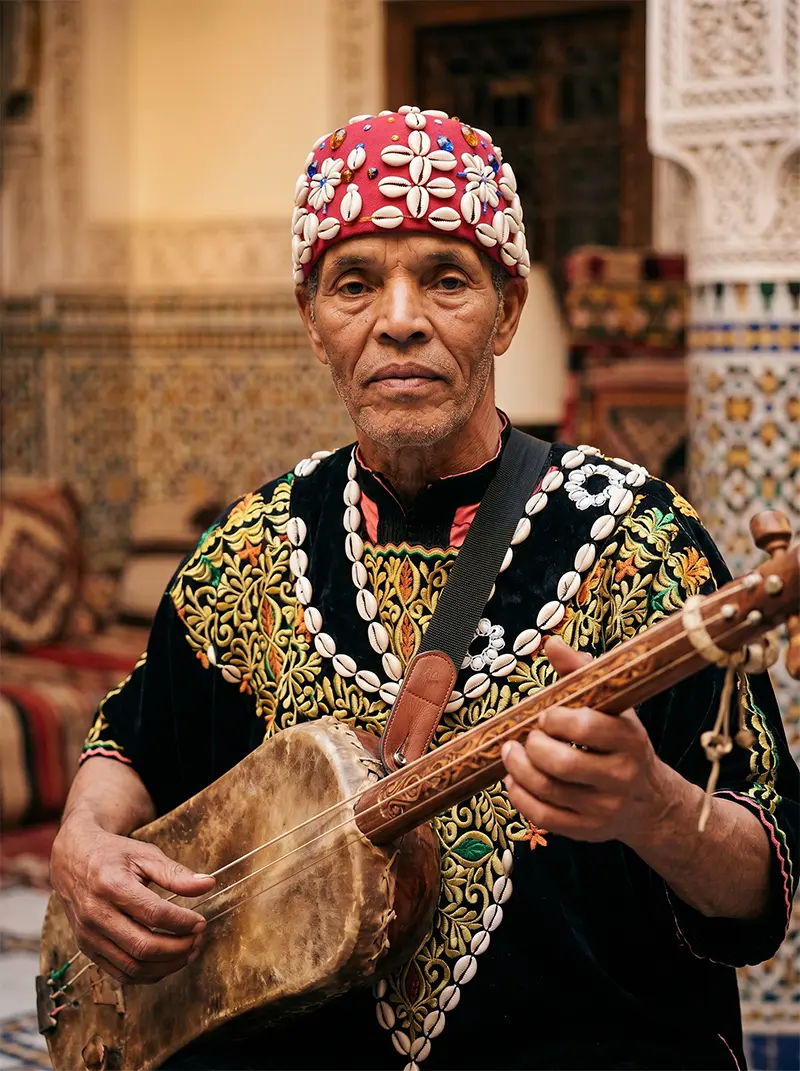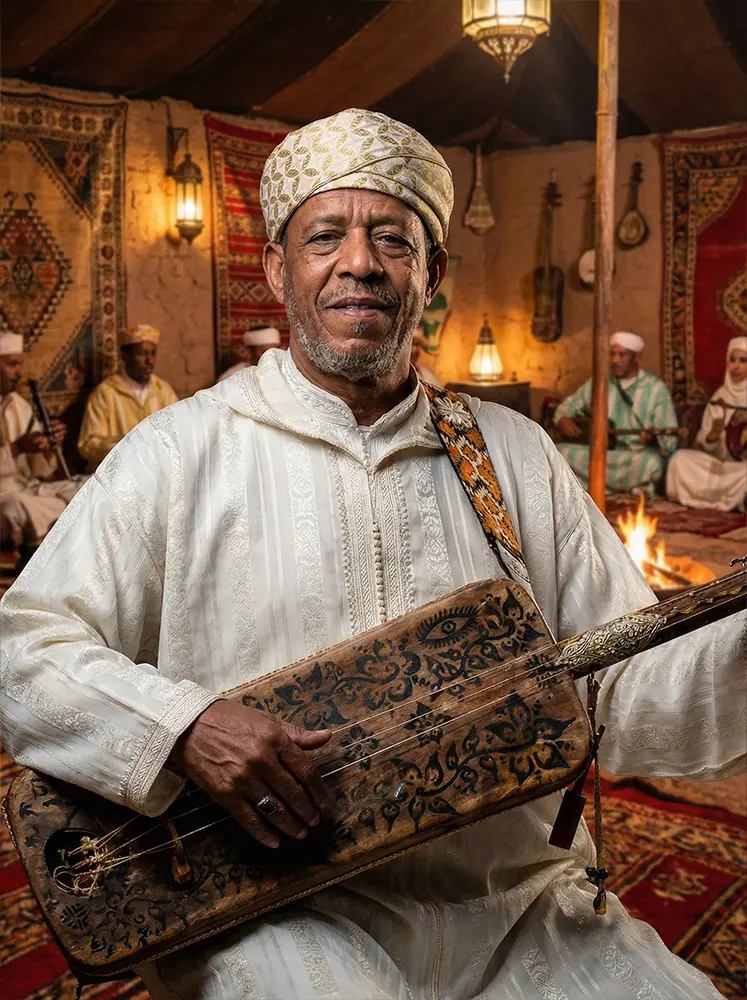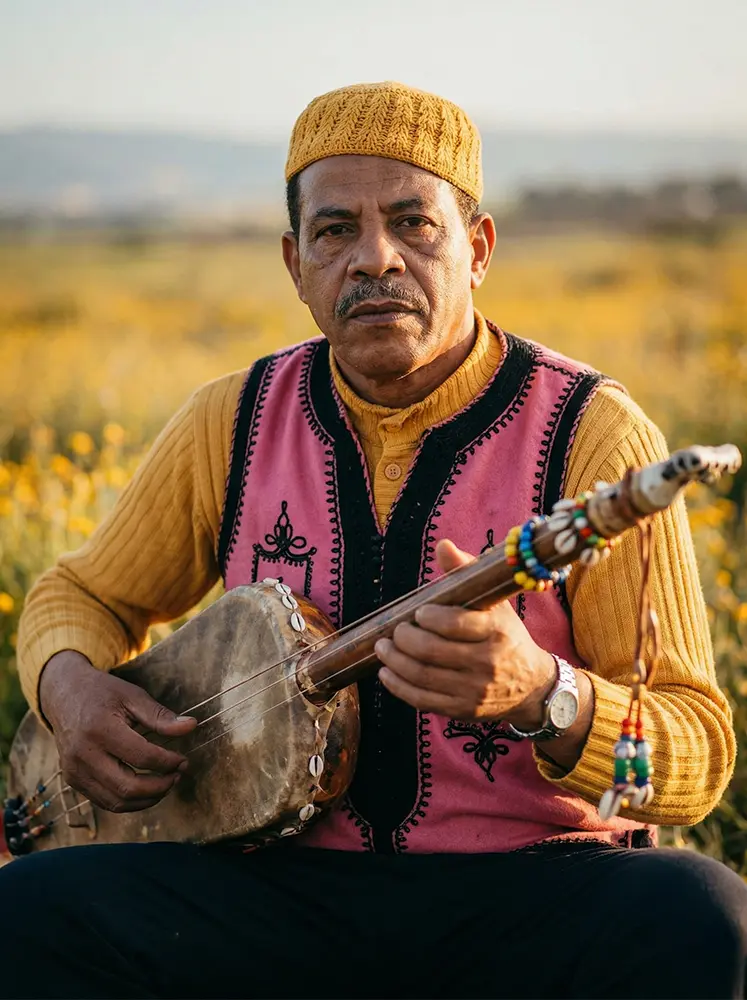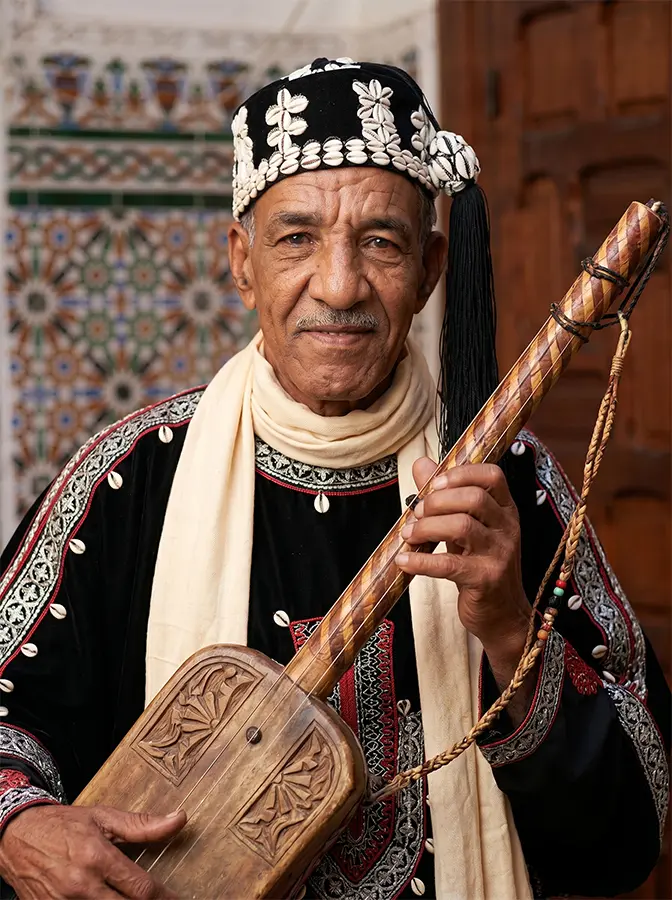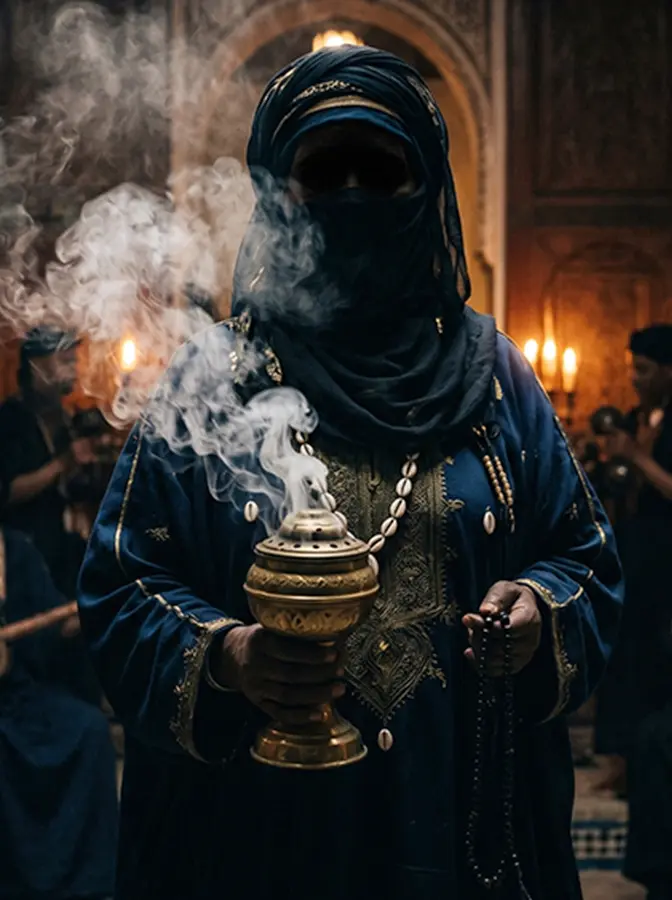
There are those in the Gnawa world who play music, and those who are the ritual itself. Moqaddema Halima El Marrakchia, known as Halima Qmichich, is one of the essential pillars preserving the balance of authentic Gnawa heritage in Marrakech. While Maâlems command the global platforms, Halima stands in the sacred shadow to conduct the true beating heart of Tagnawit: the healing night ceremony. She does not perform for entertainment — she orchestrates an invisible symphony of spirits and frequencies to heal broken souls.
“We do not play to delight the ears or decorate platforms. We light incense and wake the strings to elevate souls and heal weary bodies. Rhythm without its secret is empty noise, and color without pure intention is a garment that does not cover the wound of the soul.”
Roots: Born Inside the Sacred House
Halima Qmichich was born inside one of the most ancient Gnawa households in Marrakech: Dar Ba Ayyach. Located deep in the old medina near Bab Hmar, this ancient house is not merely a family dwelling — it is a zawiya, a sacred space, and a spiritual clinic where authentic Gnawa ritual is performed.
Halima belongs to a purely Gnawa family: she is the daughter of the late Maalem Al-Ayyachi Qmichich and the Moqaddema Mina, meaning she absorbed the spiritual secret from both its sources simultaneously. Her brothers Aziz and Mustapha are Maâlems who play the guembri, forming the family into one complete ritual unit.
She grew up in an environment where Gnawa music was the primary language of daily life — bound not to theater or entertainment, but to daily rituals inside the home. The smell of incense mixed with the deep beats of the guembri, and the sounds of iron qraqeb clashing to awaken the senses — these formed her first sensory memory as a child. She watched her mother, Moqaddema Mina, supervise every detail of the Lila, from preparing the sacrifice to arranging the colors, instilling in Halima’s consciousness that this art is a lifeline and a tool of psychological and spiritual healing.
One of the most important events proving Halima’s deep rootedness is her continuous supervision of the annual Sha’ban season at their Marrakech home. This season, preceding the holy month of Ramadan, is a transitional ritual of supreme importance in the Gnawa spiritual calendar: spirits are appeased, souls purified, and covenants with the Mlouk renewed. Dar Ba Ayyach stands as an unmissable reference in the map of Marrakchi Gnawa.
The Calling: When the Spirits Choose
In deep Gnawa custom, a person does not choose to become a Moqaddema — the spirits choose them. For Halima, accepting the torch after her mother was surrounded by intense fear and hesitation. The role of Moqaddema, locally known as Shoafa (the clear-sighted one), requires enormous psychological strength to bear the pains, problems, and negative energies of others.
The commission came on one deep Gnawa night inside the courtyard, during the playing of the “Sidi Mimoun” rhythm (spirit of the Black color, known for its power and awe). Halima felt an immense energy taking hold of her — not for jedba (trance), but energy granting her extraordinary insight to see the flows moving through the space. She felt that the spirit her mother had been directing had transferred to settle within her being, announcing her installation as the new guardian of Dar Ba Ayyach.
She overcame her initial fear through rigorous apprenticeship: learning to read the language of convulsing bodies, distinguish the type of possessing spirit from a simple finger movement or breath rhythm, and direct the Maalem with a single glance to accelerate or slow the rhythm to ensure the spirit descends peacefully and exits without harm.
The Unique Style: Engineering the Derdeba
Halima El Marrakchia represents the line of the traditional, pure, deep Moqaddema. She does not play the guembri to entertain audiences — she is the invisible maestro who directs the complete derdeba ritual from beginning to end. Her signature lies in her ability to control spiritual chaos and create a harmonious healing order.
The Seven Colors (Mahallat)
| Color | Spirit (Mlouk) | Incense | Therapeutic Purpose |
|---|---|---|---|
| Black | Lalla Mimouna / Sidi Mimoun | Black Jawi | Deep trauma healing, confronting buried fears |
| Blue | Sidi Moussa / Sea Spirits | Sheba / Sea Incense | Spiritual cleansing, releasing negative energies |
| Red | Sidi Hamou / Butchers | Red Jawi / Frankincense | Releasing suppressed anger, tension relief |
| Green | The Shurafaa / Saints | Oud / Mekki Oud | Blessings, spiritual balance, inner peace |
| Yellow | Lalla Mira / Women's World | White Jawi / Rose | Women's healing, fertility, emotional liberation |
| Black and White | Sidi Abdel Qader Al-Jilani | Fine Oud / Secret Blends | Elevating the soul, merging opposing energies |
| White | The White Kings / People of God | Orange Blossom / Pure Incense | Complete catharsis, inner peace, total healing |
No transition from one color to another can happen without Halima’s permission, her signal, and the incense she selects with her own hands. She gives signals to the Maalem to raise or slow the tempo — accelerating when a suffering person reaches the peak of trance, decelerating before they collapse physically. This biological-musical synchronization makes her an expert in crowd psychology as much as a spiritual expert.
Career and Recognition
During the French Protectorate era, Gnawa rituals faced severe social marginalization. The zawiya of Dar Ba Ayyach operated quietly as a safe refuge and secret clinic for the community.
The watershed moment came when UNESCO inscribed Gnawa in 2019 on the Representative List of the Intangible Cultural Heritage of Humanity. This global recognition spotlighted families like Halima’s who had preserved the authentic ritual without support. Anthropologists like Deborah Kapchan and sociologists like Fatima Mernissi documented women like Halima as practitioners of alternative psychotherapy rooted in somatic knowledge.
Categorically: fame did not change her relationship with the ritual. For Halima, spotlights, applause, and cameras cannot summon the Mlouk. The spirits require privacy, isolation, relative darkness, and the pure intentions of those in pain. She has resisted converting the healing derdeba into a “theatrical folkloric spectacle emptied of meaning,” maintaining the strictness and seclusion of the ritual inside the walls of Dar Ba Ayyach.
Fusion and Musical Bridges
Halima does not view Gnawa’s interaction with world music as a sudden innovation — it is a natural extension of the African Diaspora movement. Jazz, blues, and Gnawa share expression of historical slavery’s pain and the desire for spiritual liberation.
However, she categorically refuses to merge the ritual phases (pure jedba and Mlouk invocations) with any other musical patterns inside the zawiya. Fusion becomes dangerous when it distorts the original memory and strips compositions of their therapeutic properties. Introducing foreign instruments cuts the thread of communication with the recipient’s unconscious mind.
Fusion is welcomed in the “Aâda” portions — the festive introductory section before the Lila. But when the phase of “Colors and Mlouk” begins, the absolute sovereignty must remain with the sentir’s thick strings, the iron qraqeb, and the voice of prayer.
Legacy and Transmission
Halima’s apprentices receive esoteric knowledge through prolonged observation and strict direct practice — not classrooms. The trainee sits beside Halima in the shadows for years, learning when to cast jawi into the incense burner to change the room’s mood, how to sew the seven-colored garments for those afflicted, and when to intervene physically to protect someone in violent jedba.
She teaches them to be guardians of the space, not seekers of stardom.
What she wants to leave behind is a strong family institution — Dar Ba Ayyach — continuing as the last fortress of spirituality and a safe haven for those seeking healing through music and ritual. She wants history to record that women in Gnawa culture were never secondary ornaments of the Lila — they were the axis around which the wheel of healing, heritage, and memory turned.
Essential Listening: The Architecture of the Night
Ouled Bambara
Ritual / Foundation
Entry into Gnawa history. Slow, mournful guembri rhythms narrate the ancestors' suffering during the forced journey from sub-Saharan empires. Under Halima's supervision, this section is defined by mourning calm, preparing those present psychologically for the coming trance phase.
Lalla Mira -- Yellow
Personal / Therapeutic
The most requested by women seeking healing. The room fills with white jawi and rose scent. Halima directs a joyful, fluid rhythm allowing women to release psychological repression in a dance where bodies are freed from social constraints. Her capacity to create emotional safety space is at its finest here.
Sidi Mimoun -- Black
Dramatic / Deep
The true test of any Moqaddema. The heavy, accelerating rhythm confronts buried fears and deep psychological traumas. Halima's genius shows in her absolute control of the space, ensuring violent jedba energy does not become harmful chaos -- intervening at the crucial moment to slow the rhythm and cover the recovering person with a black soothing cloth.
"We do not play to delight the ears or decorate platforms. We light incense and wake the strings to elevate souls and heal weary bodies. Rhythm without its secret is empty noise, and color without pure intention is a garment that does not cover the wound of the soul."
Moqaddema Halima El Marrakchia
Continue Your Journey
- The Seven Mlouk: Colors, Spirits, Meanings — The spiritual cosmology behind every ritual phase Halima directs
- The Gnawa Lila Ceremony Explained — Full guide to the healing night Halima guards
- Maalem and Moqaddema: The Sacred Duo — Understanding the two poles of Gnawa ritual
- The Marrakech School — The regional tradition Halima represents
- Gnawa Origins and History — The African roots of the heritage she protects
- Asmaa Hamzaoui — A Maâlema who crossed gender boundaries on the world stage