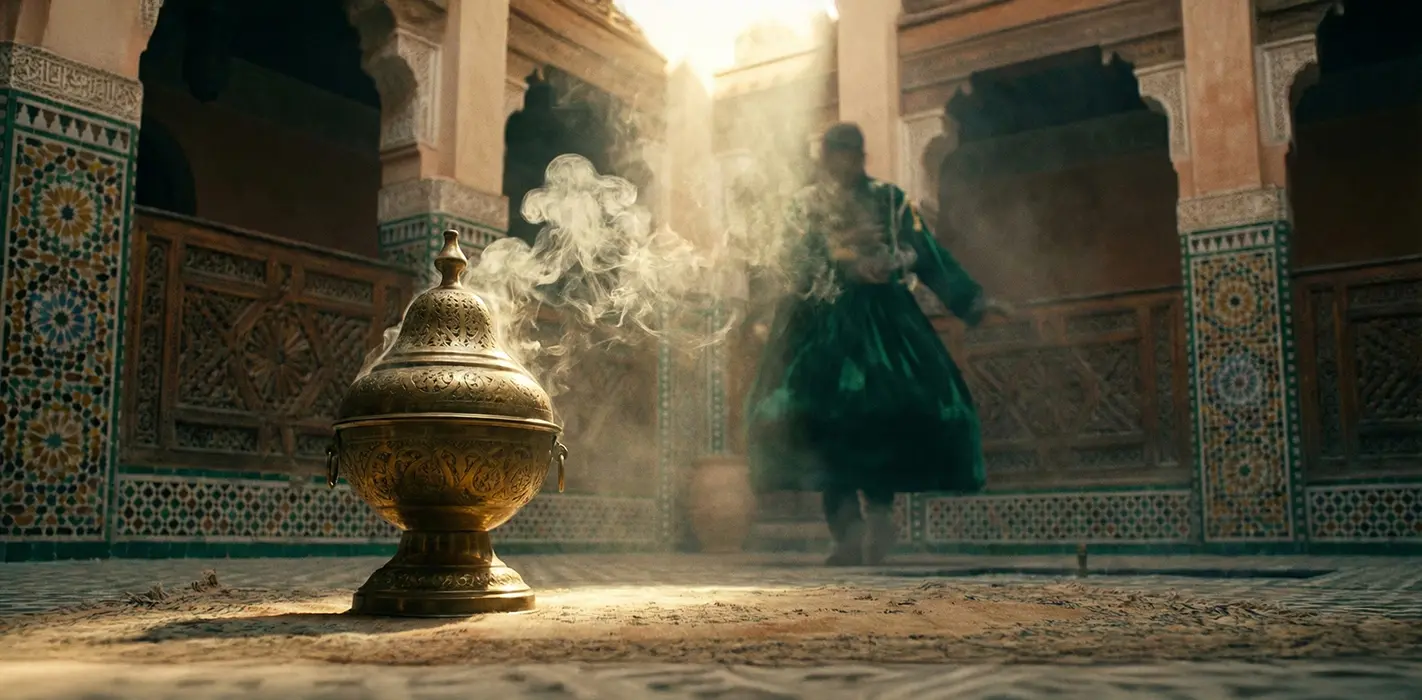
The Imperial Axis
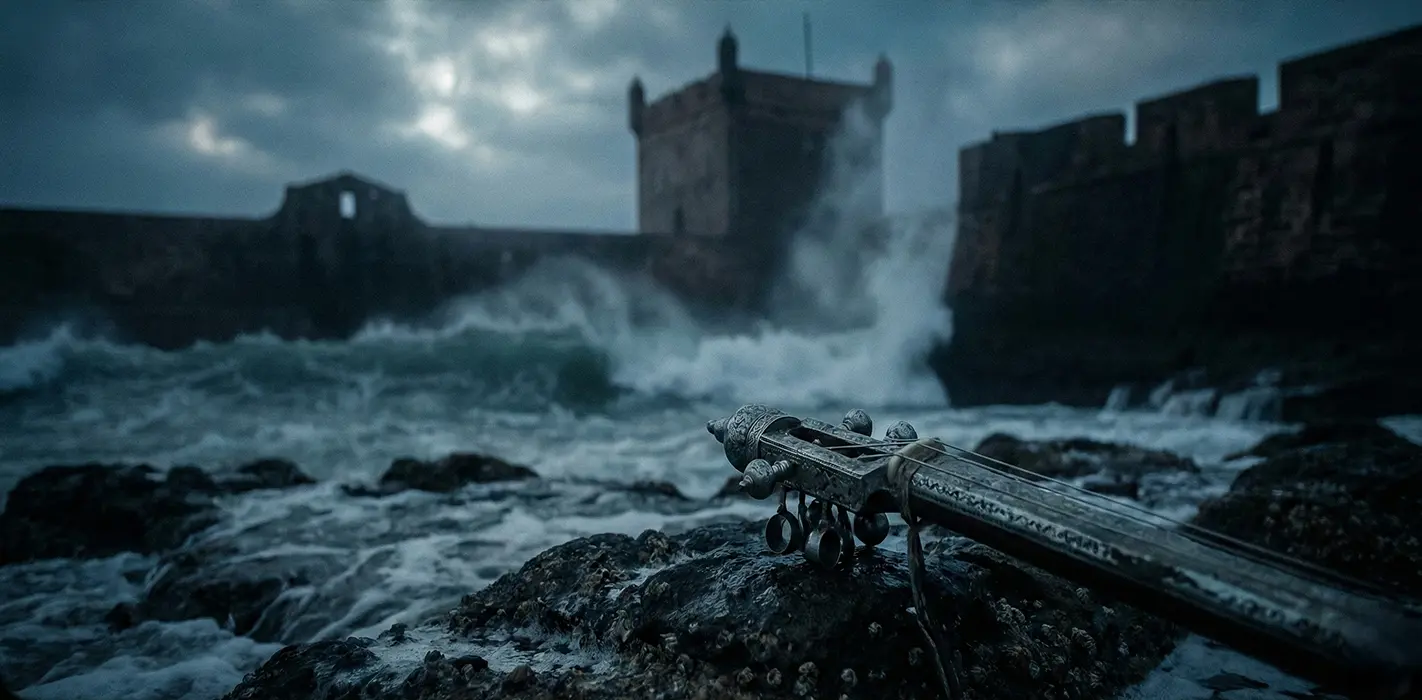
While the coastal schools of Essaouira and Tangier shaped their Gnawa traditions through ocean trade and international dialogue, and the southern school of Marrakech forged its identity through desert caravans and percussive power, the Imperial Cities of Fes and Meknes produced something entirely different: scholarly Gnawa — music refined by centuries inside palace walls, Sufi zawias, and aristocratic riads.
Here, the Guembri doesn’t thunder — it sings. The Maâlem isn’t a wandering dervish — he’s a spiritual doctor welcomed into the homes of the urban elite. And the Lila ceremony doesn’t just invoke African spirits — it converses with the Aissawa and Hamdouchia Sufi lodges that share every street corner. This is the aristocratic Gnawa — the “learned trance.”
From Sultan’s Army to Spiritual Masters
Meknes — The Military Foundation
The Gnawa presence in Meknes is inseparable from Sultan Moulay Ismail (r. 1672–1727) and his legendary Abid al-Bukhari — a standing army of tens of thousands of Black soldiers quartered in the imperial kasbas (Kasbat Hedrasch). This concentrated settlement transformed Meknes into the densest repository of African cultural memory in Morocco.
When the military role of the Abid al-Bukhari faded, their organizational structures (commanders, barracks hierarchy) transformed into spiritual hierarchies (Moqaddems, Maâlems). But the military memory survived in the music: the thundering Tbel drums, the heavy iron Qraqeb, and the disciplined formation of Meknes Gnawa ensembles still echo the march cadence of a sultan’s army. This “martial rhythm” is what distinguishes the Meknassi style from the oceanic calm of Essaouira.
Fes — The Aristocratic Integration
In Fes, the Gnawa story follows a different path — not soldiers but household servants in the great riads and palaces.
The “Dada” Institution: Gnawa women (Dadas) served as nursemaids and spiritual guardians of aristocratic Fassi homes. They brought rituals, songs, and Bakhour practices into the heart of elite families — but only after these traditions were refined to suit the conservative, scholarly environment of Morocco’s intellectual capital.
Aristocratic Strategy: To survive in the city of saints and scholars, the Gnawa couldn’t present themselves as sorcerers. Instead, they positioned themselves as followers of Sidna Bilal (the Prophet’s muezzin), linking their practices to praise of the Prophet and the great Sufi saints (Moulay Abdelqader Jilani). This strategy embedded them within the city’s Sufi fabric — transforming them from marginalized healers into a recognized spiritual order serving all social classes.
The Imperial Sound — Malhoun Meets the Guembri
The Malhoun Influence
Fes is the historic capital of Malhoun — a tradition of sung vernacular poetry born among the city’s artisan guilds. Since many Gnawa in Fes worked as craftsmen (blacksmiths, builders) alongside Malhoun poets, a deep cross-pollination occurred:
Narrative Singing: While southern Gnawa chants rely on short, repetitive phrases — sometimes in Bambara or Hausa languages — the Fassi Maâlem performs long narrative texts in clear, elevated Moroccan Arabic, structured like Malhoun qasidas (poems). The stories recount the lives of saints, the journey of the enslaved ancestors, and the spiritual hierarchies of the Mlouk — all with literary polish.
The “Singing” Guembri: Technically, the Fassi master plays the Guembri like an oud or violin — with tight string tension producing clear, precise pitches and elaborate ornamental runs (tazwiq) that follow the vocal melody. This contrasts with the heavy bass-line slapping of Marrakech or the drop-thumb frailing of Essaouira. The term for this refined approach is “dhawwaq” — “the taster,” a master who savors each note.
The Acoustic Architecture
The enclosed courtyards of Fassi riads (with their zellige tiles and carved cedar ceilings) created a natural acoustics: sound reflects and resonates in ways that reward subtlety over volume. The Imperial style evolved as chamber music — quieter, more detailed, more intimate — perfectly suited to private healing ceremonies for elite families.
| Imperial (Fes/Meknes) | Southern (Marrakech) | Coastal (Essaouira) | |
|---|---|---|---|
| Guembri technique | Melodic, ornamented, follows vocal line (Malhoun influence) | Heavy skin-slapping (darba), bass-driven | Drop-thumb frailing, staccato |
| Singing style | Clear Arabic, narrative poems, saints’ biographies | Short repetitive phrases, African languages | Balanced, oceanic chanting |
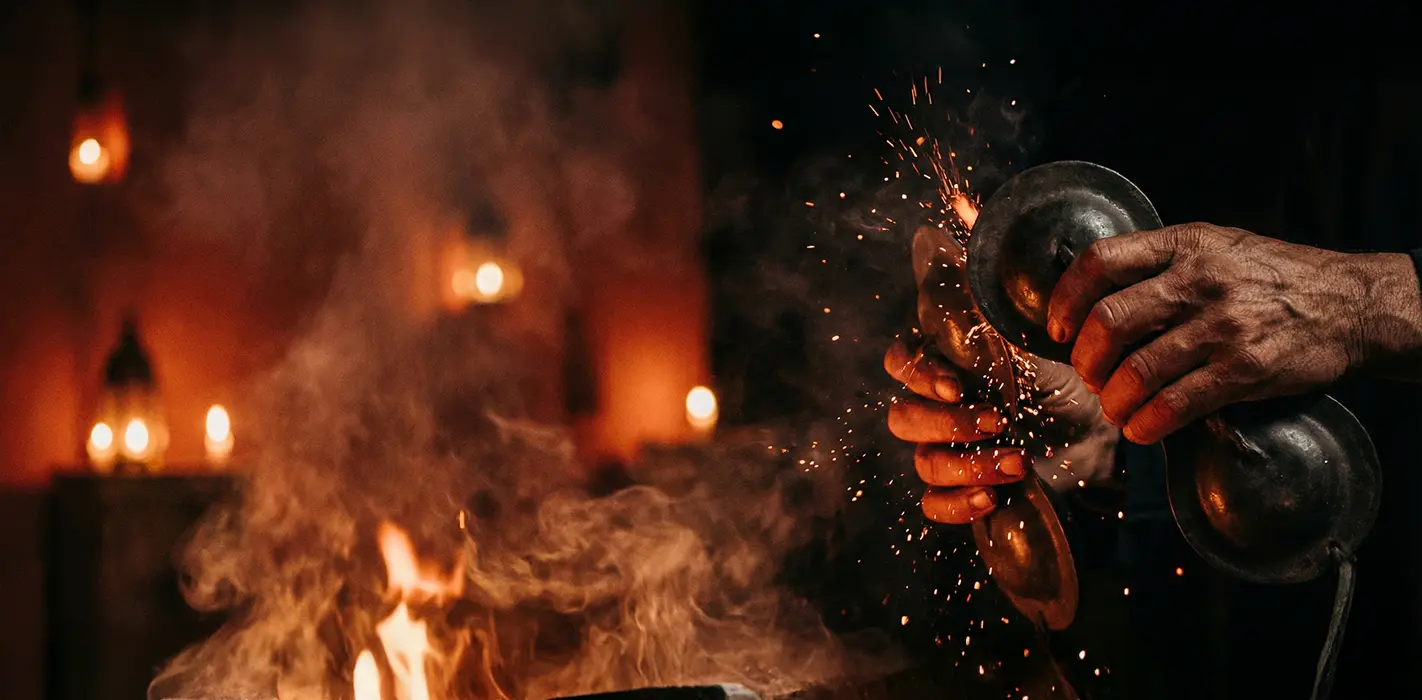
| Qraqeb | Precise, light touch, complex Aissawa-influenced rhythms | Heavy, loud, direct trance drive | Medium, wave-like patterns |
| Sufi connections | Deep integration with Aissawa & Hamdouchia | Local zawias (Sidi Bel Abbes) | Independent tradition |
| Performance space | Enclosed riads, palaces, urban zawias | Open squares (Jemaa el-Fna), rural | Beach, shrine, open air |
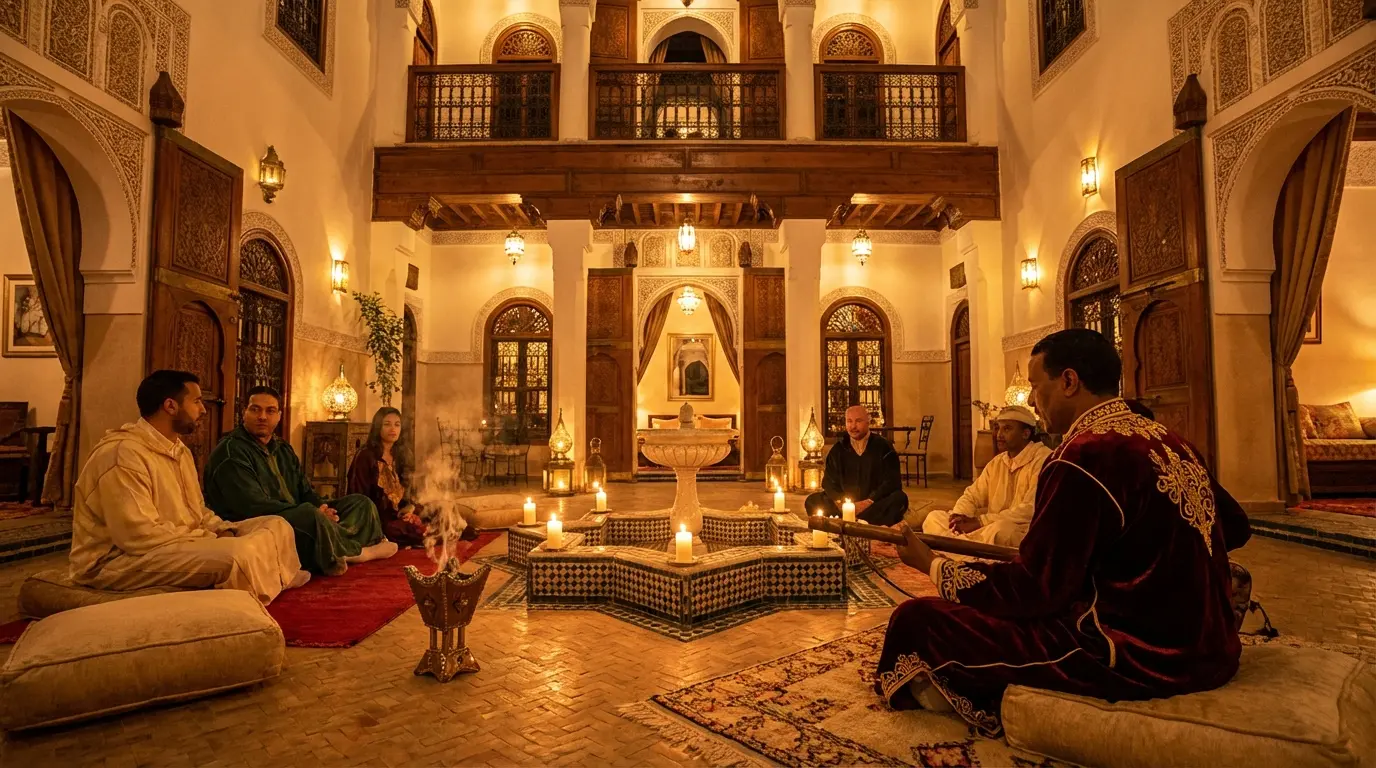
The Sufi Crossroads — Aissawa, Hamdouchia & Gnawa
The Aissawa Connection
Meknes is the spiritual capital of the Aissawa order (founded by Sheikh Al-Kamil Mohamed Ben Aissa). The geographic and social proximity between Gnawa and Aissawa families in the old medina created a unique rhythmic fusion:
- Polyrhythms: Complex 5/8 and 7/8 time signatures from Aissawa ceremonies were absorbed into local Gnawa Qraqeb patterns — creating interlocking rhythmic textures unknown in the south.
- The Dual Musician: In Meknes, it’s common for musicians to perform with both brotherhoods. This “professional bilingualism” allowed instruments like the Ghaita (oboe) to accompany Gnawa drums during the Ftouh (opening), and Aissawa praise texts to be sung over Guembri bass lines.
- Shared Hadra: Both traditions practice Hadra (presence/trance), and in Meknes the techniques blur — Aissawa ecstatic breathing rhythms appear in Gnawa ceremonies, and Gnawa spirit-invocation melodies slip into Aissawa rituals.
The Hamdouchia — Lalla Aisha’s Domain
The Hamdouchia order (founded by Sidi Ali Ben Hamdouch) specializes in healing spirit possession — particularly cases involving Lalla Aisha (Aisha Qandisha), the most fearsome of the Mlouk. When the Gnawa Maâlem reaches the black color (Lalla Aisha’s realm), he plays melodies drawn directly from Hamdouchia music — using their specific scales and phrases as “keys” to invoke this powerful spirit.
This creates a three-tier healing system: if standard Gnawa ritual doesn’t resolve the patient’s condition, the Maâlem can escalate to Hamdouchia-inspired intensity — blending traditions into what researchers call “traditional psychiatric practice” — a psychodrama of healing that has served communities for centuries.
Sidi Ali Ben Hamdouch — The Cave of Shadows
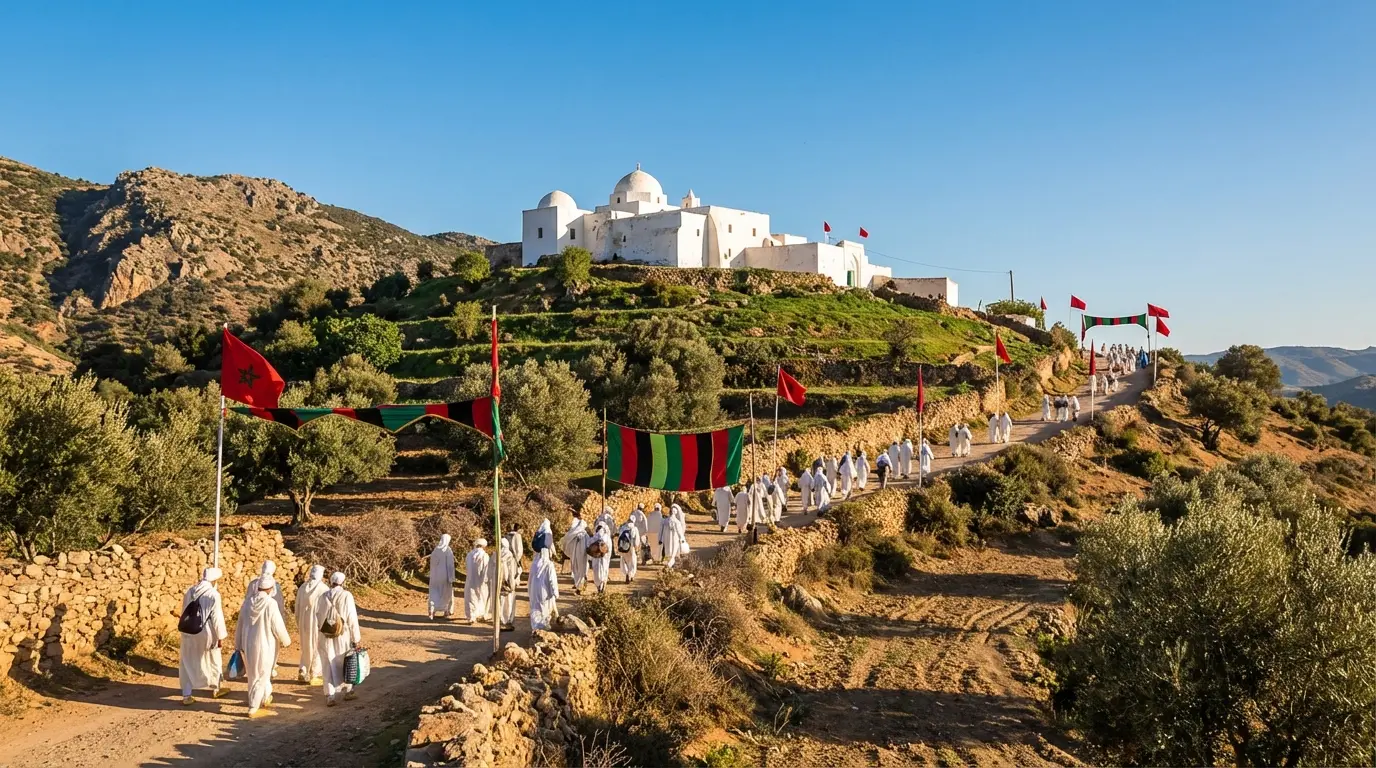
The annual moussem (pilgrimage) at Sidi Ali Ben Hamdouch (near Meknes, in the Zerhoun mountains) is the most dramatic event in Moroccan spiritual culture — a living laboratory where Gnawa, Hamdouchia, Aissawa, and Jilala converge in one sacred space.
The Two Worlds
The sanctuary divides into:
- The Upper World (the saint’s shrine on the hilltop) — representing orthodox religion, the dahir (outer law), and patriarchal authority.
- The Lower World (Al-Hafra — the cave and spring below) — the domain of Lalla Aisha, representing the batin (inner mysteries), feminine power, and direct communion with spirits.
The Gnawa Descent
In the lower cave, Gnawa masters lead the most intense rituals:
The Dakhla (procession) descends carrying black bulls for sacrifice, giant Bakhour censers billowing with black Jawi incense, and banners in the colors of the Mlouk. Tbel drums thunder at maximum volume to announce the Gnawa’s presence. Inside the cave, surrounded by flickering black and red candles, the Maâlem plays accelerating trance rhythms to invoke Lalla Aisha — building from meditative calm to overwhelming intensity.
Those afflicted by spirit possession enter violent Jedba (trance) states. The sacrificial blood is considered essential to satisfy the spirits and break sorcery. This practice — far from superstition — functions as a collective therapeutic catharsis, providing psychological release for marginalized communities who find no remedy in conventional medicine.
The Saharan Outpost — Khmilia
While Fes and Meknes represent the urban, refined end of this school, the village of Khmilia (near Merzouga, at the edge of the Sahara) preserves the most ancient form of Gnawa music — closest to the original sub-Saharan roots.
The Oujaa family (Mohamed and Zaid) maintain a style stripped of urban influences: heavy rhythms, deep repetitive chanting in African-inflected dialect, and trance techniques that predate the refinement of the city schools. Their ensemble “Hamayem Erimal” (Pigeons of the Sand) offers visitors a raw, primal Gnawa experience — music as it might have sounded when the first enslaved communities arrived from Timbuktu and the Hausa lands.
This contrast — between the aristocratic chambers of Fes and the desert sands of Khmilia — defines the breadth of the Imperial school: from the most polished to the most primal, all united under the same spiritual framework.
The Imperial Dress — Splendor as Statement
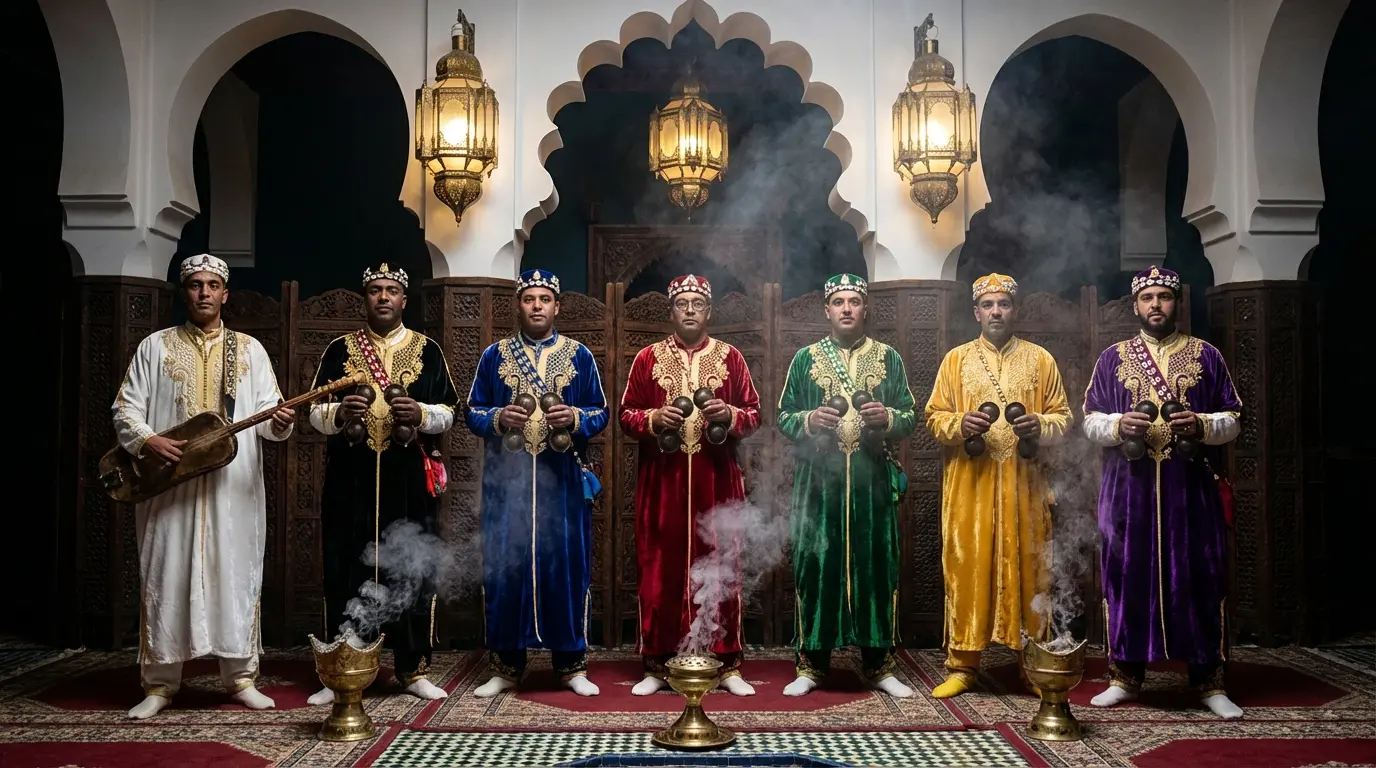
The Fassi Maâlem dresses with exceptional opulence — rivaling the attire of court musicians:
- Velvet and Silk (moubra) robes embroidered with gold and silver thread (serma) — echoing the technique used in Fassi kaftans.
- Cowrie shells (wada’) arranged in precise geometric patterns — not scattered randomly as decoration, but organized in sacred configurations that encode spiritual meaning.
- The Chachia is heavier, more ornate, and more architecturally structured than in any other school.
During the Lila, costume changes follow the seven colors of the Mlouk with strict ritual discipline — white, black, blue, red, green, yellow, purple — each representing a spiritual station. This adds a theatrical, sacred dimension to the performance that transforms the Lila into something approaching sacred opera.