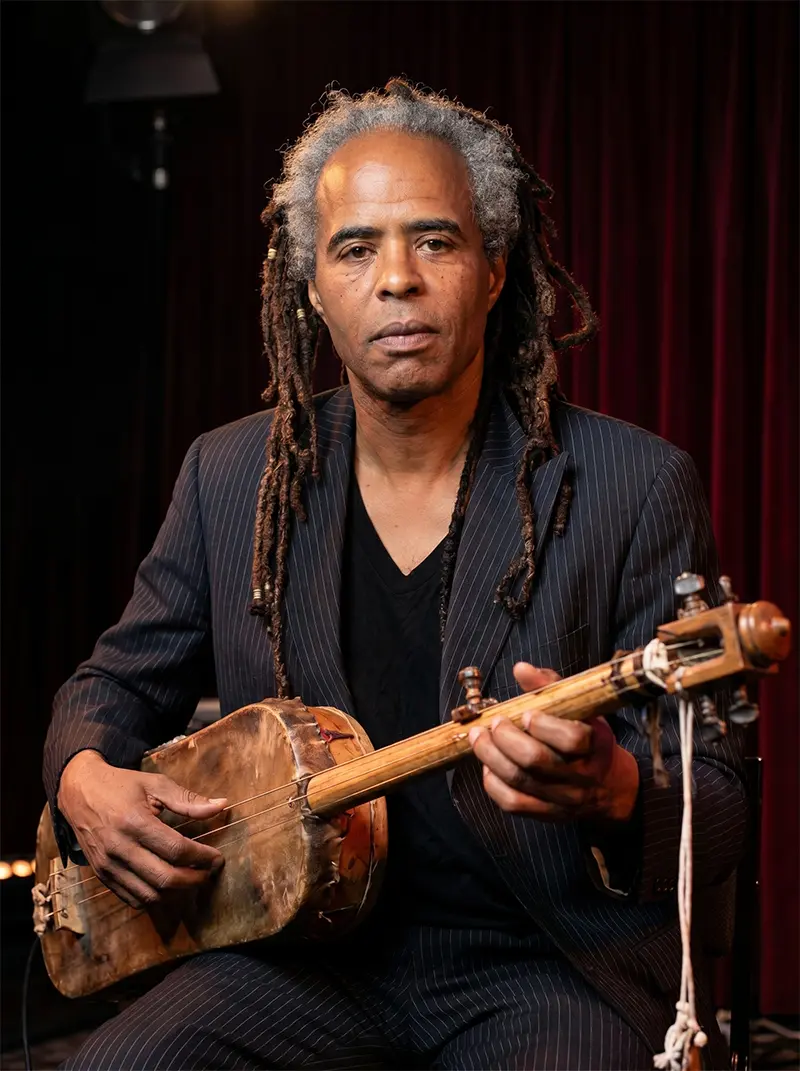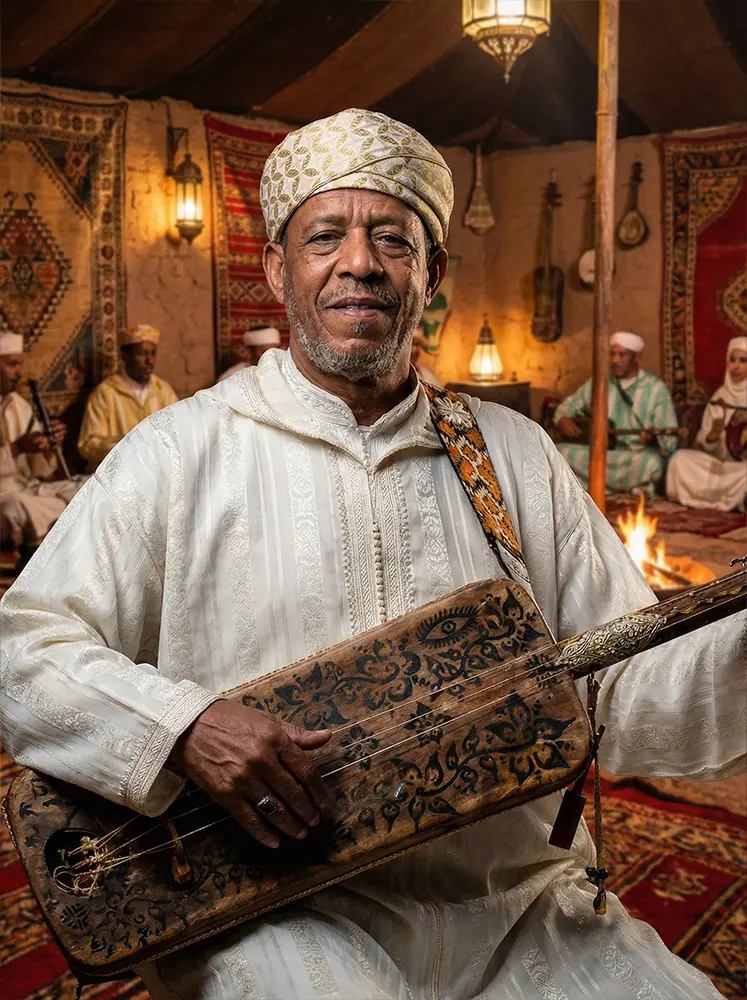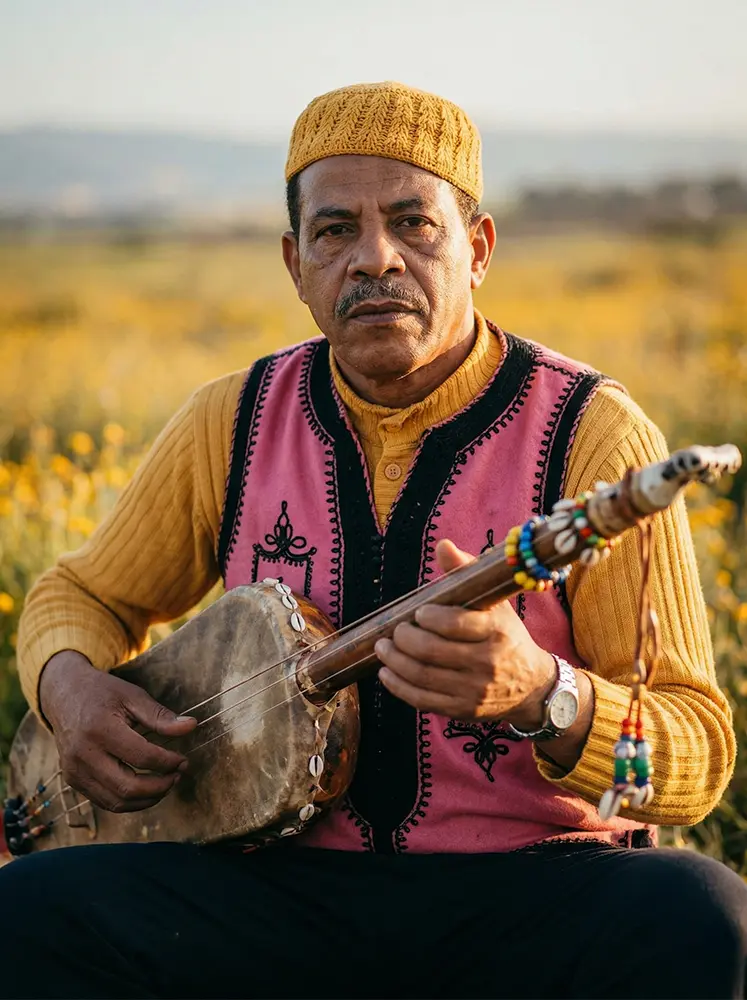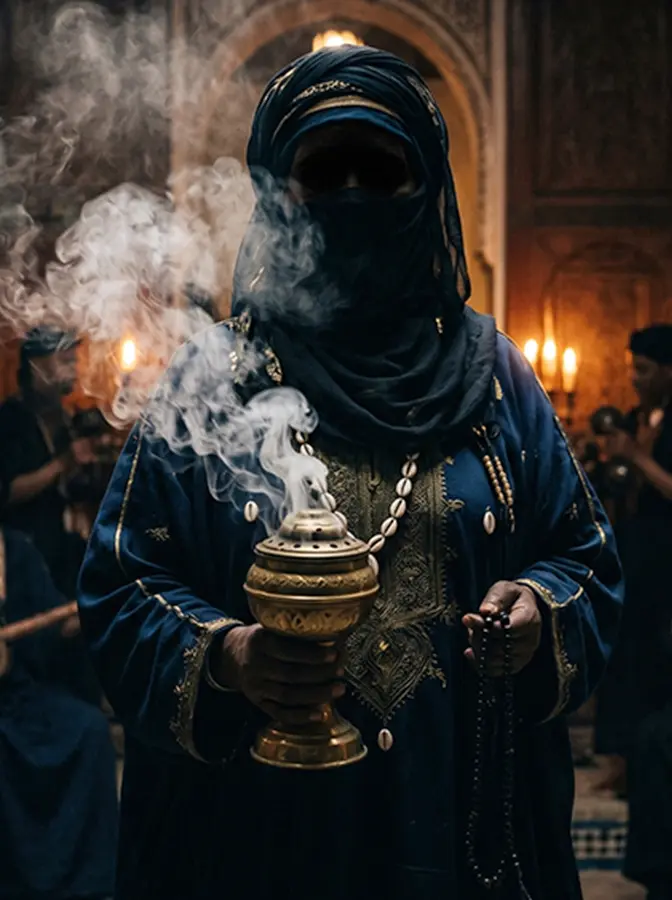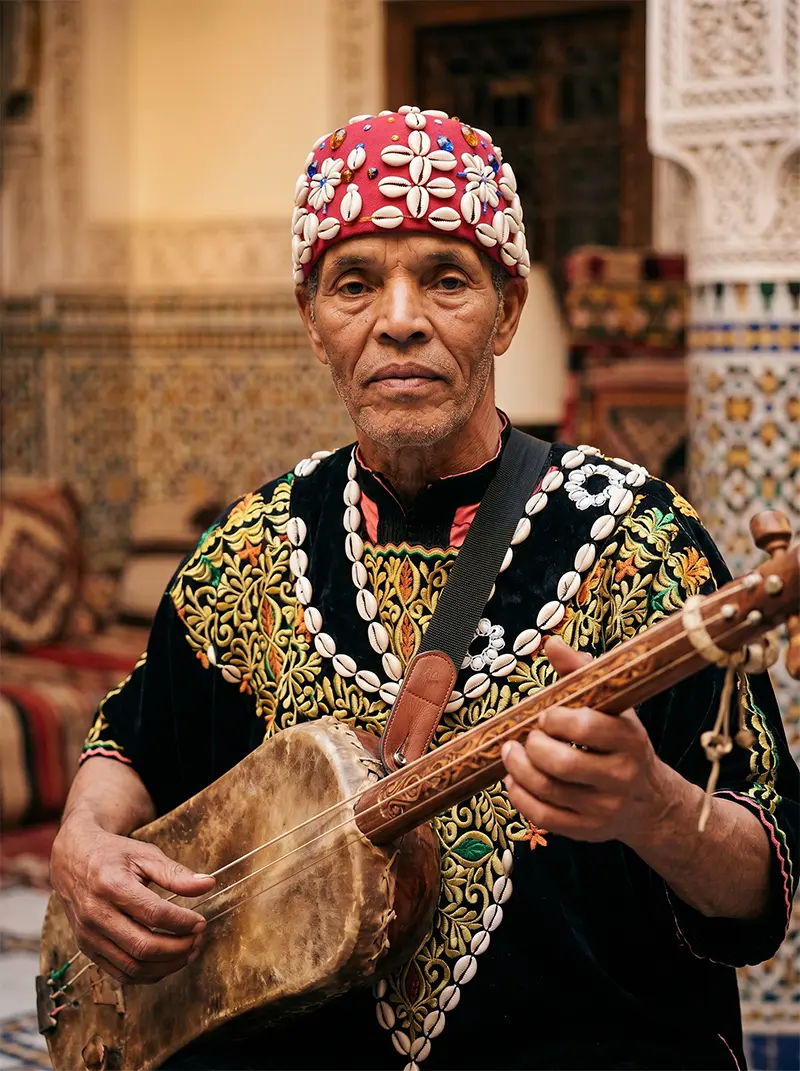
In a musical scene where random blending has become the currency of visibility, Maâlem Hassan Zeghari, known across the Gnawa world as Hassan El Gadiri, stands as an unyielding fortress. He does not merely play the guembri — he speaks through it in the unmodified dialect of the Marrakchi zawiya. His name is invoked not on commercial stages but in the conversations of ethnomusicologists and masters when they need a living reference point for the pure Marrakchi style.
What makes him exceptional is a double capacity that is genuinely rare: the ability to command the chaotic open space of Jemaa el-Fna square with a voice that cuts through the noise of daily life, and the depth to transform that same energy into something austere, precise, and spiritually dense when the doors of a lila ceremony close behind him. He does not adapt the tradition to the audience. He adapts the audience to the tradition.
Roots: The Red City and Its Living Schools
The roots of Maâlem Hassan Zeghari are woven into the spiritual and geographic fabric of Marrakech — a city that, alongside Essaouira and Fes, forms the great triangular pillar of Gnawa heritage in Morocco. Marrakech is not merely a location. It is a specific musical atmosphere: faster, heavier, more physically insistent than the Marsaoui school of the coast, built for the wide-open public spaces where the tradition first learned to command attention.
Historically, Gnawa’s presence in Marrakech carries the weight of centuries. The ancestors who were brought from West Africa — from the Bambara, Hausa, Fulani, and Songhai peoples — merged their healing practices and spirit cosmologies with the Sufi Islam of the city’s great shrines. The result was a school of Tagnawit that breathes differently from other cities: its rhythms are more percussive, more ground-anchored, its polyrhythmic complexity designed to build the physical conditions for jedba (trance) in open air rather than sheltered zawiyas alone.
Zeghari grew up inside this world. The zawiya in traditional Marrakchi neighborhoods was not merely a place of practice — it was the first classroom, the first cosmology, the first moral framework. Children absorbed the vocabulary of the mlouk (the spirits and their associated colors, incenses, and mhallat) through proximity and osmosis long before they were permitted to touch an instrument.
The Zawiya as School
In the Marrakchi tradition, the zawiya is simultaneously a house of worship, a healing clinic, and a living archive. No written curriculum exists. Knowledge is passed through presence, imitation, and years of attentive service to the instrument and the master.
Jemaa el-Fna as Laboratory
The great square of Marrakech is not a stage. It is a proving ground where the maalem must hold a crowd without a microphone, a program, or an enclosed space. The attention of the public must be won second by second. This forged a specific kind of authority in Zeghari's command.
Dynasty in the Making
Zeghari's sons -- Samir, Abedin, and Jamal -- were initiated into the tradition from earliest childhood. They now form the backbone of Groupe Oulad Gadiri, ensuring that the transmission continues in living form, not in museum archives.
The Calling: Taking the Guembri
In Gnawa tradition, a person does not decide to become a maalem. The community recognizes him, the elders test him, and the spirits — through the evidence of the ceremony — confirm him. The guembri is not handed over early. It arrives only after years of handling the qraqeb, preparing incense, learning the cosmological map of the seven mlouk and their corresponding colors and fragrances, and demonstrating the capacity to hold a lila in its complete architectural form without error.
For Maâlem Zeghari, that moment arrived through accumulated proof rather than a single dramatic event. The Gnawa tradition in Marrakech holds that the decisive test is the ability to take the guembri as sole leader of the Derdeba — the complete healing ritual that runs through the night from sunset to dawn — and to navigate its full sequence of mhallat (the spiritual suites) without falter. The maalem in this position functions as a physician of the collective spirit. An error in summoning the wrong molk in the wrong sequence, or losing the thread of the rhythm during a critical passage, carries real consequences for those who have opened themselves to the ceremony.
What confirmed his authority was the specific quality of his voice. In the Marrakchi tradition, the voice of the maalem is not decoration — it is the primary instrument of the ceremony, the thread that calls the spirits and guides the congregation simultaneously. Zeghari’s voice, rough-edged and carrying great resonant depth, became the sonic signature that practitioners and listeners would identify with the Gadiri group.
The Unique Style: Pure Marrakchi Architecture
If you need to understand what distinguishes the Marrakchi approach from other Gnawa schools, listening to Maâlem Hassan Zeghari is one of the clearest routes.
| Element | Marrakchi Style (Zeghari) | Marsaoui / Essaouira |
|---|---|---|
| Rhythmic character | Heavy, fast, polyrhythmic density. Built for open space and physical induction of trance. | Slower, more melodic, contemplative. Built for intimate enclosed ceremony. |
| Guembri technique | Powerful slapping of the skin resonator. Deep bass drone as rhythmic anchor for the qraqeb. | Lighter touch, more sustained melodic lines on the strings. |
| Vocal approach | Rough, deep, commanding. Dense call-and-response with the ensemble. Ya Moulay, Allahu Allahu as structural pillars. | Smoother, more melodic, extended solo passages. |
| Ritual adherence | Complete mhallat sequences without compression. No commercial shortening. | Also traditional, but with a different ceremonial ordering. |
His approach to the guembri treats it not as a melodic instrument in the Western sense but as a gravitational center — a force that pulls the rhythmic pattern of the qraqeb into coherence and simultaneously anchors the voices. The specific deep-slap technique he employs, striking the camel-skin resonator with a percussive emphasis that reinforces the bass string drone, is characteristic of the Marrakchi school at its most traditional.
His strict adherence to the complete sequences of the mhallat — never compressing or reordering them for the convenience of a shorter set — is what places him in the category of living reference points for the tradition. When practitioners need to verify the correct ordering of a sequence, or the appropriate rhythmic weight for a specific molk, the Gadiri group’s recordings serve as one of the primary benchmarks.
Career and Recognition: From the Square to the World
Maâlem Hassan Zeghari’s path to international recognition followed an organic rather than a commercial logic. He did not seek stages — the stages found the archive he had built through decades of practice at Jemaa el-Fna and inside the zawiyas of Marrakech.
The first major documentation of his work in an international context came in 1994, when he participated as a core performer in the ensemble Gnawa Halwa, alongside musicians including Abbas Larfaoui “Baska”, Ahmed Larfaoui, Abdenbi Benyizi, and Majid Qradi “Fany”. The result was the album “Rhabaouine”, released in France under Blanca Li Records and distributed through Mélodie Distribution. What made this recording exceptional was its origin: it was drawn from live performances of the theatrical dance production “Nana et Lila”, created by choreographer Blanca Li. Zeghari and the ensemble brought the Gnawa ritual’s architecture into a dramatic format without compromising the ceremonial weight — the lila’s logic remained present even in a theatrical context.
1994: Gnawa Halwa
Album "Rhabaouine" on Blanca Li Records. Live recording from the theatrical production "Nana et Lila." First major international documentation of Zeghari's mastery. Distributed in France and beyond.
1995: Morocco Crossroads of Time
Included in the Ellipsis Arts documentary compilation. His performance of "Sidi Musa" brought the energy of Jemaa el-Fna to international world music audiences for the first time.
2017: Atlas Electronic
Performed at Morocco's leading electronic and experimental music festival. His presence beside artists like mad miran confirmed that authentic Gnawa leads contemporary trance music rather than following it.
In 1995, his voice appeared in “{Morocco} Crossroads of Time”, the landmark Ellipsis Arts compilation that documented the deep African roots of Moroccan music. His 2009 inclusion in “Ouled Bambara: Portraits of Gnawa” on Drag City and 2s and Fews placed his performance in a specifically ethnomusicological frame, focusing on the African Bambara lineage at the heart of the tradition.
His 2011 appearances in the United States introduced the Marrakchi school to American audiences who had rarely heard Gnawa in its undiluted traditional form. And his 2017 participation in the Atlas Electronic Festival — sharing a program with advanced electronic artists — was perhaps the most vivid demonstration of his position: he did not adapt to the contemporary context; the contemporary context acknowledged his primacy.
Fusion and Collaboration: The Equal Dialogue
Maâlem Zeghari’s philosophy regarding musical collaboration is precise and uncompromising: engagement with other traditions is possible, but only when the Gnawa ritual structure remains the controlling center. Western instruments enter as guests. The circular polyrhythmic architecture of the Marrakchi tradition is not modified to accommodate them.
Trance Mission: A Model of Mutual Respect
The most significant and sustained collaboration of his career began in 2004, when Belgian baritone saxophonist Gregoire Tirtiaux traveled to Marrakech not to perform with Zeghari but to study under him. This reversal of the usual dynamic — a European academic musician becoming a disciple of an African master — is the key to understanding why the resulting project, Trance Mission, succeeded where surface-level fusion projects fail.
| Member | Role | Function in the Ensemble |
|---|---|---|
| Hassan Zeghari | Lead voice, guembri | Rhythmic and spiritual center. All other parts orbit his pulse. |
| Gregoire Tirtiaux | Baritone saxophone, voice | Co-founder. After years of apprenticeship in Marrakech, enters as a respectful guest within the Gnawa framework. |
| Abedin Zeghari | Voice, qraqeb | Maintains the cyclical Gnawa repetitive structure. |
| Jamal Zeghari | Voice, qraqeb | Maintains the cyclical Gnawa repetitive structure. |
| Giovanni Di Domenico | Fender Rhodes piano | Contemporary harmonic color without overriding the Gnawa rhythm. |
Tirtiaux did not arrive with a musical agenda. He arrived with a student’s posture, and learned the internal logic of the Marrakchi mhallat from within before he was ready to interact with them from outside. The resulting Trance Mission concerts — including the Daba Maroc series in Belgium in 2012 — demonstrated a form of dialogue where polyphony emerged from genuine mutual knowledge.
Gnawa Impulse: The Next Generation
What confirms that Zeghari’s influence extends beyond his own performance is the trajectory of his son Samir Zeghari. In September 1998, Samir met German multi-instrumentalists Jan Claudius Rass and David Bek in Marrakech. The result was Gnawa Impulse — a project centered on the concept of “Living Remixes,” layering Gnawa ritual recordings (including “La Ilaha Illa Allah”) with techno and trance electronic rhythms. This early experiment in Electro-Moroccan production proved that the Zeghari family’s relationship with tradition was not about preservation through isolation but about building deep roots that enabled genuine contemporary exploration.
Legacy and Transmission: The Living Archive
The most important thing Hassan Zeghari will leave behind is not an album catalogue. It is three sons who carry the tradition in their bodies rather than in documentation.
Samir, Abedin, and Jamal Zeghari were not taught Gnawa as a career. They were initiated into it as a way of living. Each underwent the full apprenticeship — years at the qraqeb before approaching the guembri, memorization of hundreds of poetic strophes in both Moroccan Arabic and African Bambara dialect, immersion in the cosmological ordering of the seven mlouk and their sequences in the lila. They form the Groupe Oulad Gadiri not as a commercial act but as a continuation of the Zeghari zawiya’s living practice.
Beyond his sons, Zeghari’s willingness to transmit to a European disciple (Tirtiaux) reflects an understanding that Tagnawit is a human heritage beyond ethnic boundaries — one that can be learned by those outside the bloodline who approach it with the necessary rigor and respect.
What he fears losing: not the music itself, but its meaning. The transformation of Gnawa into tourist entertainment or festival spectacle — Gnawa without the therapeutic intention, without the careful sequencing of the mhallat tied to specific spirits and healings, without the weight of the jedba as a real event rather than a performance — is, for him, the disappearance of the tradition even while its outer form survives.
What he wants to leave behind: a school that breathes. Voices that still know “Ya Moulay” in the correct context. A Marrakchi Gnawa that can stand on a world stage without apologizing for its complexity or simplifying itself to be understood.
Essential Listening
Arbi A Moulay / Sidi Bou Ganga
Gnawa Halwa: Rhabaouine / 1994
An anthropological document as much as a recording. The invocation of the forest spirits in the Gnawa ceremonial sequence. Zeghari's deep rough voice over the locked qraqeb pattern -- this is what a Marrakchi zawiya sounds like in the early hours of a lila, when the spirits are closest.
Sidi Musa
Morocco Crossroads of Time / 1995 / Ellipsis Arts
Selected for an internationally distributed compilation precisely because it captures something unrepeatable: the performance energy of Jemaa el-Fna square translated into a recording. The water spirit mhalla with the full percussive weight of the Marrakchi polyrhythm behind it.
Trance Mission Live
Collaborative / Daba Maroc Series / Belgium 2012
The practical proof of the equal-dialogue principle. Tirtiaux's baritone saxophone finds spaces within the Marrakchi polyrhythm without displacing it. Zeghari's guembri does not adjust its tuning or tempo to accommodate the jazz musician. The jazz musician learned to move inside the Gnawa structure.
"The guembri is not wood and string that we play for entertainment. It is the tongue of the ancestors. When we strike its skin, we are not making music -- we are waking sleeping memory and healing wandering souls."
Maâlem Hassan Zeghari (El Gadiri)
Hassan Zeghari did not chase the world. He held his position at the center of a living tradition in Marrakech, and the world came to find what was there. His sons carry it forward. His students carry it outward. And the guembri he still plays inside the old city’s zawiyas continues to speak in the unbroken language of a tradition that arrived in chains centuries ago and refused, across all that time, to become anything less than itself.