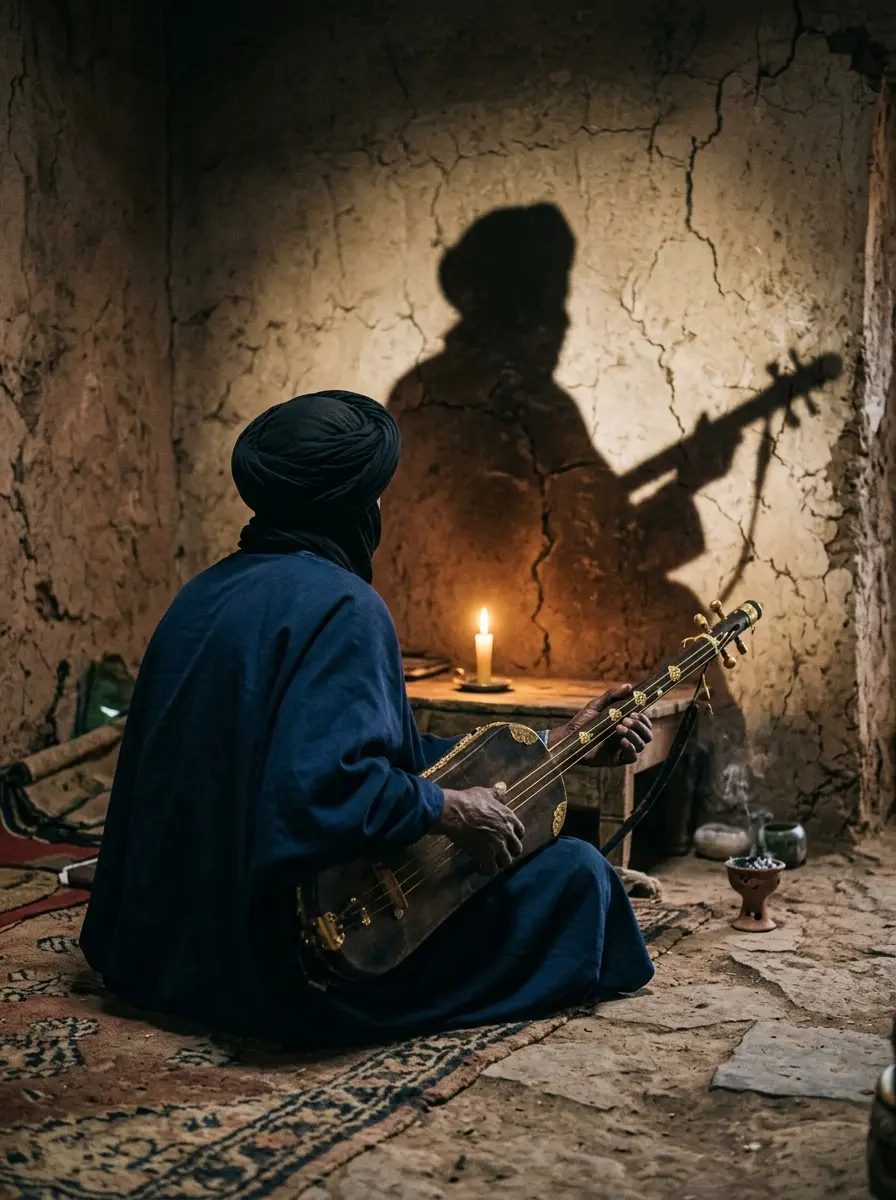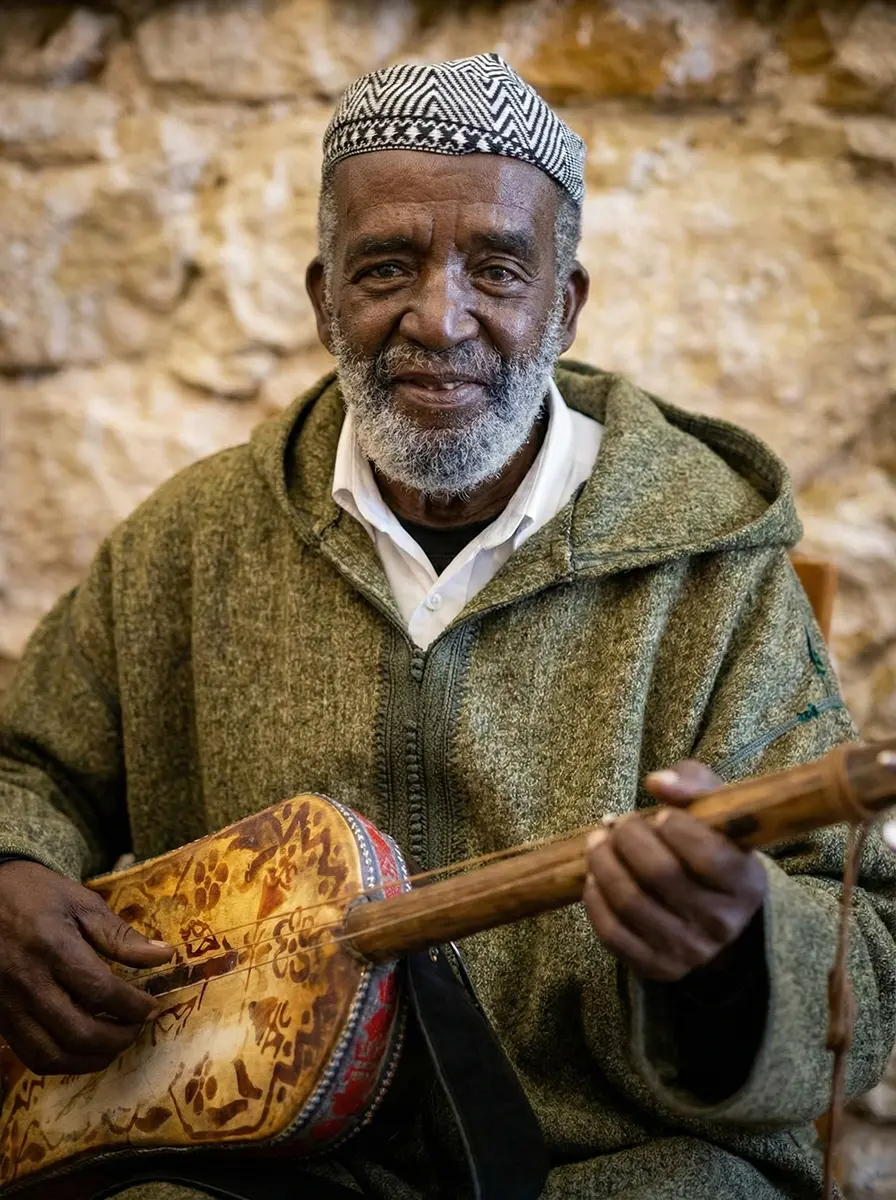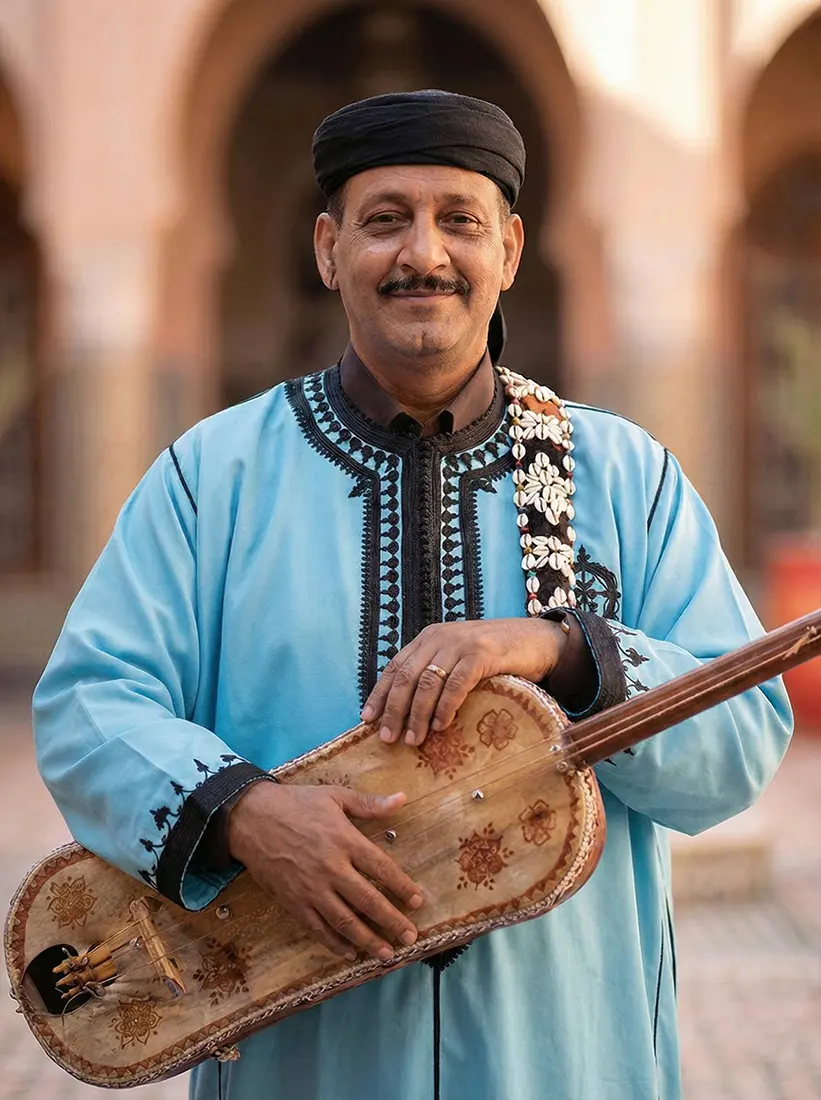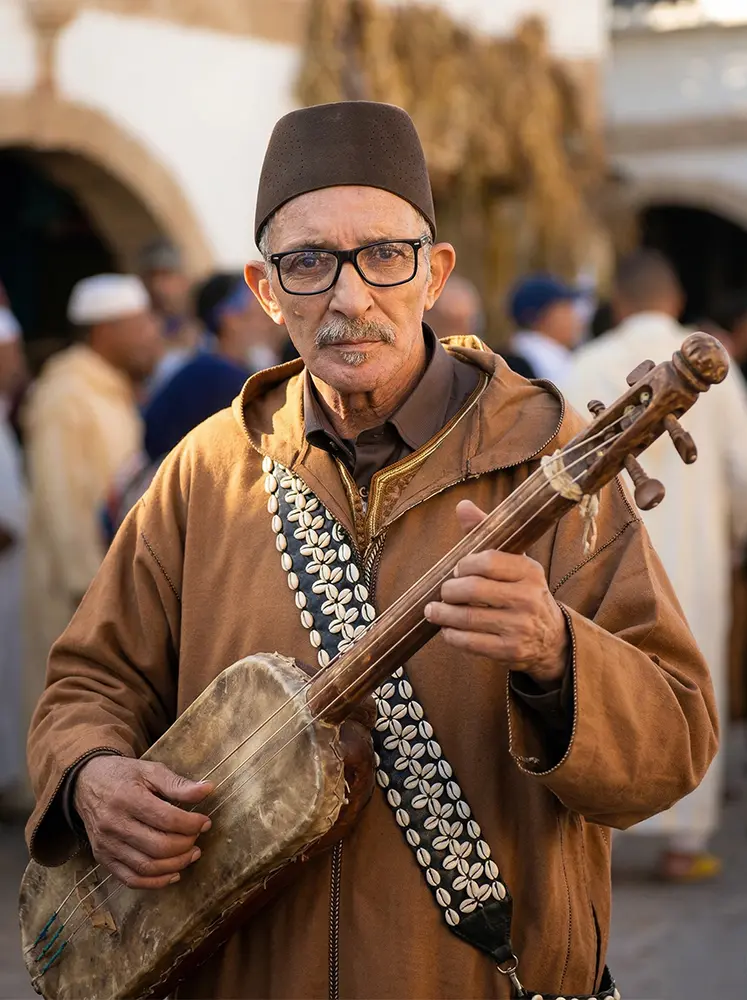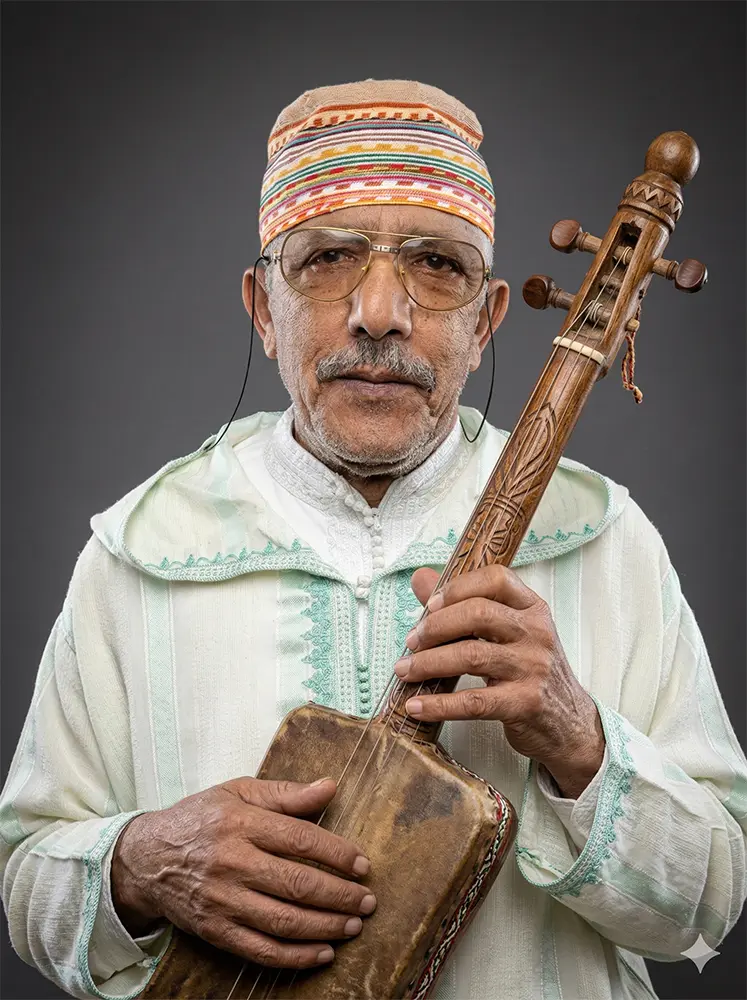
In the hierarchy of Gnawa masters, there are names that command stages and names that command respect. Maâlem Abdelouahed Stitou commands both — but if forced to choose, he would choose respect every time. Born in Tangier in 1947, Stitou is the living encyclopedia of the Northern school, the man whose hands have held the guembri for over six decades, whose voice has guided generations through the treacherous passages of the lila, and whose pedagogy produced the most famous Gnawa voice on earth: Maâlem Hamid El Kasri.
He is not merely a traditionalist. He is a guardian who can walk through the door of jazz and world music — as he proved alongside Randy Weston — and return to the zawiya without a single note out of place.
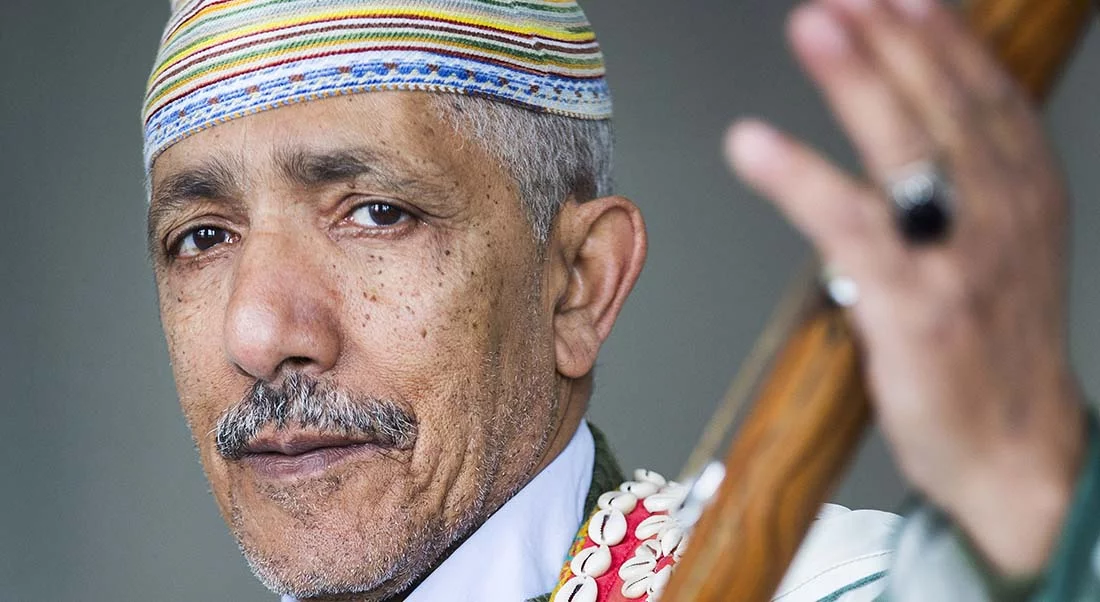
Roots: Tangier 1947 — The International Zone
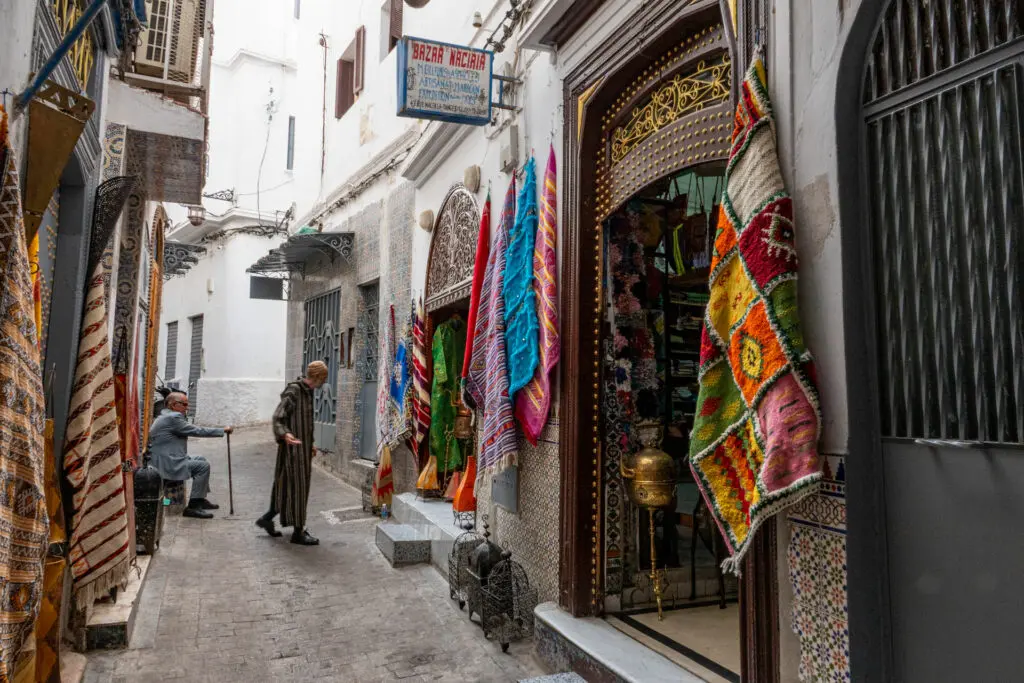
The story of Abdelouahed Stitou begins in the Tangier of 1947 — a city that was simultaneously an International Zone where Mediterranean cultures collided, and a fortress of ancient African memory buried in its zawiyas. In the old alleys of the Kasbah and the narrow streets of the medina, the ancestors of the Gnawa — carried from Mali, Senegal, and Niger along the trans-Saharan routes — had preserved their Bambara, Hausa, and Fulani rhythms within the framework of Tagnawit.
Stitou’s introduction to Gnawa was maternal. In interviews, he points to his mother as the original source — not a musician in any formal sense, but a woman who possessed al-hal (the state of spiritual clarity and attraction). He describes her with a phrase as economical as it is profound: “She had it, she had it” — confirming that she carried the authentic Gnawa spirit, and that she was the first vessel to transmit these genes before his fingers ever touched a guembri string.
At the age of eight, the young Abdelouahed entered the formal path of apprenticeship — not in academic conservatories but in the Sufi zawiyas of Tangier, specifically at the legendary Zawiya Dar Badidi. There, he attended his first lilas. For an eight-year-old, the lila was an overwhelming sensory and spiritual journey: the varied incenses (jawi, oud, serghina), the seven colors symbolizing the spirits, the thunder of the ganga drums, and the metallic clash of the qraqeb — which in their historical unconscious replicate the sounds of the chains that once bound the ancestors.
The Calling: Thirty Years at the Feet of Masters
The transition from disciple to maalem in Gnawa is not a promotion. It is a spiritual crossing. For Stitou, it was not a momentary decision but the accumulation of decades of service and listening.
In a world without mobile phones or recording devices, knowledge transfer depended exclusively on human memory and direct oral transmission. Stitou describes this phase with precise detail, noting that a disciple was obligated to remain beside the master for extremely long periods. He states it plainly: “You must stay beside the master for thirty or forty years, playing only the qraqeb.” This declaration reveals the severity and patience demanded by this school. The disciple learns to regulate the entire lila’s rhythm—understanding the shifts in Gnawa maqams and the moods of the mhalla (spirit groups) — without being permitted to touch the guembri at first.
Was there a defining night? Yes. The transformation occurs through a collective recognition ritual known as al-Fatiha or la Soirée. When the elders decide a disciple has matured spiritually and musically, a special night is organized — a graduation ceremony. Masters from across Morocco — from Marrakech, Rabat, and beyond — converge to witness this new birth. A senior master opens the night, prepares the atmosphere, then hands the guembri to the new disciple. The disciple must lead the entire night — with all its complexities, rhythms, and shifting maqams — until dawn.
When the sun rose on that morning, the Fatiha was read and the words spoken: “Go, may God help you.” At that precise moment, Maâlem Abdelouahed Stitou was born.
The Shamali Fingerprint: 243 Songs and Counting
What makes Stitou an indispensable name in ethnomusicological studies of Gnawa is his strict preservation of the Northern style combined with an encyclopedic command of the repertoire — over 243 songs in the traditional canon.
The Dual Technique
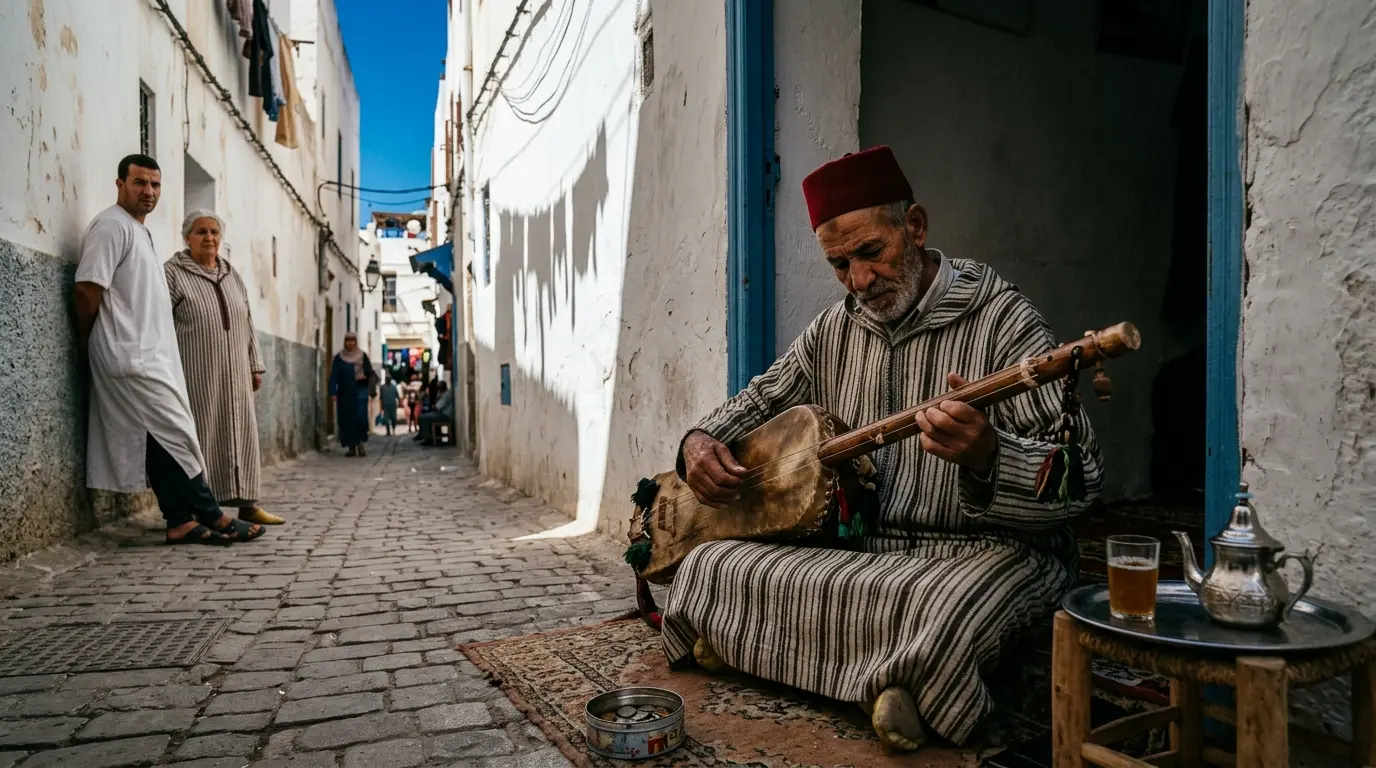
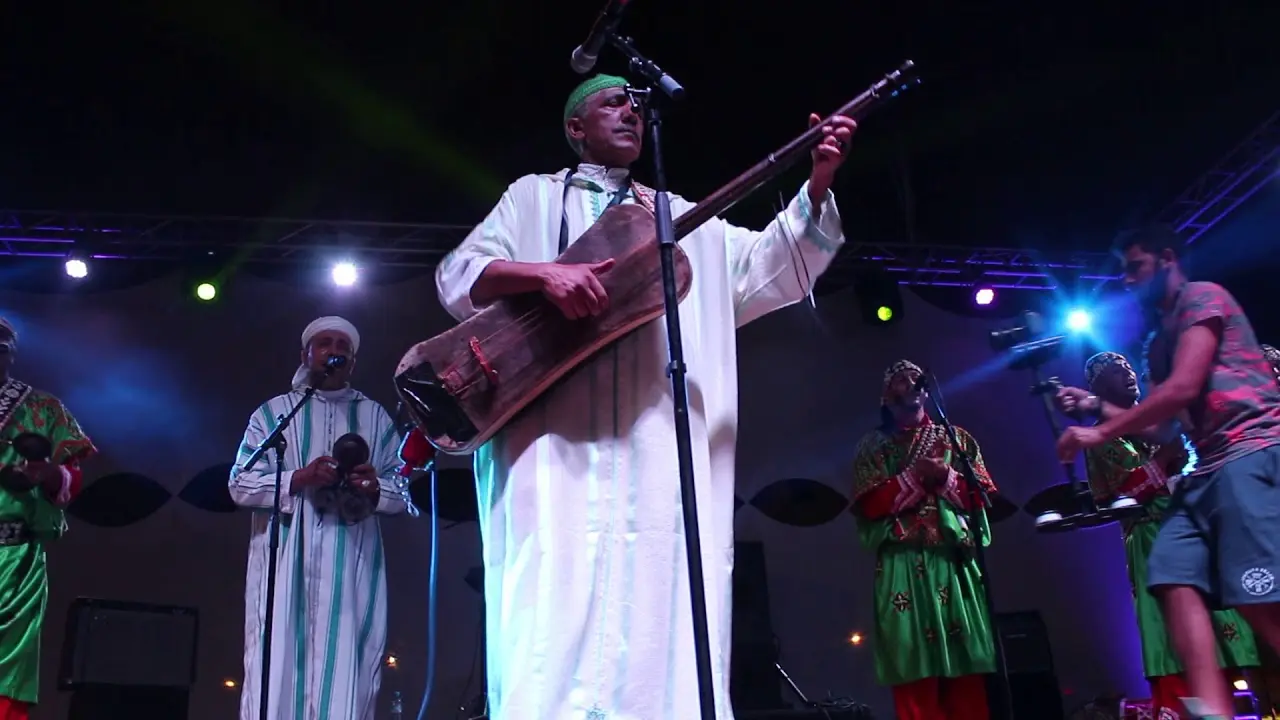
Stitou possesses an exceptional technique: plucking the strings with one hand while slapping the skin with the other, creating a polyrhythmic compound melody that parallels combining a double bass with a drum in Western music.
The Al-Aada Guardian
Stitou is a fierce defender of *Al-Aada* — the opening street procession that precedes entry into the zawiya. He considers this ritual an essential bond with *"ahl al-blad"* (the people), insisting that Gnawa is not elite closed art but music that draws energy from open community blessing.
Stage vs. Zawiya
In ritual contexts, Stitou adheres literally to the melodic and textual pathways. On stage or at festivals, he adapts the heritage with flexibility — without distortion — relying on the pentatonic scale that is the common ground between Gnawa, blues, and jazz.
| Aspect | Shamali (Stitou's Style) | Southern Schools |
|---|---|---|
| Melodic Structure | Melodic call-and-response, contemplative | Rhythmic density, rapid repetition |
| Rhythm Management | Circular, ascending calmly with space for meditation | Heavy, direct push toward physical trance |
| Guembri Technique | Melodic lines highlighted with precise staccato rhythms | Rhythmic slapping dominance to boost bass |
| Geographic Influence | Mediterranean intersections, local Andalusian music | Direct Sub-Saharan African depth |
Randy Weston and the Atlantic Bridge
The most historically significant chapter in Stitou’s international career is his collaboration with the Afro-American jazz legend Randy Weston. To understand the depth of this partnership, one must grasp Weston’s vision: the pianist settled in Tangier in the late 1960s and founded a jazz club there, believing that jazz was nothing but an extension of ancient African music. Weston was certain that Gnawa practitioners were “brothers and sisters” of African Americans — their shared ancestors carried as slaves, some across the Atlantic to create blues and jazz, others across the Sahara to create Gnawa.
In the 1990s, Stitou entered a close collaboration with Weston. This partnership produced a series of historic concerts and participation in the landmark recording “The Splendid Master Gnawa Musicians of Morocco” (1994), which brought Weston together with the greatest masters. In this collaboration, Stitou was not a “folkloric addition” to a Western jazz ensemble — he was an equal who led the rhythm. He demonstrated that the pentatonic scale and polyrhythmic structures of Gnawa could absorb complex piano improvisations, transforming the encounter from musical fusion into a spiritual embrace between two continents.
The Essaouira Stage and UNESCO
Stitou participated in numerous editions of the Gnaoua and World Music Festival in Essaouira since its inception. He was not merely a participant but an ambassador carrying the “spirit of Tangier Gnawa.” On the stages of Essaouira, he demonstrated to new generations and foreign audiences how music can be precise and committed, and how humility can be the defining trait of a true maalem. Critics and organizers described him as a “living encyclopedia” — he does not content himself with performing popular songs but excavates the ancient repertoire to extract pieces that had nearly been forgotten.
His long career was crowned by his active participation in the efforts that led to the inclusion of Gnawa art on UNESCO’s Representative List of the Intangible Cultural Heritage of Humanity. Stitou’s presence at the celebrations accompanying this international recognition was a tribute to an entire generation of masters who preserved this heritage in their hearts before books recorded it and recordings documented it.
The Transmission: From Tangier to Brussels
The true measure of a Gnawa maalem is not his fame but his students. And here, Stitou’s legacy is monumental.
He is the direct teacher of Maâlem Hamid El Kasri — today the most internationally famous Gnawa performer. Born in 1961 in Ksar El Kebir, El Kasri began his musical training at just seven years old under Stitou and Maâlem Alouane in Tangier. Under Stitou’s strict supervision, El Kasri absorbed the Northern style with all its technical and spiritual complexities before later merging this foundation with southern rhythms to create his universally unique approach.
But Stitou’s legacy extends beyond his famous students — it flows through his blood. His son, Maâlem Réda Stitou, carries the Northern school’s banner today not in Tangier but in Brussels, Belgium. Réda founded his own Gnawa ensemble there, gathering diaspora musicians — proof that “the spirit of the guembri continues and echoes from generation to generation, far from its original soil.”
His teaching philosophy is brutal in its simplicity: strict memorization, moral discipline within the zawiya, and deep listening before practice. He wants to leave behind not recordings but a trust — a generation of masters who understand that the guembri is a living being that breathes with the pain of the past, and that it is a religious and moral responsibility before it is a source of entertainment.
Essential Listening
Al-Aada — Bambara
Ritual / Opening Procession
The essence of the opening *Aada* ritual that Stitou fiercely defends. Bambara rhythms connecting Gnawa directly to its roots in Mali and West Africa. Listen for his skill in organizing the collective rhythm that prepares spirits and audience for the sacred space of the [lila](/blog/gnawa-lila-ceremony-explained).
Ftouh Rahba
Transitional / The Seven Spirits
The central phase of the lila where the [seven spirits](/blog/seven-mlouk-colors-spirits-meanings) are summoned. Showcases Stitou's strict Northern engineering: a contemplative, gradually ascending call-and-response where his finger technique is on full display — ideal for both stage and academic listening.
Moussawiyine
Personal / Sidi Moussa (Blue)
Connected to Sidi Moussa (lord of the sea) and water rituals, in the light blue maqam. Here Stitou leaves space for his deep, sorrow-laden voice to merge with the [guembri's](/instruments/guembri) rhythmic resonance — a profoundly personal piece reflecting the spiritual stillness and humility that define him.
"The first masters taught us that the guembri is not played with the hands — it is played with the heart and the intention. The qraqeb remind us of the chains that fell, and the guembri rejoices the spirit that remained. We are merely guardians of this secret, passing it on exactly as we received it: pure and elevated."
— Maâlem Abdelouahed Stitou
Maâlem Abdelouahed Stitou does not chase applause. He chases accuracy — the accuracy of a struck note, the accuracy of a ritual sequence, the accuracy of a tradition passed without distortion from mouth to mouth across centuries. The Northern school does not merely survive because of him. It knows itself because of him.