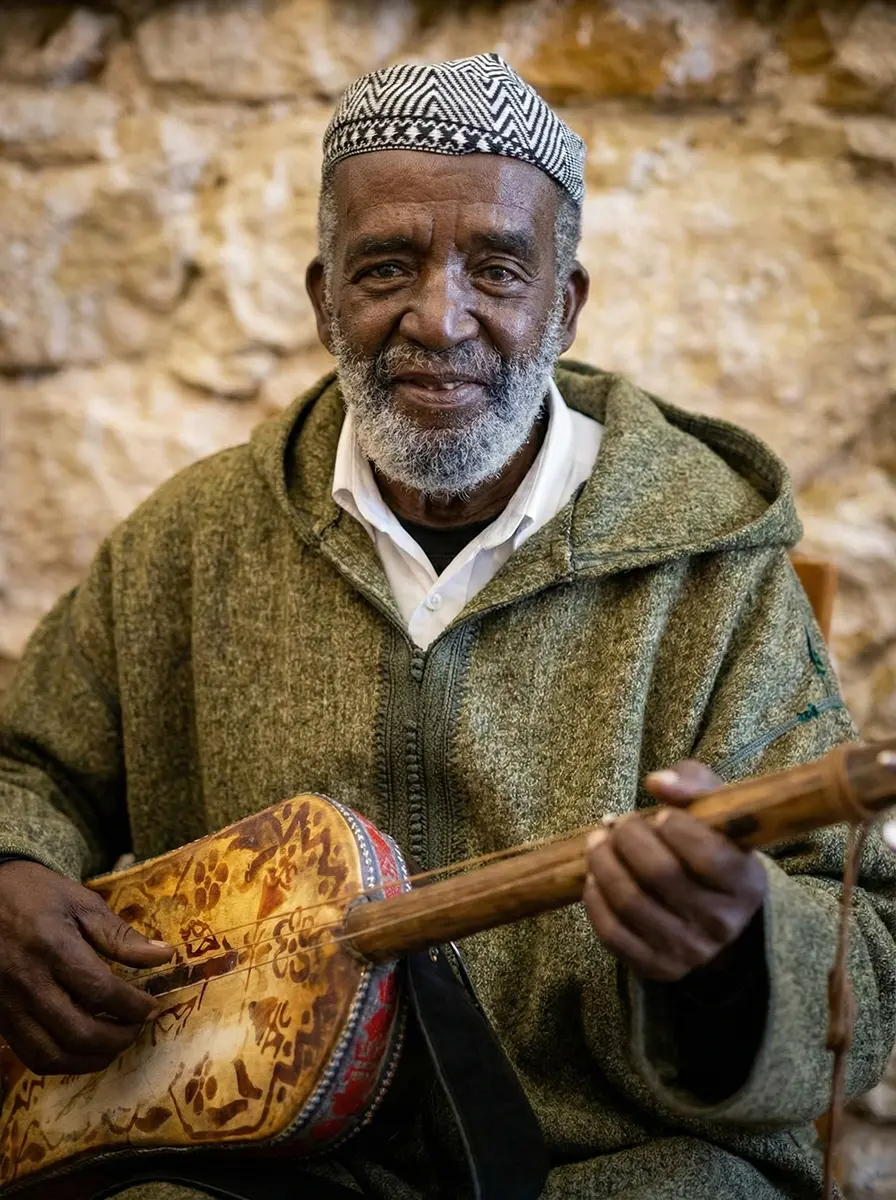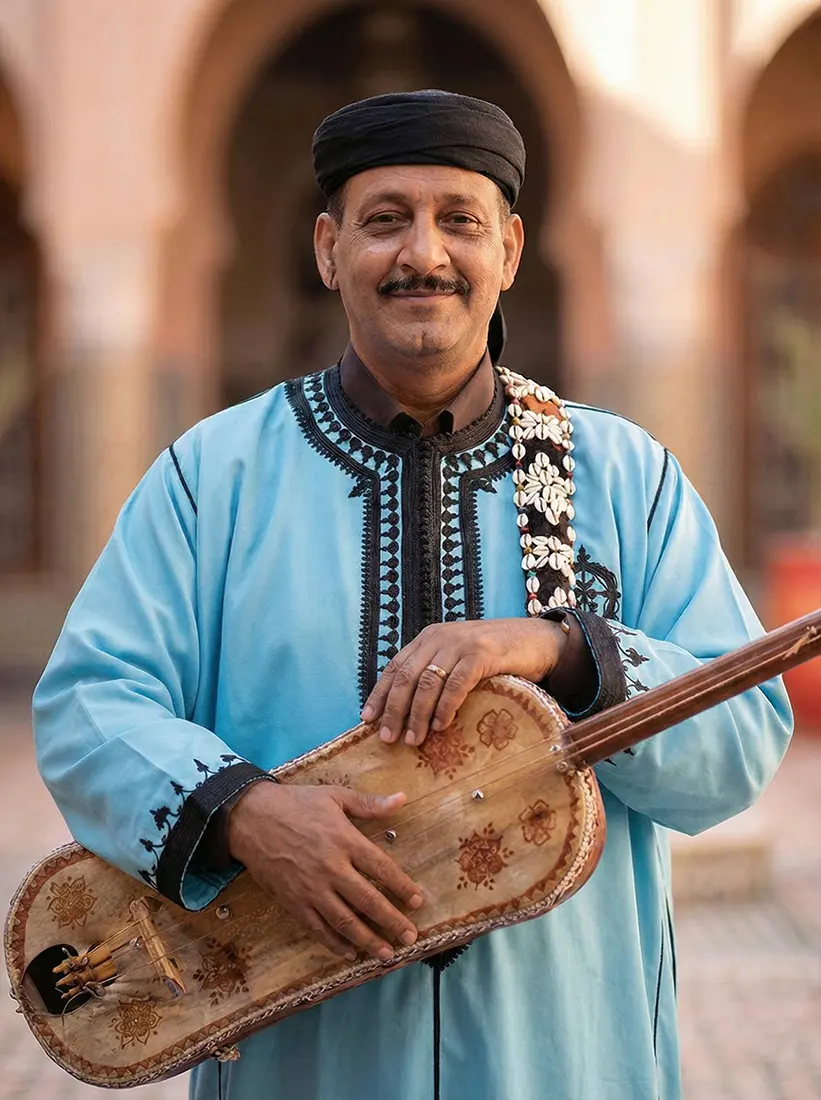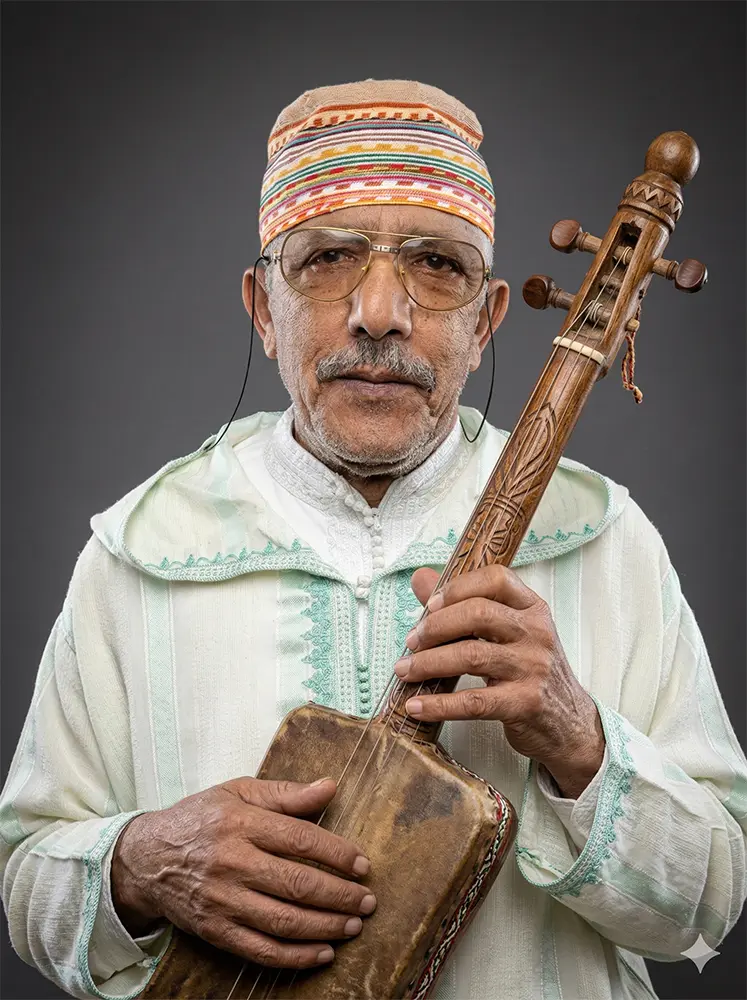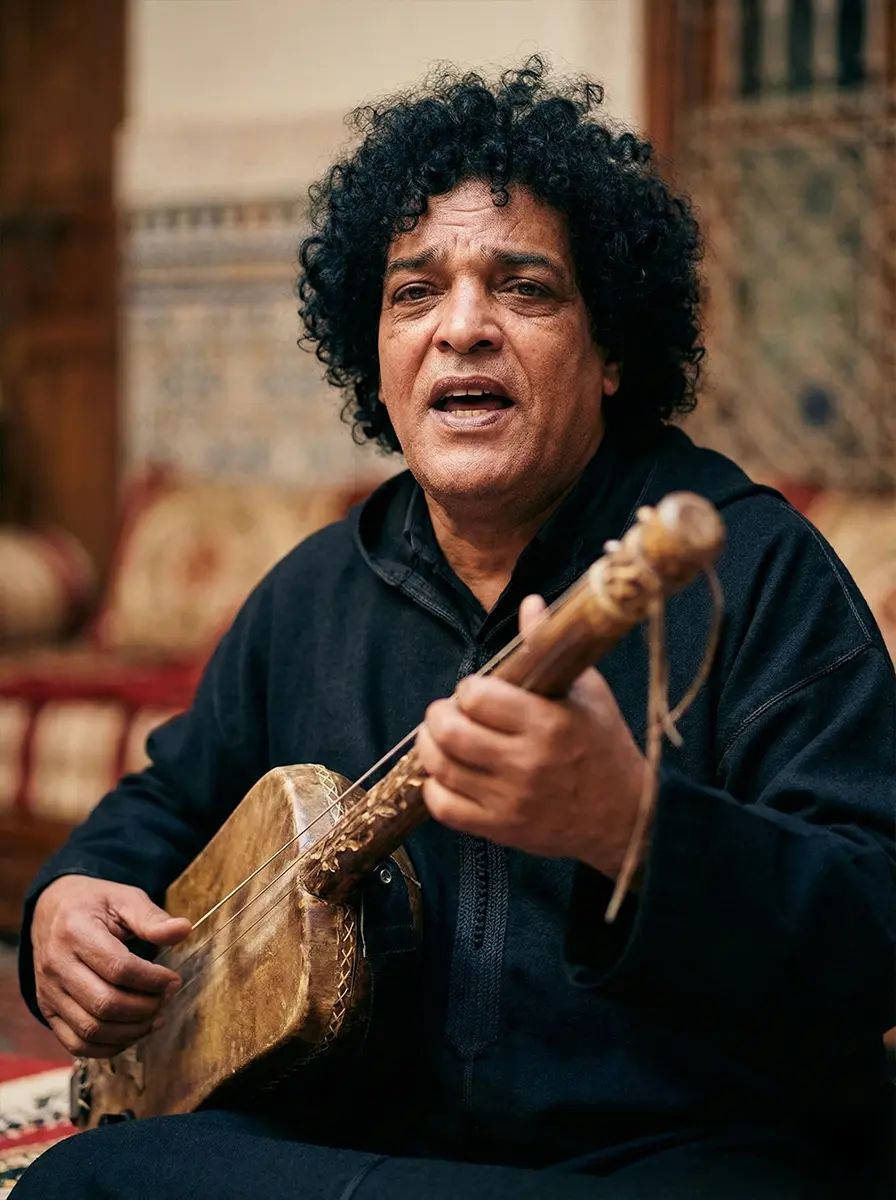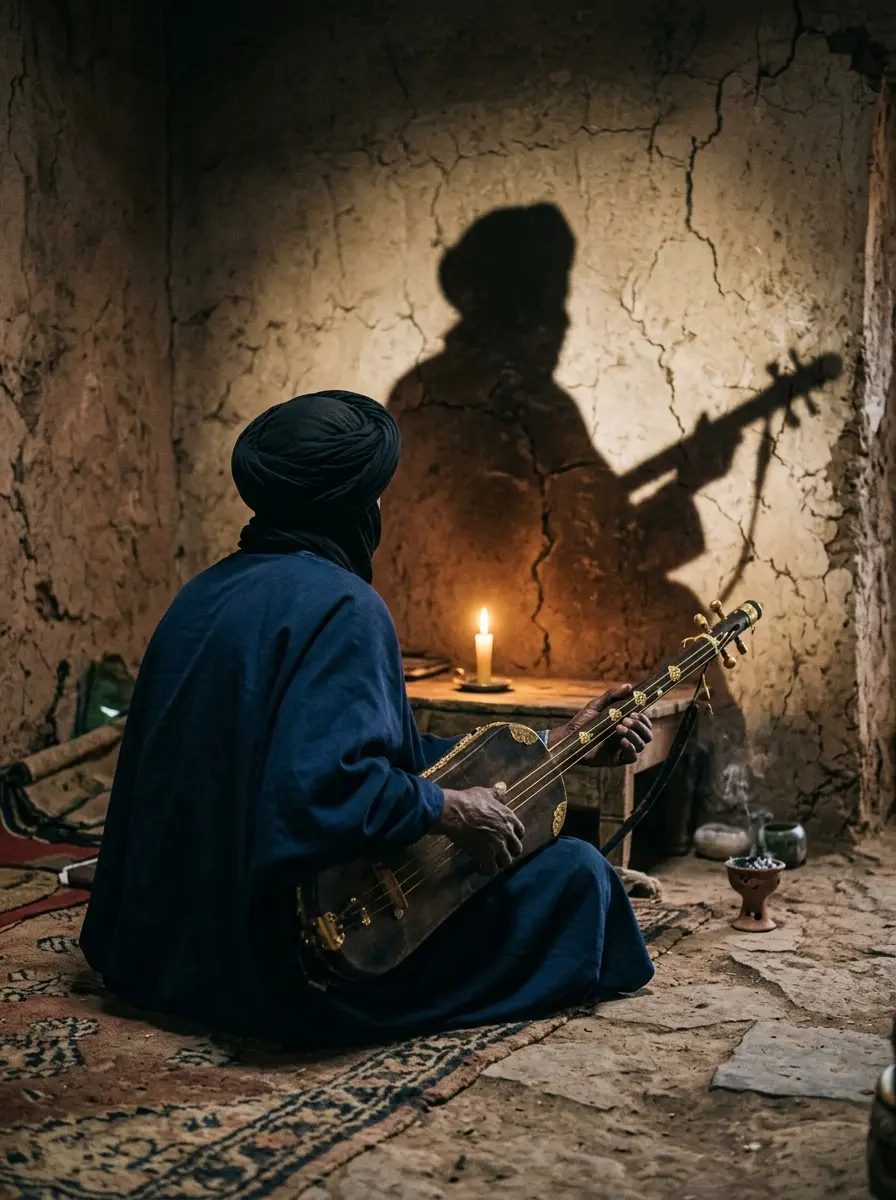
In the shadow world of Gnawa zawiyas, where fame is measured not by audiences but by the precision of a single struck note during a derdeba, the name Maâlem Alouane carries the weight of law. He was not a celebrity. He was a seal — the keeper of the Northern school’s spiritual protocol, the man whose rhythmic architecture defined the Shamali style, and the teacher whose methods produced the most internationally recognized Gnawa musician alive today: Maâlem Hamid El Kasri.
His story is not one of stages and applause. It is the story of a man who turned refusal into art — refusing to simplify, to commercialize, to explain what the guembri communicates to those who already know how to listen.
Roots: The Spiritual Geography of the North
The roots of Maâlem Alouane are woven into the spiritual geography of Ksar El Kebir and Tangier — two cities that formed, across centuries, a crucial meeting point for Sufi orders and African spiritual lineages arriving from south of the Sahara. In these northern communities, Gnawa was not performance. It was a complete healing system, a way of life bound to spiritual lineages stretching back to the Bambara peoples, where ancestral beliefs merged with Moroccan Islam and Sufi practice to produce the philosophy of Tagnawit.
Maâlem Alouane grew up inside this closed world. In the old houses of Ksar El Kebir, music was tied to precise rituals conducted behind the zawiya’s half-open doors. The maalem was the spiritual father. The moqaddema was the guardian of incense, colors, and offerings. Attachment to the zawiya was not social affiliation — it was absolute spiritual commitment demanding total submission to the hierarchy.
The first lila the young Alouane attended as a child was not merely an event. It was a second birth. The ethnomusicological literature describes the child’s first contact with the guembri’s voice as an ancient call from the ancestors — a moment where material time stops and spiritual time begins. In that promised night, amid the dense smoke of jawi incense, the child felt the vibrations of the thick strings course through his thin bones before his ears could process them. He understood that the metallic crashes of the qraqeb were not random noise but the sonic representation of the historical chains of the enslaved — transformed by time and endurance into instruments of spiritual liberation.
The Calling: From Disciple to Master
The transition from disciple to maalem in Gnawa tradition is not a career decision. It is a metaphysical passage equivalent to total consecration. Maâlem Alouane did not choose this path out of personal ambition. It was imposed by his exceptional gift, by the insistent voices inhabiting his fingertips, and by the elders who recognized in him a pure vessel for the preservation of the secret.
In the Northern school’s strict traditions, reaching the rank of maalem required more than musical mastery. The true maalem must be a skilled craftsman of the guembri from scratch — knowing how to carve its wood, stretch the skin of its neck, and weave the ceremonial costumes embroidered with cowrie shells. He must be a human repository memorizing the complex regional repertoire, including chants sung in Darija Arabic and those tracing back to African dialects like Bambara.
Every great name in Gnawa history has a defining night — typically a night when the senior maalem is absent or unable to lead a dangerous passage of the ceremony, and the most gifted disciple is called forward to take the guembri and steer the ship. These moments are accompanied by immense awe — any small error in rhythm, any slip in the ancient words, could produce devastating consequences for the possessed dancers in the ring.
The night Maâlem Alouane took the guembri as leader of the troupe was the official announcement of a legend that would guard the Northern tradition for decades.
The Shamali Sound: Weight, Cycles, and the Deep Pluck
What distinguishes Maâlem Alouane’s style is his embodiment of the Shamali (Northern) approach at its purest. This style differs fundamentally from the better-known schools of the south, and no one represented it more completely than him.
Cyclical Polyrhythms
Heavy, circular rhythms that don't aim for rapid physical release but build a slow, deep hypnosis — a spiritual tension that ascends gradually and with extreme care, inducing trance through patience rather than percussion.
The Deep Pluck
A distinctive plucking technique on the [guembri](/instruments/guembri) strings producing a resonant, rough, warm sound — giving wider sonic space for extended vocal chanting, unlike the aggressive skin-slapping of southern schools.
The Rabbani Method
Every struck string serves the pure spiritual ritual and communication with the unseen world. Alouane and his disciples call this the "Rabbani" approach — divine service through sound, categorically rejecting any connection to sorcery or commercial exploitation.
His philosophy was precise: changing the melody or rhythm of the Gnawa repertoire was not innovation — it was falsification of a sacred text. Yet this strict adherence did not mean rigidity. It meant extracting the maximum creativity from within the traditional constraints themselves.
| Aspect | Shamali (Alouane's Style) | Marsaoui / Marrakchi |
|---|---|---|
| Rhythmic Focus | Heavy, cyclical, slow ascending hypnosis | Faster, emphasis on dynamic physical movement |
| Guembri Technique | Deep plucking, sustained resonance, precision skin strikes | Aggressive attack, rapid skin-slapping for festive sound |
| Vocal Approach | Wide solo spaces, deep extended chanting | Intense chorus, rapid call-and-response |
| Core Function | Strictly ritual, therapeutic, contemplative | Ritual at core, adaptable to stage and public celebration |
Between the Zawiya and the World
Maâlem Alouane’s career remained for a long time in the shadows — behind the closed walls of zawiyas and old houses in northern Morocco. His emergence from the purely local frame to national and then international recognition was not the result of marketing campaigns or a chase for spotlight. It was the inevitable academic and artistic recognition of his value as an extraordinary human repository of a heritage threatened by extinction.
Recognition began to extend beyond Tangier and Ksar El Kebir when ethnomusicologists, anthropologists, and Western musicians started arriving in Morocco to explore the deep African roots of blues and jazz — and found in his precision and rhythms a material of extreme complexity, authenticity, and depth.
The international academic and musical audience viewed the school Maâlem Alouane represented with immense reverence, considering it the true “classical music” of Gnawa — where rhythmic discipline, high artistic rigor, and micro-tonal precision are valued over the quick, exotic beats that superficial orientalism seeks.
Did fame change his relationship with rituals? Absolutely not. For Maâlem Alouane, the stage of world festivals — however vast — was merely a spatial extension of the zawiya. The guembri played before thousands at major festivals was the same guembri played with devotion to heal the sick during a closed ritual night surrounded by the seven incenses. The sanctity of the lila remained the strict compass directing his entire career.
The Fusion Question
In the heated debate around Gnawa fusion, Maâlem Alouane represented the rational, conservative, and guiding voice. As the foundational authority that produced luminous names who later carried out the most important musical fusions in the world, he held a precise and highly sensitive vision.
For the Northern school he guarded, fusion was categorically rejected if it distorted the “skeletal structure” of the Gnawa rhythm, or if it forced the guembri to abandon its authentic micro-tonal tuning in favor of the standardized Western musical scale.
But he did not see skillful fusion built on solid foundations as an imminent danger. He saw it as a potential necessity for building bridges between human cultures, provided it occurred on a ground of mutual respect — where Western instruments enter as respectful guests upon the Gnawa’s steady controlling rhythm, not the reverse.
The dream collaboration that did not materialize directly in his personal classical career was realized in its fullest form through his gifted students — particularly Hamid El Kasri, who carried Alouane’s fingerprint to stages with Joe Zawinul (2004), Snarky Puppy (2018), and Jacob Collier at the BBC Proms. These bridges were built thanks to the solidity of the Shamali rhythmic structure that Maâlem Alouane had drilled into them.
The Transmission: Seeds That Became Forests
The true heart of Maâlem Alouane’s legend lies not in performances but in pedagogy. Alongside his companion Maâlem Abdelouahed Stitou, he stands as one of the most important teaching figures in the history of contemporary Gnawa.
His greatest student — now the highest-profile international Gnawa performer — is Maâlem Hamid El Kasri. The story of this transmission begins when Alouane took under his wing a seven-year-old boy from Ksar El Kebir who did not belong to a direct Gnawa bloodline but had absorbed the passion through his grandmother’s husband, a man of Sudanese origin. Here emerges Alouane’s deep teaching philosophy: Gnawa is a spiritual calling before it is genetic inheritance. The secret is given to whoever has a heart strong enough to carry it, regardless of direct lineage.
His teaching method relied on strict oral transmission, close observation, and daily cohabitation (sohba). The instruction encompassed not just guembri technique but a complete spiritual and cultural formation: memorizing hundreds of ancient poetic verses in Moroccan and African languages, understanding the complex hierarchy of colors and scents in the lila, and absorbing the subtle differences between playing styles.
What did he fear losing? That Gnawa would become hollow consumer product — that the Shamali techniques would be buried under the fast rhythms demanded by impatient modern audiences seeking quick entertainment rather than spiritual cleansing.
What did he want to leave behind? Not a name carved on commercial albums, but an army of authentic practitioners who master the respect of the mhalla and keep the covenant of the zawiya. His true legacy lives today in the voices of his students — led by Hamid El Kasri — who carried his sonic fingerprint and, thanks to his sober teachings, merged northern and southern rhythms to raise the banner of Gnawa across the world.
Essential Listening
Moulay Ahmed
Ritual / Shamali Core
One of the deepest ritual maqams demanding a rough, deep, and awe-inspiring voice. It embodies the slow, masterfully ascending rhythm of the Shamali style — every [qraqeb](/instruments/qraqeb) strike a precise unit of spiritual time. Hamid El Kasri later recorded it carrying his master's spirit.
Hamdouchia / Lalla Aicha
Stage Classic
A classic piece displaying the brilliant cultural intersection between Hamadouchia Sufi heritage and African-rooted Gnawa in northern Morocco. Theatrical by nature, it showcases the [guembri](/instruments/guembri) player's ability to contain compound open maqams.
Taqsim Chemeli
Solo Improvisation
Free-form solo — no vocals, no [qraqeb](/instruments/qraqeb). A private spiritual conversation between the maalem and his instrument. This reveals Alouane's distinctive plucking technique and his sensitive handling of the natural gut strings in their purest form.
"نحن لا نعزف الموسيقى لنطرب الأسماع العابرة، بل نضرب أوتار الكمبري الممتدة من الأجداد لنوقظ الأرواح النائمة، ونستحضر بركة الرباني في صمت الزوايا."
("We do not play music to entertain passing ears. We strike the guembri strings extended from the ancestors to awaken sleeping spirits and summon the blessing of the Divine in the silence of the zawiyas.")
Maâlem Alouane
Maâlem Alouane was not a man who sought the light. He was the root system beneath a forest — invisible, essential, and the reason the trees above could reach the sky. His strict adherence to the Shamali tradition did not make him a relic. It made him the foundation upon which an entire generation of world-class musicians was built. The Northern school stands today because he refused to let it fall.