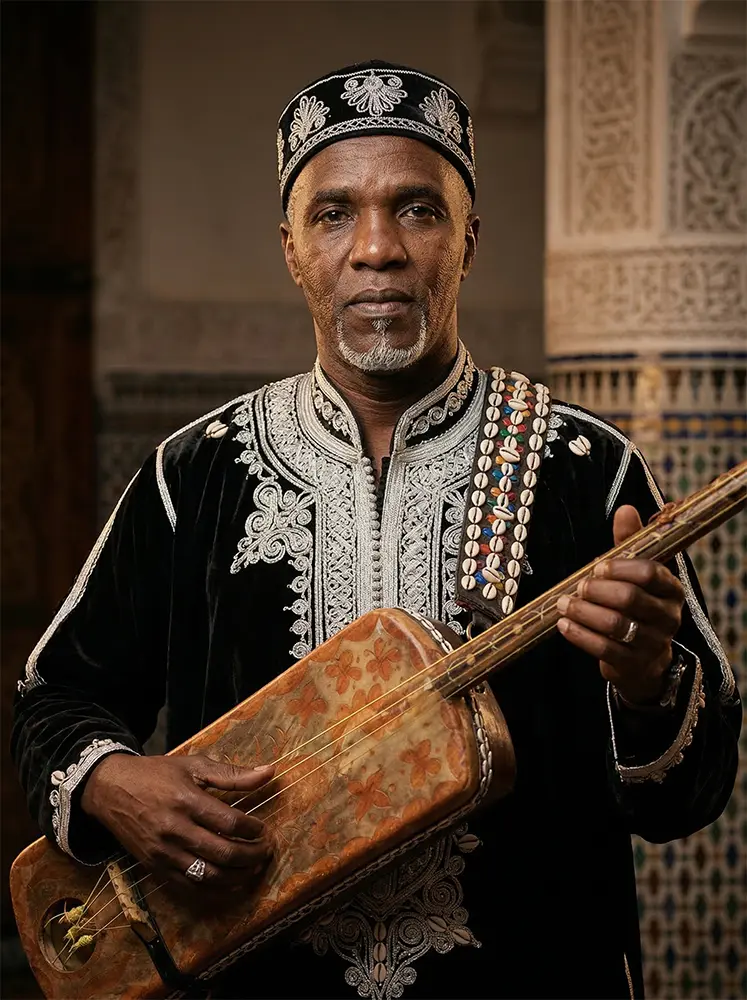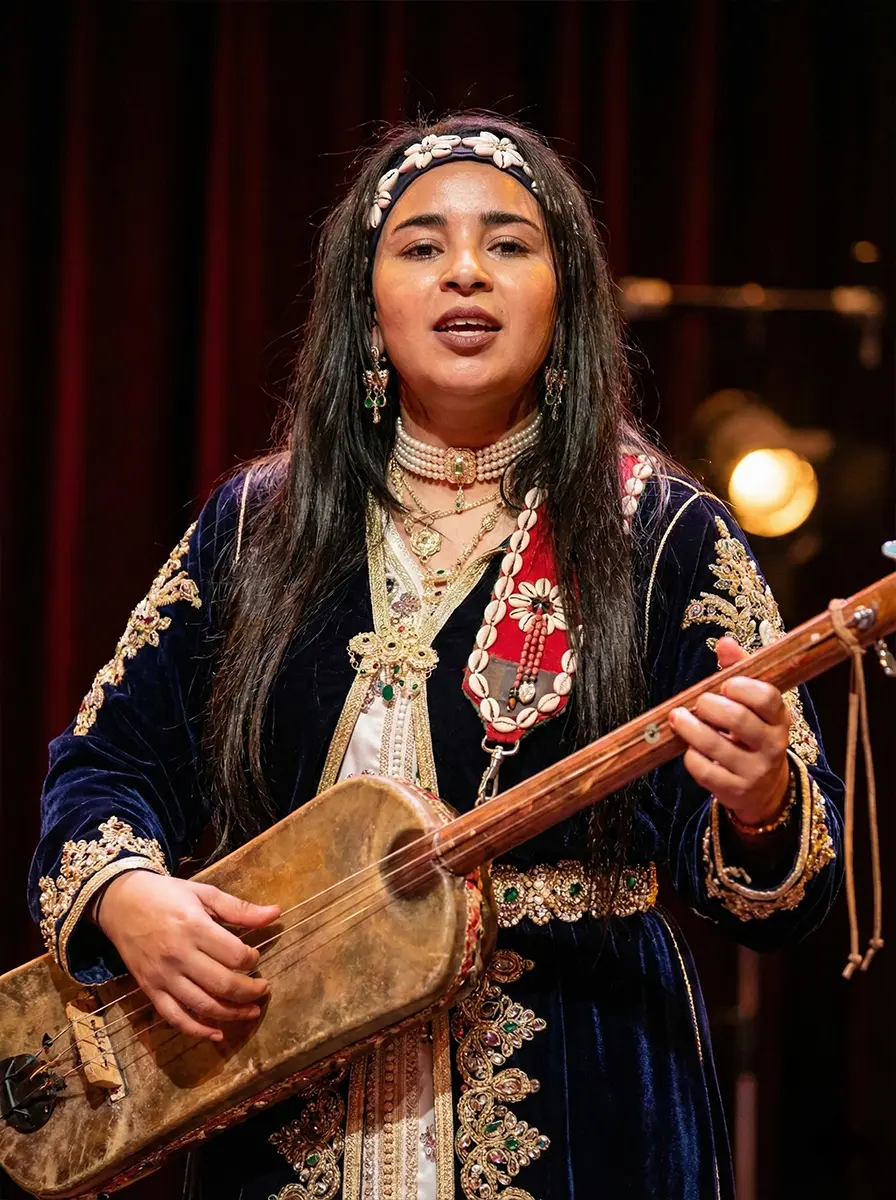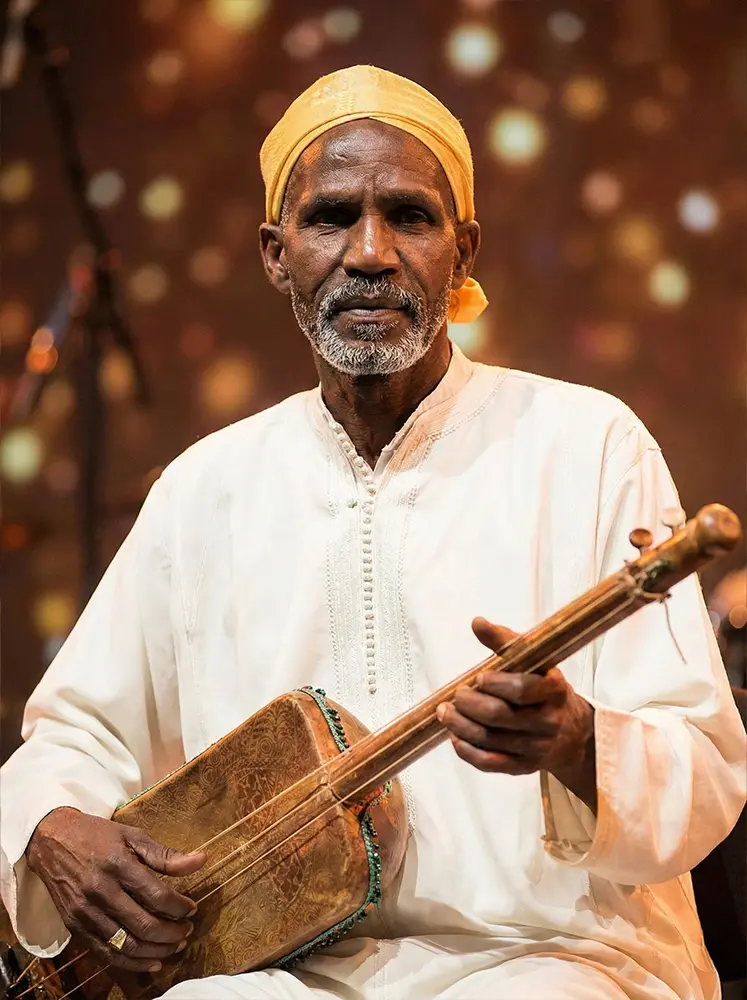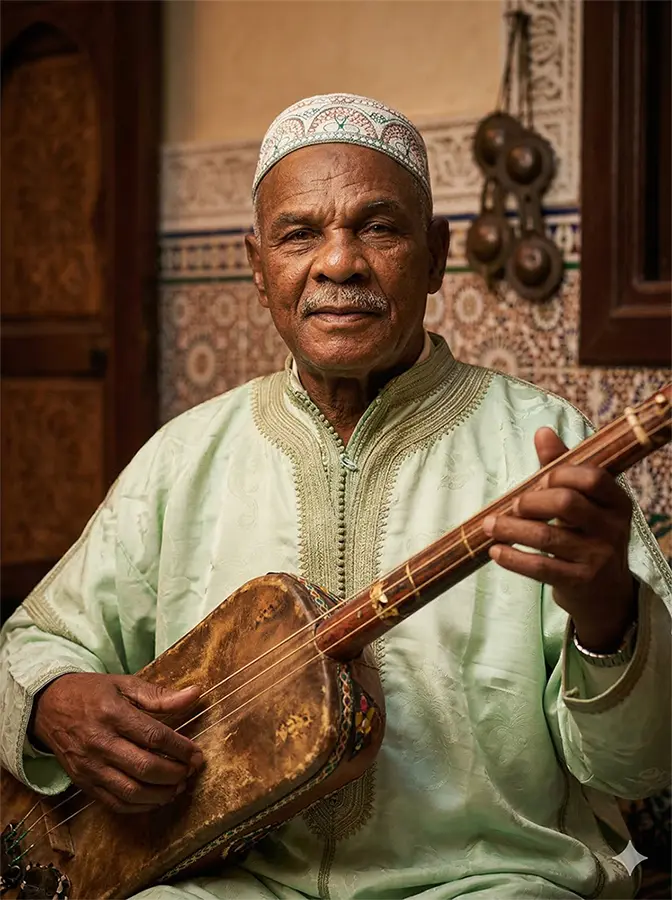
Some names exist at the center of a tradition. Not at its edge, not in its popular face, but at the exact point where the roots meet the earth. Maâlem Abdelkader Benthami, known in Gnawa circles simply as “Bentha”, is one of those names. He did not study Gnawa. He was born inside it, breathed it before he could speak, and spent a lifetime being its most uncompromising keeper in Casablanca.
He is what those who know the tradition call a “Maalem of Maalems”: not only a master player, but the reference point to whom other masters came when they needed to learn the tourka, the deep protocols of the lila that cannot be read in any book and cannot be purchased at any school.
Born into Tagnawit
The clearest window into who Maâlem Abdelkader Benthami was opens through his own words, spoken in one of his rare interviews. He said, without hesitation: “Khoti, kolshi Gnawa. El waled Gnawi, jdi Gnawi, jdati Gnawa… ma qrina, qrina ghir Tagnawit.”
In English: “My brothers, everything is Gnawa. My father is Gnawi, my grandfather is Gnawi, my grandmother is Gnawa. We did not study anything. We studied only Tagnawit.”
This is not a poetic statement. It is a precise description of his life. The Benthami household in Casablanca was not a place where Gnawa was practiced on special occasions. It was a living zawiya where the lila was inseparable from daily existence, where the guembri was the household’s first voice, and where the mlouk were as present in family life as any living relative.
The Formation: A House as a School
The Gnawa tradition holds a clear principle, expressed in a phrase that every apprentice learns early: “Sikh bla shikho, jbah khawi” — a master without a master is a hive without honey. Lineage alone does not make a maalem. The full transmission requires years of sitting beside a teacher and absorbing something that cannot be written down.
For Abdelkader Benthami, that teacher was the legendary Maâlem Zouitni, one of the foundational pillars of the tradition in Casablanca. Under Zouitni, Benthami learned not just fingering on the guembri. He learned the cosmology of the lila: the seven mlouk and their colors, the specific incense for each spirit, the exact order of the mhallat, the psychology of the people who come seeking healing, and the weight of being the person in the room who is responsible for bringing them back safely from jedba.
He worked for years in the rows of the kwiyo, the qraqeb players who form the rhythmic foundation of the ensemble, before ever touching the guembri as a leader. This was not a shortcut he could take. The tradition does not offer shortcuts.
Building the Casawi Sound
In the 1960s, Casablanca became the gathering place for a generation of masters who would define urban Gnawa for decades. Benthami stood at the center of this formation, alongside names that have since become legendary: Maâlem Hmida Boussou, Maâlem Sam, and Maâlem Abdenbi El Kadari who had migrated from Marrakech.
In the dense, working-class neighborhoods of Casablanca, Gnawa served a population under pressure: rural migrants, factory workers, families displaced by the speed of modernization. The lila was not folklore for these people. It was medicine, community, and a thread back to the ancestors.
The Circular Weight
The Casawi rhythm opens slowly and deliberately. The "tathqil" at the opening of a lila is not hesitation. It is controlled accumulation, building the conditions for jedba note by note before a single spirit is summoned.
The Drop-Thumb Technique
Ethnomusicologists call it "brushless drop-thumb frailing": the right thumb falls repeatedly on the bass string while the fingers produce complex rhythmic patterns on the upper strings, and the knuckles strike the camel-skin resonator simultaneously. One player, two instruments.
The Drone and the Buzz
The metal sound-modifier on the guembri's neck creates the "zenna", the characteristic metallic buzz that is not an imperfection but an essential element. It is the voice that reaches the mlouk, the frequency that separates daily consciousness from ritual space.
The Night He Claimed the Ending
The moment that revealed Maâlem Benthami’s full stature did not happen on a festival stage. It happened at a gathering of great masters at a sacred shrine, where the tradition held that the participating maalems would divide the lila between them, each taking a section of the mhallat.
Benthami spoke clearly. He said, in words that have been passed down among those who were present: “In this ceremony, every master took a portion of the mhallat he would serve at the shrine… But I took the ending, the final of the mlouk. They begin with El Aada, from El Aada to El Ftouh, then Oulad Bambara… the service continues with the red and black mlouk… I took the last. I will serve Aissa Soudaniya, which is how we close the mlouk and the full list.”
Aissa Soudaniya is considered one of the heaviest mhallat in Gnawa ceremonial practice. The spirits at this point are at their most present, the people in the room are at their most open, and the maalem who leads this section carries the full weight of closing the door safely. That Benthami volunteered for this position, and that no one questioned his right to it, tells you everything about his standing.
1990: Night Spirit Masters
The moment the wider world encountered what Benthami represented came in 1990, when the American producer and bassist Bill Laswell traveled to Morocco to record what became “Night Spirit Masters”, one of the landmark documents of world music.
Laswell did not ask the masters to come to a studio and adapt their music to Western formats. He brought his equipment to the old medina of Marrakech and recorded in the natural environment of the tradition. Benthami appears as a principal player on this album, performing alongside his son Said Oukssal and other masters. The recording captures something that live recordings of Gnawa at the time could not: the full physical weight of the guembri’s bass frequencies, the complexity of the drop-thumb technique, and the layered resonance of the qraqeb ensemble.
For Western listeners who had never encountered this music, the album arrived as an experience that could not be easily categorized. It was structured like no folk music they knew. It moved like nothing they had heard. And at the center of its gravity was the Casawi approach that Benthami had spent his life perfecting.
The Maalem of Maalems
What confirms Benthami’s place above the line of great masters and into a separate category is who studied under him.
Abderrahman Kirouche, known as Maâlem Paco, one of the founding members of Nass El Ghiwane and one of the most important figures in the history of Moroccan music, came to Casablanca specifically to learn the tourka from Benthami. He sat before him and absorbed the ceremonial protocols, the order of the mhallat, and the ethics of the lila, before going on to stand alongside musicians like Jimi Hendrix and reshape what Moroccan audiences understood music to be.
When the student you trained reaches those stages, you are not a teacher. You are the source from which others draw.
His sons carried the lineage forward. Maâlem Abderrahim Benthami, born in 1956, emerged at the tenth Essaouira Festival in 2007 as the recognized inheritor of the Casawi tradition. Maâlem Said Benthami carried the music to Madrid for years before returning to Casablanca. Said died in 2021, shortly after performing a healing lila, struck by a virus while doing exactly what he had always done: serving the ceremony, until the last moment.
Maâlem Mohammed Rbaai grew up in Rabat and later moved to Casablanca, spending years absorbing the tradition under both Hmida Boussou and Benthami before carrying it to the United Kingdom in 2020.
The Benthami school did not produce performers. It produced guardians.
The Line He Would Not Cross
Benthami’s position on musical fusion was precise and consistent. He did not reject dialogue with other traditions. His participation in Night Spirit Masters proves the opposite. What he rejected was dilution: using Gnawa music as exotic background for Western compositions that had no understanding of what they were borrowing from.
His philosophy was that the Gnawi is the host. Other musical traditions may enter, but they enter as guests who respect the house rules: the circular architecture of the rhythm must not be broken, the metric structures of Western music must not be imposed on a music designed to spiral inward rather than march forward, and the heavy mhallat tied to healing must remain off-limits for artistic experimentation.
He saw fusion as possible and even necessary, but only when built on deep knowledge. Curiosity without knowledge, he believed, does not expand Gnawa. It damages it.
Essential Listening
Mimoun Mamrba
Night Spirit Masters / 1990
The black mhalla recorded in Marrakech under Bill Laswell's production. Benthami's bass drone against the metallic qraqeb, with Said Oukssal's voice in double-call. This is not a performance of Gnawa. This is Gnawa from inside the lila, as close as a recording has ever come to the real thing.
Baba L'Rouami
Night Spirit Masters / 1990
The ensemble at full force. The qraqeb locked into the guembri's groove, the voices layered above the rhythm. This track opened the ears of a generation of Western musicians to what Casawi Gnawa could do, and it is still the clearest demonstration of Benthami's approach to collective rhythm.
Aissa Soudaniya
Closing Mhalla / Lineage
The mhalla Benthami claimed as his own at the shrine gathering. Listen to any performance of Aissa Soudaniya from the Benthami school and you hear the closing architecture of the lila: spirits returning, the room stabilizing, the maalem guiding everyone back. This is what it sounds like to close a door with complete authority.
"Khoti, kolshi Gnawa. El waled Gnawi, jdi Gnawi, jdati Gnawa... ma qrina, qrina ghir Tagnawit."
Maâlem Abdelkader Benthami
"My brothers, everything is Gnawa. My father is Gnawi, my grandfather is Gnawi, my grandmother is Gnawa. We did not study anything. We studied only Tagnawit."
Maâlem Abdelkader Benthami did not seek recognition. Recognition followed him because what he carried was too important to be overlooked. He built no personal brand. He issued no manifesto. He simply held the Casawi tradition with both hands for his entire life and refused to let anyone reduce it to something smaller than it was.
What he left behind is not nostalgia. It is a living school, carried by Abderrahim in his guembri, by the memory of Said in the lilas Said died serving, by Maâlem Paco’s foundational years before the big stages, and by every maalem who learned from this family that the tourka is not a set of rules. It is the weight of everything that came before.