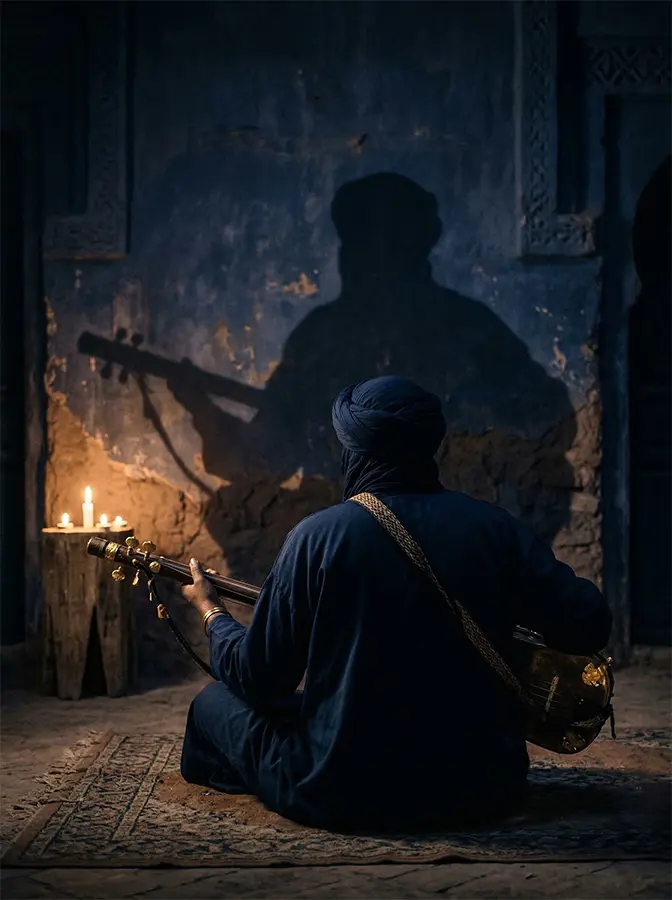
Before the festival stages, before the world music sections of record stores, before any Western microphone ever pointed at a guembri, there was a generation of masters who built something from the ground with no audience in mind except the spirits. Maâlem Ahmed Ould Dij is the deepest root of that generation in Casablanca.
He is not celebrated the way his students were celebrated. He sought no stage. What he sought was the completion of the lila, the correctness of the mhallat, and the transmission of a tradition that arrived in Morocco in chains and refused, across centuries, to die. Every master-level player who emerged from Casablanca in the second half of the twentieth century traces a lineage that, followed carefully enough, leads back to him.
The Root That Feeds the Tree
Gnawa music did not begin in Morocco. It arrived with the people who were enslaved and brought from West Africa, primarily from the Songhai, Bambara, Fulani, and Hausa peoples, intensifying in the seventeenth century under Sultan Moulay Ismail. These ancestors carried their spiritual practices with them, their healing ceremonies and their methods of summoning the spirits, and they merged these over generations with Moroccan Sufi Islam to produce what we now call Tagnawit.
The Casablanca that shaped Maâlem Ahmed Ould Dij was a city under enormous demographic pressure. Rural migrants poured in from the south, carrying a cultural inheritance that reached deep into sub-Saharan Africa. In this environment, the zawiya was not a place of entertainment. It was a parallel institution where healing was practiced, memory was preserved, and the collective trauma of displacement was metabolized through rhythm.
Ould Dij was born into this world. His formation happened not in any school that issued certificates, but inside the closed spaces of the zawiya, lit by candles, heavy with the incense of jawi and fassoukh, and structured entirely around the logic of the lila.
The Weight of Becoming a Maalem
In Gnawa tradition, a person does not decide to become a maalem. The mlouk identify him, the elders recognize him, and the community of practitioners accepts him. The guembri is not given early. It is earned through years of carrying the qraqeb, sweeping the ritual space, preparing the incense, and learning through complete immersion everything that cannot be written in any language.
Ould Dij passed through all of this. He understood from his earliest years that the maalem is not a performer. He is a physician of the spirit, a craftsman who must know how to build the guembri from raw material, how to stretch the camel skin, how to forge the qraqeb, and how to read the congregation during a healing ceremony and adjust the ceremony in real time to bring the person in jedba back safely.
The lila he presided over was not a spectacle. It was a precise architecture with a specific beginning, a specific sequence of mhallat, specific colors for specific spirits, specific incense burned at specific moments. The slightest error, the calling of the wrong spirit in the wrong sequence, could result in consequences for the people who had opened themselves to the ceremony. Ould Dij carried this weight without complaint. It was, for him, simply the nature of the work.
The Casablanca School: A Style He Named with His Life
The Casablanca school of Gnawa is not a formal institution. It is a set of shared characteristics that developed in the city through the work of a generation of masters who knew each other, influenced each other, and collectively established an approach that is now recognized internationally.
Heavy and Hypnotic
Where other Gnawa schools sometimes favor speed or melodic lightness, the Casablanca style is built around slowness and weight. The rhythm accumulates like a tide before it breaks. The congregation is brought into jedba gradually, never rushed, never forced.
The Talking Guembri
Ethnomusicologists who studied the generation Ould Dij represented describe their guembri technique as making the instrument speak. The bass string drone does not simply accompany the voice. It mirrors the human voice, weeps with it, calls out the names of the mlouk with it, in a unity that dissolves the line between player and instrument.
Absolute Protocol
Ould Dij was a strict traditionalist. The sequence of the mhallat was not negotiable. The transition from El Aada to El Ftouh to Oulad Bambara and through the colored spirits followed one order. This rigidity was not rigidity for its own sake. Every sequence was placed where it was for therapeutic reasons developed over centuries. Changing it was not innovation. It was damage.
The Transmission That Built the World
The true measure of Maâlem Ahmed Ould Dij is not what he played. It is who he produced. And here the history of Gnawa becomes inseparable from his name.
He took in a young Hmida Boussou and oversaw his formation in the Tagnawit with a rigor that the tradition demanded. Under Ould Dij’s supervision, Hmida Boussou became a certified maalem at the age of sixteen, an achievement that speaks to both the student’s extraordinary gift and the teacher’s extraordinary ability to recognize and develop it.
Hmida Boussou would go on to become “The Grand Master” of Gnawa, working alongside Maâlem Sam between 1962 and 1968, traveling to Europe, and eventually passing the tradition to his own son, Maâlem Hassan Boussou, who performed at the Essaouira Festival in tribute after his father’s death in February 2007.
The lineage continues: Ould Dij taught Hmida, Hmida taught Hassan, and the Casablanca school moves forward. Every stage Boussou Ganga performed on, every festival appearance, every recording: all of it carries the DNA of what Ould Dij established inside those early Casablanca zawiya.
How He Taught
Ould Dij’s pedagogy had nothing to do with written scores or structured lessons. It was based on what the tradition calls “tashrrob”: absorption. The student begins by being present. He watches. He carries the qraqeb for years, learning the rhythmic foundation from the inside before he ever approaches the guembri. He prepares the incense, learns the meanings of each color, understands the protocol for each spirit.
Only after this extended apprenticeship, which could last years, was the student allowed to touch the guembri. And even then, the guembri was only officially handed over after a kind of testing in live ceremony, where the student had to prove he could navigate the full architecture of the lila without error.
What Ould Dij feared losing was not the music. It was the meaning inside the music. He feared the day when the old Bambara words embedded in the Gnawa chants would be sung without anyone understanding what spirit they were calling or why. When the qraqeb, which carry the memory of the chains of enslaved ancestors, would be treated as simple percussion instruments. When the guembri would become a decorative bass lute with no relationship to healing.
His entire life as a teacher was a response to that fear.
Fusion as Threat, Legacy as Answer
Maâlem Ahmed Ould Dij’s generation did not practice fusion. What they practiced was preservation. The question for them was not how Gnawa could dialogue with jazz or rock. The question was how Gnawa could survive in a city that was modernizing at speed, in a country where the tradition had historically been stigmatized as the practice of the enslaved and the marginalized.
His answer was transmission. The most effective defense against dilution was producing students who understood the tradition so completely that no outside force could hollow it. A musician who carries the full knowledge of the lila, who knows every mhalla and every spirit and every protocol, can enter any musical dialogue without losing who they are. One who does not carry this knowledge will be absorbed and disappeared.
The great fusions of the following generations, including Abdellah El Gourd’s collaborations with Randy Weston and Archie Shepp, the international tours of Hmida Boussou’s ensemble, the work that brought Gnawa from the zawiya to the concert halls of Europe and the Americas, were possible precisely because Ould Dij’s students were unloseable. The root held. The branches could extend in any direction.
Essential Listening
Ouled Bambara
Ritual / Foundation
The classical opening of the Casablanca lila. Listen to any performance of Ouled Bambara from the Boussou lineage and you hear the architecture Ould Dij established: the slow accumulation, the qraqeb locking into the guembri's bass drone, the voice calling the ancestors forward from across the Atlantic.
Sandiya
Technique / Mastery
The complex metallic acceleration that reveals what the Casablanca guembri technique demands at its most advanced. The maalem never loses the thread connecting melody and percussion, playing both simultaneously while the qraqeb drive the dancers toward full release. This is where Ould Dij's teaching showed its most visible results.
Sidi Mimoun
Deep Ritual / Black Spirit
The black mhalla, associated with the earth and the heaviest of the mlouk. Ould Dij used this mhalla to test the true readiness of the students he trained: whether they could hold the weight of the spirit being summoned without losing control of the ceremony. Performed by the Boussou lineage, it remains the most faithful record of what he built.
"The guembri is not wood and string that we play with for amusement. It is the body of those who have passed and the spirit of those who will come. We are only the trusted hands that wake them in the darkness of the night to heal the soul."
Maâlem Ahmed Ould Dij
The history of Gnawa music is commonly told through its international moments: the festivals in Essaouira, the collaborations with jazz musicians, the UNESCO heritage inscriptions. But every one of those moments has a deeper history. Follow any of them far enough and you find a generation of men who practiced in closed rooms, in the dark, without cameras, for people who needed healing.
Maâlem Ahmed Ould Dij is the furthest point that lineage reaches when traced backward from Casablanca. What he built, he built to last. It lasted. It continues.